

Biju Dharmapalan
bijudharmapalan@gmail.com
More than half a century after humans last ventured beyond low Earth orbit, NASA’s Artemis II mission marks a decisive turning point-not just in space exploration, but in the trajectory of human civilisation itself. This is not merely a return to the Moon; it is a rehearsal for humanity’s expansion into deep space, a technological leap, and a philosophical shift in how we see our place in the universe.
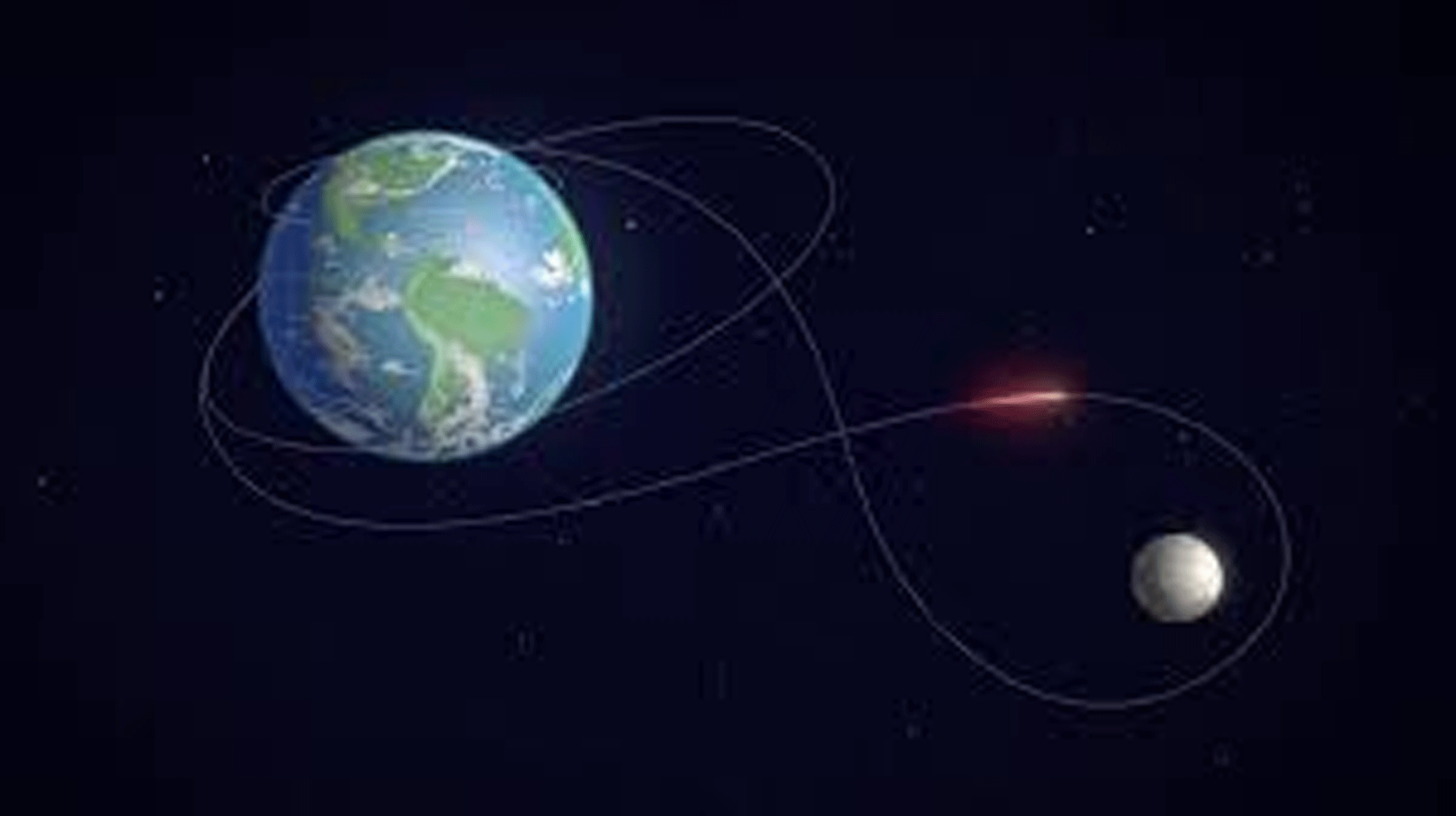
The mission, launched on 1 April 2026 at 18:35 CDT (23:35 BST), sends four astronauts ( pilot Victor Glover, mission specialist Jeremy Hansen, mission specialist Christina Koch and commander Reid Wiseman) on a 10-day journey around the Moon, the first crewed lunar voyage since 1972. However, to appreciate why Artemis II is important, one should not only focus on the visuals of rockets and astronauts but to explore the undertones that it contains in the context of science, geopolitics, technology, and the future of human life.
A Bridge Between Earth and Mars
Artemis II is not an isolated mission; it is a critical stepping stone toward long-term human presence on the Moon and eventual missions to Mars. Artemis is sustainable, unlike the Apollo era, which was propelled by geopolitical rivalry. The mission tests life-support systems, navigation, and communication technologies necessary for deep space travel-technologies that will be essential for the two-to-three-year journey to Mars.
By pushing astronauts farther than any human has ever travelled-over 250,000 miles from Earth-Artemis II expands the operational boundary of humanity. It is, in essence, humanity’s first real step toward becoming a multi-planetary species.
Rewriting the Narrative of Exploration
One of the most striking aspects of Artemis II is its symbolism. The crew consists of the first woman (Christina Koch), the first person of colour (Victor Glover) and the first non-American astronaut (Canada’s Jeremy Hansen) to go beyond low Earth orbit. This is the big change compared to the Apollo missions which indicated a limited demographic and geopolitical identity.Artemis II reframes space exploration as a shared human endeavour rather than a nationalistic competition. It signals that the future of space will be collaborative, inclusive, and international. This is crucial to the human race as the complexities of deep space such as radiation, isolation, and sustainability are too big to be addressed by a single country.Technology That Will Transform Life on Earth
Space missions have historically led to technological innovation, which subsequently changed the lives of common people- satellite communications, medical imaging and so on. Artemis II follows this trend. The mission also rigorously tests next-generation systems, including advanced life-support systems, high-rate optical communications, and spacecraft durability in extreme conditions. These inventions have direct uses on Earth. As an illustration, enhancing air recycling would transform Earth’s environment, whereas developing remote communication would make the world more connected. In addition, Artemis II advances knowledge of human health in deep space. Radiation and physiological stress on astronauts will provide important data for medicine, especially in ageing, bone density, and immune response. This knowledge may lead to healthcare breakthroughs on Earth.
The Moon as Humanity’s Laboratory
In contrast to Apollo, which used the Moon as a destination, Artemis uses it as a laboratory and a stage. Artemis II is a mission that is the precursor to future missions that will see an established human presence on the lunar surface, especially in the south pole of the moon. Water ice is thought to be found in this region- a priceless resource that can be turned into drinking water, oxygen and even rocket fuel. When effectively utilised, it may offer a self-sustaining economy on the moon and lower the price of deeper missions in space. Artemis II, in this regard, is not only exploration; it is infrastructure. It prepares the future where space will not be a far-off frontier but a continuation of human endeavour.
A New Space Race-or a New Cooperation?
While Artemis II embodies collaboration, it also unfolds within a renewed global competition in space. Countries such as China are also in the process of making their lunar missions and by 2030, they are determined to reach the south pole of the Moon. The future of humanity in space will be determined by this dual dynamic competition and cooperation. Competition may, on the one hand, speed up innovation and investment. Conversely, it also raises issues of militarisation, resource exploitation, and the lack of robust legal frameworks that regulate space. Artemis II, therefore, compels humanity to answer a dire question: Will space be a common commodity or a disputed space?
The Philosophical Shift: Humanity’s Place in the Cosmos
The philosophical effect of Artemis II is perhaps the greatest. It is the first time in generations when people will see the Earth again in deep space the blue planet floating in the vortex of the universe. This view, also known as the overview effect, has long been used as a way of changing the perception of astronauts about the earth, creating a feeling of cohesion and responsibility towards the environment. Artemis II is taking the experience to the next generation and may redefine the idea of planetary stewardship in the minds of the population. Meanwhile, there is a warning by critics that space exploration should not be romanticized. Other people claim that colonization of space is a dangerous move that will lead to the same historical patterns of exploitation and inequality. These issues underscore the necessity to have moral principles that will direct the growth of humanity off the planet.
Inspiring the Next Generation
Artemis II is more an inspirational than a scientific project. The mission has already attracted the attention of the whole world, capturing millions of viewers and renewing the desire in people to explore space. To the youth and particularly in a place as a country as India, it makes a strong message: the future of science and exploration is accessible to everyone. It promotes the study of STEM careers among students and creates a culture of curiosity and innovation. Artemis II is a combination of ambition, technology, and vision. It is a mission that restores humanity to its spirit of exploration and it provides a foundation of a future that goes beyond Earth. It is important not just in its destination, but in what it can make possible sustainable exploration, global partnership, technological innovation and a redefinition of human place in the universe.
If the 20th century was defined by reaching the Moon, the 21st century may well be defined by what we do after getting there again. Artemis II is the beginning of that story-a story in which humanity steps out of its planetary cradle and begins, cautiously but decisively, to claim its place among the stars.
(The author is the Dean -Academic Affairs, Garden City University, Bengaluru and an adjunct faculty at the National Institute of Advanced Studies, Bangalore)
 Follow our WhatsApp channel
