

Ashok Nilakantan Ayers
NEW YORK: There are Oscar nights that feel like clerical exercises — the industry awarding itself with the dutiful efficiency of a board meeting — and then there are nights that feel like history being made in real time. The 98th Academy Awards, held Sunday at the Dolby Theatre in Los Angeles, belonged unambiguously to the second category. This was a ceremony that didn’t merely celebrate cinema. It corrected the record.
When the final envelope of the evening was torn open and One Battle After Another was named Best Picture, the Dolby Theatre erupted with the particular ferocity of a crowd that has been holding its breath for a very long time. Because what was being celebrated wasn’t just a film — brilliant as it is — but the overdue recognition of Paul Thomas Anderson, arguably the greatest American filmmaker of his generation, who had spent more than two decades making some of the most extraordinary motion pictures Hollywood has ever produced, and collecting almost nothing to show for it.
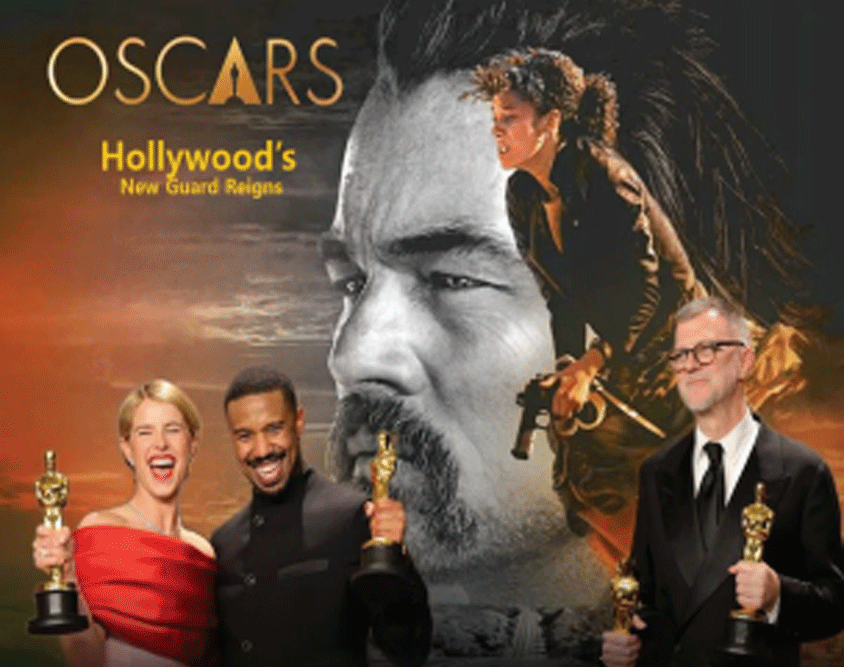
That injustice ended on Sunday night, emphatically and completely. Anderson walked away with six Oscars, including Best Director and Best Adapted Screenplay, for his sweeping political epic about a fractured, ferociously divided America. It was, by any measure, the evening’s defining act of justice.
To understand the weight of Anderson’s victory, one must appreciate the absurdity of what came before it. Boogie Nights. Magnolia. There Will Be Blood. The Master. Phantom Thread. A body of work so consistently visionary, so rigorously personal, that film scholars will still be studying it a century from now. And yet the Academy — famously suspicious of directors who refuse to flatten their ambitions — had withheld its ultimate prize, year after year, with almost bureaucratic indifference.
One Battle After Another, led by a smouldering Leonardo DiCaprio and a volcanic Sean Penn, gave the Academy no hiding place. The film’s portrait of American society tearing at its own seams arrived at a cultural moment that demanded exactly this kind of ambitious, uncomfortable storytelling — and the Academy, to its considerable credit, met the moment.
Penn, who was absent from the ceremony, won Best Supporting Actor for what many critics have called the finest performance of his late career. Best Film Editing went to Andy Jurgensen, and the newly introduced Best Casting prize — the Academy’s first acknowledgment of casting as a competitive art — was awarded to Cassandra Kulukundis, in what was quietly one of the most significant institutional shifts the ceremony has produced in years.
If Anderson’s night was about historical restitution, Michael B. Jordan’s was about something else entirely: arrival. His performance in Ryan Coogler’s Sinners — a shape-shifting supernatural thriller that defied every genre category critics attempted to pin on it — was the kind of work that doesn’t just win awards but redefines what an actor is capable of. His Best Actor win, over a field that included both Timothée Chalamet and DiCaprio himself, was met with a standing ovation that felt genuine rather than performative.
Sinners entered the evening carrying the weight of history before a single award had been announced. With 16 nominations — the most in Academy Awards history — it arrived as the most decorated contender the ceremony had ever seen on paper. It did not sweep as some had predicted, but it claimed four pivotal prizes: Jordan’s acting honour, Best Original Screenplay for Coogler, a thunderous Best Original Score for Ludwig Göransson, and a genuinely historic Best Cinematography win for Autumn Durald Arkapaw, who became the first woman ever to receive that award. The cinematography prize, long one of the Academy’s most stubbornly male-dominated categories, finally cracked open — and it did so for work of extraordinary visual daring.
Not every victory on Sunday belonged to the battle between the evening’s two titans. Guillermo del Toro’s Frankenstein — a gothic reinvention of Mary Shelley’s myth, as visually opulent as anything del Toro has produced — claimed three awards in the craft categories: Production Design, Costume Design, and Makeup and Hairstyling. The latter was almost an understatement as a category. Jacob Elordi’s transformation into the Creature reportedly required ten hours of makeup each day of filming, an act of physical and artistic endurance that the Academy recognized with something approaching reverence.
Del Toro, who has spent his career insisting that beauty and terror are not opposing forces but collaborators, received his awards with the quiet satisfaction of a man who has never needed validation but accepts it graciously when it comes.
The acting races delivered a few outcomes that scrambled the conventional wisdom of the awards season. Jessie Buckley’s Best Actress win for Hamnet — in which she plays a mother consumed by grief after the death of her son — was a surprise only to those who had not seen the film. Those who had understood immediately that it was not Emma Stone or Kate Hudson who had delivered the year’s most devastating performance, but Buckley, working in a register of barely suppressed devastation that the camera could barely contain. Veteran actress Amy Madigan claimed Best Supporting Actress for Weapons, delivering a speech of such warmth and unpretentious joy that it briefly paused the ceremony’s momentum entirely — and no one seemed to mind.
In an era when the Oscars broadcast has frequently been accused of being too long, too self-congratulatory, or too anxious about its own cultural relevance, the 98th ceremony felt, remarkably, like none of these things. The credit belongs substantially to Conan O’Brien, hosting for the second consecutive year and doing so with a grace and assurance that his first turn — already widely praised — had only hinted at.
O’Brien is a specific kind of comedian: cerebral, self-deprecating, never cruel, and constitutionally incapable of the smug condescension that has plagued some of his predecessors at the podium. His opening monologue threaded the needle between sharp and kind with practiced ease, landing jokes at the expense of Hollywood’s studios and the Academy itself without drawing the kind of blood that generates headlines but poisons the room. He moved the ceremony along with a veteran broadcaster’s instinct for pace, allowing emotional moments to breathe while keeping the machine from stalling. The broadcast felt tighter, more human, and more alive than it has in years.
The evening produced a handful of genuinely unprecedented moments beyond the major races. For the first time in over a decade, a tie was declared — in Best Live Action Short Film, jointly awarded to The Singers and Two People Exchanging Saliva, only the seventh tie in Oscar history. And KPop Demon Hunters, the animated feature that had seemed like an unlikely contender, won both Best Animated Feature and Best Original Song for “Golden” — a moment of cultural rupture that felt entirely, inevitably right. K-pop, the global phenomenon that has spent years orbiting Hollywood’s consciousness, finally landed on its most consecrated stage.
The performance of “Golden” during the broadcast — all choreography and spectacle and irresistible joy — stopped the Dolby Theatre cold. In the audience, even the stoic veterans of a hundred award shows appeared to be having, simply, a good time.
The 98th Academy Awards will be remembered as a ceremony that understood its own moment. It gave the industry’s most overdue filmmaker his crown. It crowned a new generation’s most compelling star. It broke a barrier in cinematography that had endured for nearly a century. It introduced a new category, opened its doors wider to global culture, and did all of this under the stewardship of a host who made dignity look effortless.
Hollywood has a long history of getting things wrong and eventually — slowly, reluctantly — getting them right. Sunday night at the Dolby Theatre was one of the rarer occasions when it managed the second part with something approaching style. (IPA Service)
 Follow our WhatsApp channel
