

Bhaddu State, Bhimber, Bharakh, Buddhal
Lalit Gupta
Bhaddu State (Kathua district)
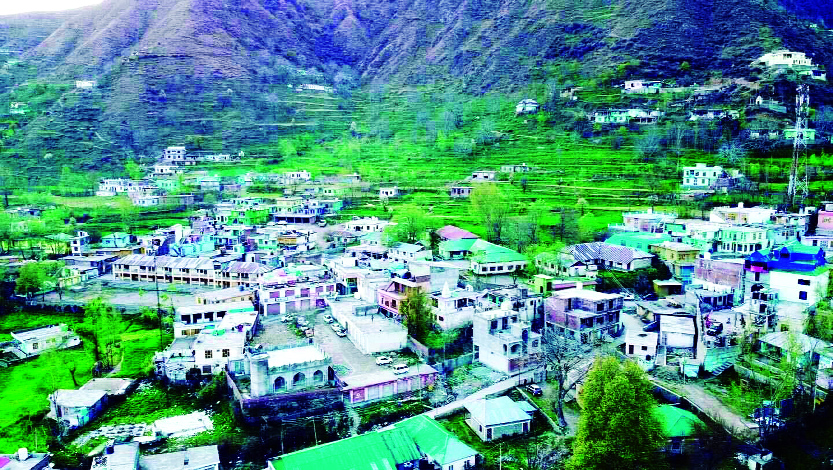
Bhaddu was an offshoot of the ancient Balor-Basohli State, encompassing a small portion of territory to the south of Balor (Billawar) and its capital was located on a hill at Bhaddu, near the left bank of the Bhini, the same stream on which Balor is situated further north.
Bhaddu lies about 12 kilometres from Balor, while Basohli, another significant cultural site, is located 28 kilometres east of Balor. These three locations-Bhaddu, Balor, and Basohli-form a cultural triangle in the Duggar region, nestled between the Ravi and Bhini rivers.
At the time of its foundation, Bhaddu-according to folklore- is said to have comprised 36 villages. The state was bounded by Karaidhar to the south (separating it from Jasrota) and Mankot (modern Ramkot) to the west.
The historical record for Bhaddu is limited, relying primarily on the Vansavalis (genealogical records), which list the names of the Rajas who ruled the state, as well as supplementary accounts found in Tawarikh-i-Rajputan Mulk-i-Punjab by Kahn Singh Baloria.
According to the Vansavali, Bhaddu was founded in the mid-11th century following the resolution of a feud between Tukka Pal and Tokh Pal, sons of Triloka Deva, a ruler of Billawar. The ruling clan adopted the demonym Bhadwal, derived from the name of their new domain, Bhaddu.
Descendants of Tokh Pal ruled the state for approximately 800 years, until Bhaddu lost its independence in 1840 CE, when it came under the control of the Jamwal rulers. Suchet Singh, who was granted Bandralta (Ramnagar) as a fief, brought both Bhaddu and Mankot under his sway.
Cultural and Historical Legacy of Bhaddu and Surrounding Regions:
In the 18th century, during the reign of Bhaddu’s Raja Prithipal, lived Kavi Dattu, one of Dogri’s renowned poets. Another legendary figure in Bhaddu’s lore is Sonu Kotwal, a devoted subject of the Bhadwal ruler. In a symbolic act of defiance, Sonu Kotwal refused to bow before Suchet Singh, the new lord of Bhaddu, who had ousted the Bhadwals. Instead, he entered through a specially made narrow door, feet first-a gesture considered highly disrespectful. As a result, he was beheaded by Suchet Singh.
The Heritage-Rich Landscape: Baolies (fresh-water springs) adorned with sculptural reliefs of gods, goddesses, and Naga Devtas, as well as forts, temples, dharamshalas, dhakkis, dharamarth gardens, and large sacred trees, testify to the region’s vibrant spiritual and architectural traditions.
A particularly sacred site is Panjtirthi, near the village of Mandali, some eight kilometres southwest of Bhaddu. In Hindu tradition, the confluences (sangam) of rivers are revered as places of divine significance. Panjtirthi, where five streams-Ujjah, Bhini, Talaehan, Suttara Khadd, and Tanari-merge, holds both archaeological and religious importance. Every year, devotees from the surrounding areas gather here to celebrate a grand mela on the occasion of Chetar Choudaya.
Bharakh (Reasi District):
According to Kahn Singh Baloria’s Tarikh Dogra Desh, the village of Bharakh was established by Rajouri’s Raja Juman Khan on a hillock in 1387 CE. Bharakh was a jagir comprising thirteen villages. During the reign of Gulab Singh, the jagir was given to Mohammad Sukalsi. In 1950, after the arrival of refugees from Poonch, a new settlement came up at the foothill of old Bharakh. Since then, the old Bharakh has lost its importance.
Bhimber (now in PoJK)
Presently in Pakistan-occupied Jammu and Kashmir (PoJK), Bhimber was historically part of the ancient Darvabhisara and served as the capital of the Chibbhal dynasty, which lasted from 1400 to 1856 CE.
The town of Bhimber is situated on the banks of the Bhimber stream. Located about 47 kilometres southeast of Mirpur, it was a key settlement, especially on Mughal routes to Kashmir. It is mentioned in historical records, such as Ain-i-Akbari and Tuzuk-i-Jahangiri.
After the Mughal decline in the 18th century, the region came under Afghan and then Sikh control. In 1846, under the Amritsar treaty, Gulab Singh became the Maharaja of Jammu and Kashmir, and Bhimber was granted to his brother Raja Dhiyan Singh. After Dhian Singh’s death, his sons divided the land-Moti Singh got Poonch, and Jawahir Singh received Bhimber, Mirpur, and Kotli, who was later exiled in 1859 for conspiracy. The territory was subsequently incorporated into the state. In 1860, it was recognised as the Bhimber district, and later made part of the Mirpur district. Bhimber remained a Hindu-majority tehsil until 1947, when, during the partition, it came under the occupation of Pakistan.
Budhal: A Historical and Strategic Highland Settlement (Rajouri District)
Budhal is a historically significant town located 57 kilometres from Rajouri, in a valley south of the Pir Panjal range. It lies along a tributary of the Ans River and served as an important station on the Budhal Pass over the Pir Panjal, a key route historically frequented by traders, travellers, and armies moving from the North-Indian plains to Kashmir.
Historically, Budhal is referred to as Baddivas in Kalhana’s Rajatarangini (11th century). Its name may derive from a ruler, Budpaul, or from the early Buddhist presence. It gained prominence due to its association with Tunga, who was the chief minister of Rani Didda (c. 924 CE – 1003 CE). It was also called Rajnagar in the olden times.
The area was once inhabited by Khasas, the ancient warrior clans, who supported the Rajouri principality. According to Rajatarangini of Jonraja (late 15th CE) and Tariq-e-Farishta (written between 1589 and 1603 CE), Shah Mir, the founder of the Shah Mir dynasty of Kashmir (1339-1561 CE), originated from the Panj Gabbar area near Budhal. The Thakkers of Buddhal supported Shahi Khan in 1420, who became Sultan Zain-ul-Abdin and rewarded them with jagirs.
During Maharaja Ranjit Singh’s 1814 campaign toward Kashmir, Thakker Namdar Khan, the ruler of Budhal, who allied with the Maharaja, was later granted a jagir in Kashmir and conferred the title of Raja.
In 1846, following the Treaty of Amritsar, Maharaja Gulab Singh annexed Rajouri and Budhal. Raja Rahim Ullah Khan of Rajouri and Bandhu Khan, son of Namdar Khan of Budhal, went into exile in Rohalu, Kangra (Himachal Pradesh), and Budhal came under direct Dogra administration.
From 1846, Budhal became part of the Rajouri tehsil, initially under the governance of Mian Hathu. In 1860, it was attached to Bhimber District, and in 1904, reassigned to Reasi District. This administrative status remained unchanged until 1947.
The 1947-48 Conflict: During the 1947 invasion by Pakistan-backed forces, much of Rajouri, Mirpur, and Budhal fell under their control, except Poonch city. Budhal, along with the areas, was liberated on 26th November 1948 by Indian forces along with the Dogra Maharaja’s 3rd JAK Rifles.
 Follow our WhatsApp channel
