

Lalit Gupta
Babor: (Babbapura) The Forgotten Capital of Duggar
First mention of Babor anciently as Babbapura is found in Kalhana’s Rajatarangini, wherein the ruler of Babbapura, Kirti, is recorded to have visited the court of King Kalasa of Kashmir in 1087-88 CE. Today, this historically significant site known as Manwal is located east of Jammu on the Udhampur Dhar Road (Lat: 32° 46′ 8″ N, Long: 75° 7 55″ E).
Historical and Political Significance:
During the 9th-10th centuries, Babbapura was a flourishing urban centre and served as the capital of Durgara State. The ‘Lord of Durgara’ mentioned in the Chamba copper-plate inscription likely ruled from this city. Babbapura remained politically and culturally significant until the capital shifted to Jammu in 1380 CE.
The political and socio-historical importance of Babbapura is evident from the large number of temples built during a period of two or three centuries. Many of these structures have not survived particularly due to the modern development-notably, the construction of Udhampur-Dhar road which physically split the ancient settlement.
Archaeological and Artistic Heritage:
Excavations by the Srinagar Circle of Archaeological Survey of India (ASI) have revealed settlement layers dating back to the Kushan period (1st- 2nd cent. CE), underscoring the antiquity of Babbapura.
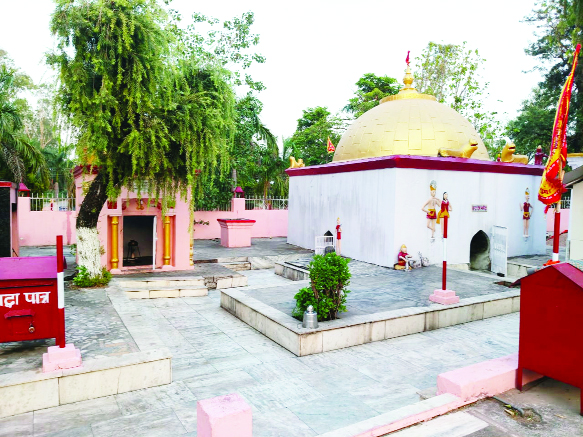
Today, only 15 temples survive in different conditions of preservation and out of these, seven temples have been painstakingly preserved by the ASI. Some of the standing monuments include: the 10th century. Shiva Temples, Thalora and Nand Babour, the 11th cent. CE, Devi Bhagwati temple, Manwal, and Temples of Kala Dehra I and Kala Dehra II.
The Babapura group of temples represent a distinct regional variation of the pan-Indian Nagara style of temple architecture. Characterised by mandapas and antarals, supported by pillars, they feature exquisite doorjambs, niches and friezes, with outer walls adorned with richly carved sculptures. The high level of artistic refinement attests to the Jammu region’s deep connection with the Bharatiya Vastu and Shilpa traditions, highlighting Duggar’s integral role in Bharatiya civilizational heritage.
Decline and Destruction:
Following the 12th century CE, Babbapura endured a series of periodic Muslim incursions, which gradually weakened the settlement. The final blow came with Timur’s leading his armies into India in the year 1398-99 CE.
Timur advanced as far as Delhi, and hearing of Hindus who inhabited the Shivaliks, he determined to carry the holy war against them on his way to the Indus. Described in Malfuzat-i-Timuri, during his devastating campaign, he faced severe conflict in the outer valleys, between Satluj and Bias. Timur probably passed through Pathankot, crossed the Ravi and reached Mansar, whence the final advance was made on Jammu. He encamped near a village which he names as ‘Baila’. The Gulabnama gives the name as ‘Bablianah’. According to Sukhdev Singh Charak, most probably both these names are the corrupted form of Babbor or Babbapura. Timur’s arrival seems to have led to the destruction and abandonment of this once-vibrant centre of power and culture.
Bahu: The Citadel of Jammu’s Heritage
Located opposite the old town of Jammu on the right bank of the Tawi River, the Bahu locality is perched approximately 300 meters above the river at the end of a commanding ridge. Its most striking feature is the Bahu Fort, which dominates the Tawi valley and historically served as a strategic lookout over the approaches to Jammu and the inner Himalayan ranges.
Historical Background:
According to local oral traditions, the original fort at Bahu was constructed by Bahu Lochan, the brother of Jambu Lochan, the legendary founder of Jammu. Although historical references are sparse, this connection underscores the antiquity and symbolic importance of the site.
Medieval records recount that after the death of Raja Kapoor Dev in 1507 CE, the Jammu State was divided between his two sons, Jag Dev and Smail Dev, creating two rival principalities-Jammu and Bahu-with the Tawi River acting as the natural boundary. This division persisted until Raja Hari Dev ascended the throne and reunified the territories between 1650 and 1685 CE. Like other hill principalities, Jammu (including Bahu) remained subordinate to Mughal authority during this period. The local pronunciation of “Bahu”-often rendered as Bahwa-reflects a linguistic corruption over centuries.
Bahu Fort:
Although frequently mentioned in medieval Muslim chronicles, the fort is often referred to simply as the “Fort of Jammu,” and the name “Bahu” is rarely used in these records. The site was repeatedly attacked by Muslim invaders and was also invaded by Timur in 1399 CE.
The current fort is believed to have been rebuilt in 1585 CE by Autar Dev, grandson of King Kapoor Dev, likely on the site of the original structure. Over time, the fort suffered various demolitions and reconstructions, culminating in its major renovation under Gulab Singh when he was coroneted as Raja of Jammu under the Sikhs.
The Mahakali Temple at Bahu Fort:
One of the most revered shrines in the region, and popularly known as the Bahwe Wali Mata Temple, is located within the Bahu fort complex. Considered as the guardian deity of Jammu, the image of Goddess Mahakali housed in the temple, as per legendary accounts, was brought from Ayodhya in the 8th century CE.
The present temple structure, which stands on a high platform, is constructed using small stone bricks. While its form is architecturally modest, apart from its decorated door jambs, the temple is significant for its spiritual importance rather than ornamentation. It is generally dated to the early 18th century CE, with its final form likely completed shortly after Gulab Singh’s coronation in 1822 CE. Today, the temple continues to be an important pilgrimage site for locals as well as tourists. Thousands of devotees gather to pay homage to the Goddess, especially during the Navaratras.
 Follow our WhatsApp channel
