

Lalit Gupta
Batote: Located some
100 kilometres from Jammu, Batote is an important junction point on the Jammu-Srinagar highway. From Batote, the road bifurcates to major centres of Chenab Valley such as Kishtwar and Bhadarwah.
As per Charles Allison Bates, it was called Begum Chand. The area of under the rule of Rana Batu Jamwal. It was from his name that the place got its name as Bato-t/e. The other view is that it means the place which is under the shade (oa?) of thick trees. Some say that it was under the Hunta (Chenaini) state. But it was never a capital town.
Behram Gala (Poonch district): Located 45 kilometres from Poonch city, the hill village of Behram Gala is situated near the base of Ratan Pir Mountain pass at an altitude of 8600 feet. Below it is the Sangam of rivers Poonch and Purnoyi. A nallah by the name of Chitta Nallah also flows by it. Till CE 1542, this village was called Bhairon. Gali. That’s the name by which Rajatarangini refers to it. It got its present name after Behram Naik, the local jagirdar, who had built a fort here. An important security stronghold, the fort is said to have been built in 1542 CE.
In the same year, the Mughal Emperor used this village as a base camp for his invasion of Kashmir. The Mughal forces favoured Behram Gala as a route to Kashmir. It retained its position for a long time thereafter. Many battles were fought here. The ruins of the fort of Behram Naik are testimony to the village’s past.
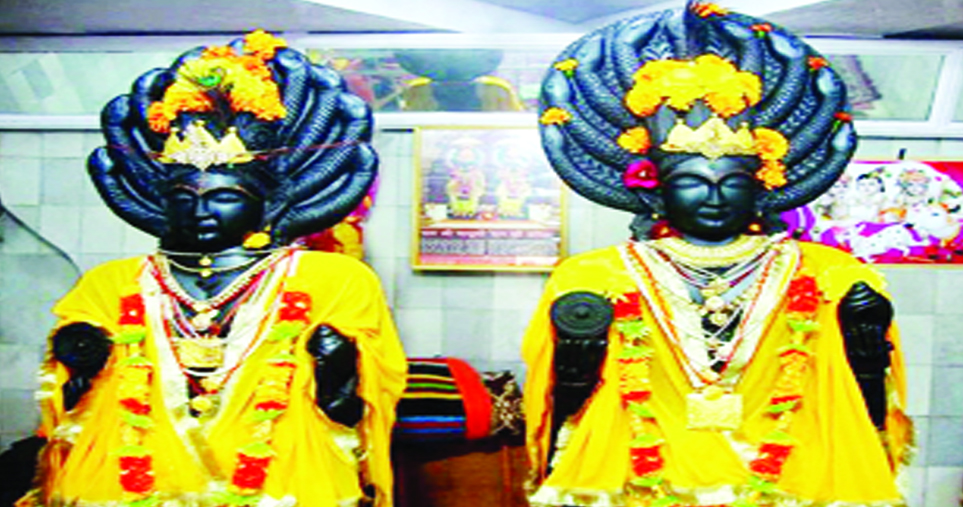
Bhadarwah: The Enchanted Land of Nagas: Bhadarwah, often referred to as Nagabhumi or the land of Nagas, stands as a testament to Bharata’s rich spiritual and cultural heritage. Steeped in rich mythology, this Himalayan region is adorned with a number of ancient Naga temples and pilgrimages. Bhadarwah is a living tapestry woven with the vibrant warp and weft of its unique culture, time-honoured traditions, and colourful festivals.
Enclosed by mountain chains, with Billawar in the south, Chamba in the east, Kishtawar in the north, Bhadarwah consisted of valleys of River Neeru, and the Kargad, the Bhalessa nallah, both tributaries of Chandrabhaga or Chenab. The areas normally included under it from time to time were Bhalessa, Thathri, Ramban, Assar, Batote, Marmath, Ruiggi and Galihan.
Myth of Basak Naga: Basak Naga (Vasuki in Sanskrit), the presiding deity and first king of Bhadarwah, is a revered pan-Indian Naga god with roots in local mythology. According to legend, after being driven out of Kashmir by stepbrother Garuda, Basak Naga took refuge at Kaplash Kund in Bhadarwah along with his brothers. His sister, Bhaderkali (Bhadra), then queen of Bhadarwah, offered him her throne and divided the land among her brothers. Basak received the main valley, Shesh Naga (Sabar Naga), the right bank of the Neeru, and Mahel Naga, the surrounding areas near Bhalessa and Marmet. Temples dedicated to these deities still stand in these regions, where they are worshipped as kul devtas (family gods).
Kaplash Kund Yatra: Since ancient times, there has been a major pilgrimage to Lake Kaplash atop the Kaplash (spelt as Kamalas by some) peak (14241 ft). The three-day yatra dedicated to deity Vasuki Nag takes place in the month of Bhadaon (August-September) during the Dwadashi tithi in Krishna Paksha. After negotiating a trek of 21 kilometres, the devotees take a holy bath in the ice-cold waters of Kaplash kund to seek the blessings of the Vasuki Naga.
History of Mountain Kingdom: The earliest reference to the mountain kingdom of Bhadarwah, which was known in ancient times as Bhadrakashi or Bhadravaksha, comes from Kalhana’s Rajatarangini. It is believed that its ancient capital was Dughanagar (present-day Satingal). It is also believed that the Pandavas defeated Jobnath, the last king of that dynasty.
According to some historians, Bhadarwah was founded in the 8th century CE by Bharadapal, a prince of Billawar, while some say that it was Prince Radhik Pal who established the princely state of Bhadarwah not before the 10th century CE. Radhik’s kin ruled Billawar, Bhaddu, Kulu and Batol. Probably, Batol was the ancient Vartula, near Ramban. (The Batol rulers accepted Islam in the 17th century).
King Nag Pal: A contemporary of Mughal Emperor Akbar, Nag Pal is said to have been conceived by Rani Kandani, his recently widowed mother, when she spent a night in devotion to ‘kul devta’ at the Basak Nag temple. The child born with a snake hood on his back was named Nag Pal, also known as Than Pal.
Nag Pal was invited to Akbar’s dubar. Akbar was offended when Nag Pal, instead of bowing, only offered a salute to him. Akbar got a low door constructed so that Nag Pal would have to bend to enter the court. So, Nag Pal started entering that door backwards. Akbar asked him to explain his behaviour. Nag Pal said that he would bow only before Basak Nag. The next day, when he went to Akbar’s court, five-headed Basak Nag popped out of Nag Pal’s turban and ‘threatened to ascend the throne on which Akbar was seated.
On the request of terrified Akbar, Nag Pal called the snake god off. Impressed by the display of divine power, Akbar granted Nag Pal the privilege of naubat (royal drums), which down to the present day are played at the temple of Basak Nag temple at Bhadarwah. Akbar also gave ornaments of gold and silver and silken robes of honour. The robes ( Sanskrit- Patta Vastram are known as patt in the Bhadarwahi language. Mela Patt, a three-day festival of royal robes, is held every year to commemorate the victory of Nag Pal over Akbar. The king Nag Pal died in 1620 CE.
Subjugation of Bhadarwah: The Chamba kingdom would subjugate Bhadarwah. From time to time, Billar/Basohli and Kishtwar, too, exercised control over it. By the end of the 18th century, Sikhs held supremacy over most of the hill kingdoms. The last king of Bhadarwah chose to abdicate and settled in Amritsar, where he later died.
Dogras made an unsuccessful attempt under Zorawar Singh to wrest Bhadarwah from Chamba. It was after the 1846 treaty of Amritsar that Bhadarwah was annexed by Dogras. Maharaja Pratap Singh gave away Bhadarwah as jagir to his brother Raja Amar Singh, who ruled over it as his ‘Private Dominion’. In 1931, Bhadarwah was merged with the Udhampur district. In 1948, it was made a part of the newly created Doda district, first as a tehsil and later a sub-division. This remains its position to this day.
 Follow our WhatsApp channel
