

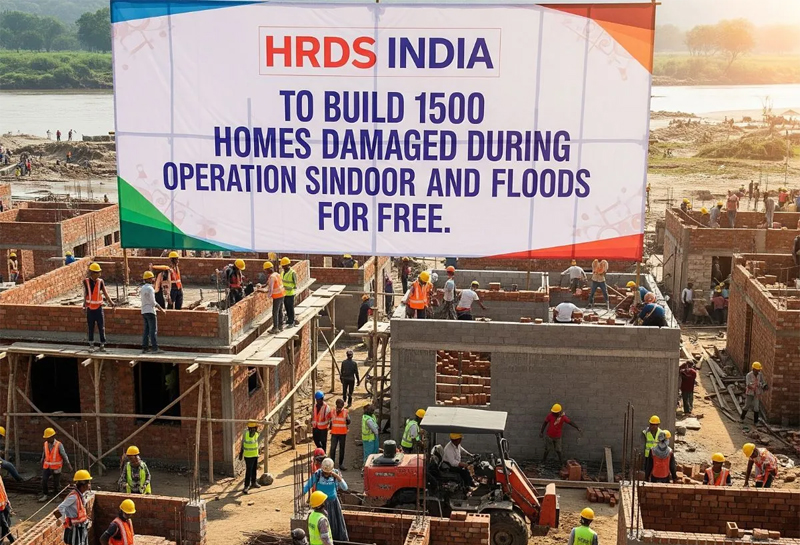
For any family, losing their home to a natural calamity or a man-made disaster is no less than the end of the world. A house is not merely four walls and a roof; it embodies years of savings, sacrifice, and the emotional security of generations. When floods or shelling snatch away that sanctuary, what is lost is not just property but dignity, stability, and the very essence of a secure life. In the case of Jammu and Kashmir, where people have endured both the fury of nature and the cruelty of cross-border shelling, the trauma multiplies. In this backdrop, the recent initiative announced by the Lieutenant Governor assumes immense significance. By roping in the High-range Rural Development Society (HRDS India) to construct 1,500 smart, three-bedroom houses for victims of Operation Sindoor, floods, and terrorism, the administration has sent a powerful message: the Government stands shoulder to shoulder with its people in their darkest hour.
The signing of the MoU between HRDS India and the Divisional Commissioners of Jammu and Kashmir is more than a formal exercise; it represents a bridge between grief and hope. These houses are not charity but symbols of reassurance and rebuilding. While monetary compensation is traditionally offered by the Government to victims of disasters, the reality remains stark-such compensation, bound by rigid norms, is often too meagre to construct even a modest dwelling. Families, already reeling from loss, are left to fend for themselves. In contrast, the HRDS project seeks to provide not only permanent, fully equipped housing but also an ecosystem of support that touches every aspect of life.
The houses being built under this scheme are not bare shelters. They are to be delivered as “Smart Houses”, incorporating modern amenities for safety, comfort, and sustainability. The add-ons are far from cosmetic-they represent a thoughtful attempt to restore not just homes but lives. The psychological importance of this project cannot be overstated. The loss of a home to floods or shelling often leaves families scarred with fear, insecurity, and a sense of abandonment. To rebuild their lives, they require more than material support-they need healing. The repainting of homes every five years, regular visits by trained HRDS volunteers, and free awareness sessions on health and hygiene might sound routine on paper, but, in reality, they represent a handholding exercise, a reaffirmation that society has not forgotten them.
The inclusivity of this project is equally laudable. By deciding to cover families whose homes were destroyed by terrorists, the administration has widened the scope of compassion. The scars of terrorism in Jammu and Kashmir run deep, and identifying such victims for support is a welcome decision. While 1,500 homes may appear modest in number compared to the scale of devastation caused by floods, shelling, and terrorism, it is the beginning of a larger movement. A successful rollout of this initiative can pave the way for scaling up and extending benefits to many more. Another significant aspect is that both Jammu and Kashmir divisions will benefit. The choice of location for constructing these homes will also be crucial. Efforts must be made to ensure that families are not displaced far away from their native places, as forced displacement would only add to their trauma. Instead, the aim should be to help them rebuild their lives within familiar surroundings where social and cultural bonds remain intact.
Lieutenant Governor Manoj Sinha’s vision behind this project is clear-governance is not only about policies and statistics but also about empathy and human connection. Words backed by concrete action bring healing to communities battered by disasters both natural and man-made. Looking ahead, this project should not be a standalone effort. With this project, the Government has delivered a strong message: it stands firmly with victims in their hour of distress and is committed to mitigating their suffering. The hope now is that this effort becomes a model, replicated and expanded in the future, ensuring that no family ever feels abandoned in the aftermath of tragedy.
 Follow our WhatsApp channel
