

by: InderJeet S.Bhatia “Prince”
aramedicalcounciljammu@gmail.com
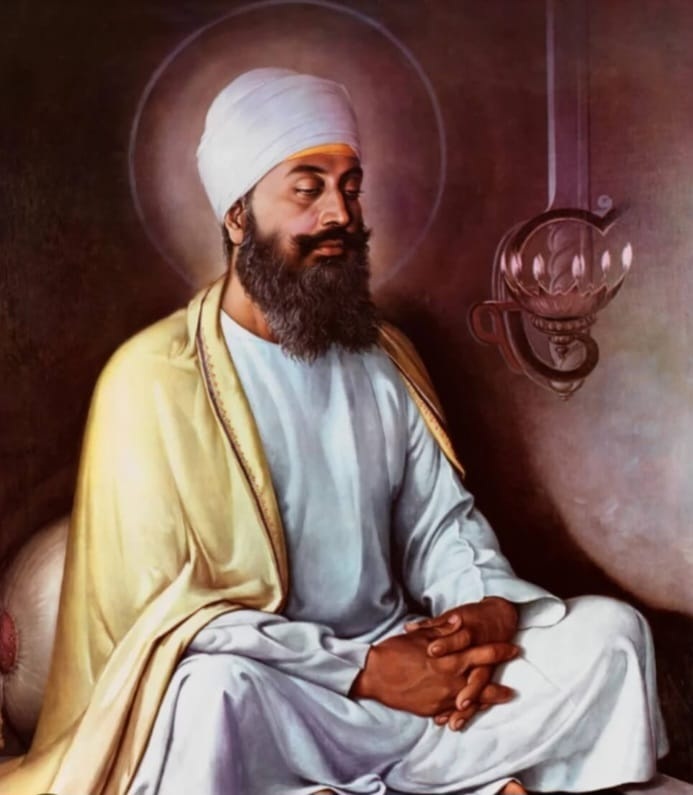
As the Sikh community and the Nation prepare to observe the 350th Martyrdom Day of Guru Tegh Bahadur Ji on 25th, November, It is a moment to reflect on the life, sacrifice, and immortal legacy of the Ninth Guru of the Sikhs—an extraordinary figure who chose death over the forced conversion of others. Guru ji’s martyrdom in 1675 remains one of the most defining events in the history of faith and human rights, not only in India but in the entire world.
EARLY LIFE AND SPIRITUAL FORMATION
Guru Tegh Bahadur Ji was born on April 1, 1621, in Amritsar to Guru Hargobind Sahib Ji, the sixth Sikh Guru known for introducing the doctrine of” MIRI-PIRI “—the inseparable combination of spiritual and temporal responsibility. From childhood, young Guru Tegh Bahadur Sahib ji was trained in both spiritual meditation and martial discipline. Guru ji’s bravery was witnessed in the Battle of Kartarpur and Battle of Amritsar, earning the title “TEGH BAHADUR SAHIB JI ”, meaning Brave of the Sword. Yet, unlike the martial title, Guru ji’s temperament was marked by deep contemplation, humility, and compassion. Guru ji spent years in prayer and reflection at Bakala before being recognized as the Ninth Sikh Guru.
GURU OF THE DOWNTRODDEN AND A VOICE FOR RELIGIOUS FREEDOM
During Guruship of Sri GuruTeghBahadur ji, the political landscape of India was dominated by the Mughal Emperor Aurangzeb, whose policies aggressively pushed Islamic orthodoxy. Regions such as Kashmir saw intensified pressure on non-Muslim communities. Sikh, Hindu, and even some Muslim historians agree that Guru Tegh Bahadur emerged as a defender of oppressed voices. The renowned Sikh historian Khushwant Singh, in his book “A HISTORY OF THE SIKHS”, emphasizes that Guru Tegh Bahadur ji’s stand was not for one religion alone but for the “universal right of every human being to practice faith without fear.” Similarly, historian Nikki-Guninder Kaur Singh notes that his message upheld “a spiritual humanism that transcended religious boundaries.” Guru Tegh Bahadur Sahib Ji’s writings included in the Guru Granth Sahib reflect this vision. Verses such as:
“BHAYE KAHU KO DET NAHIN,
NAHIN BHAYE MANAT AAN ”
(He causes fear to none and fears none) articulate a moral courage rooted in spiritual conviction.
THE CRISIS IN KASHMIR
According to historical records, a delegation of Kashmiri Pandits approached Guru Tegh Bahadur ji at Anandpur Sahib around 1675, seeking refuge from state repression. The Guru ji’s response was remarkable: Guru ji did not speak of war, revenge, or politics. Instead, Guru ji put forth a moral challenge—to Aurangzeb’s empire and to history itself.
Guru Tegh Bahadur Sahib ji stated that if the emperor could convert himself, the leader of a major faith community, then the entire Hindu population would willingly convert. But if the Guru resisted, the emperor’s policy would stand exposed. This was a stand for principle, not power.
Historians have written extensively on this moment. Professor Satish Chandra, the Mughal historian, interprets the event as “a resistance to state coercion, rather than a clash of religions,” while scholar J.S. Grewal calls Guru Tegh Bahadur ji’s decision “a profound assertion of individual liberty.”
ARREST AND IMPRISONMENT
Guru Tegh Bahadur Sahib ji traveled towards Delhi knowing well that the journey was one of no return. Guru ji was arrested along with his companions—Bhai Mati Dasji, Bhai Sati Das ji, and Bhai Dayala ji. Their trials and tortures have been recorded by Sikh chroniclers and several Persian sources. In Delhi’s Chandni Chowk, Guru ji’s companions were executed in unimaginably brutal ways—Bhai Mati Das ji was sawn alive, Bhai Dayala ji was boiled in cauldron, and Bhai Sati Das ji was wrapped in cotton and set ablaze. Their courage shook even some court observers. Guru Tegh Bahadur ji was offered riches, land, and imperial titles if Guru ji abandoned their stand. Instead, Guru ji remained calm and unwavering. Guru ji’s refusal was not simply religious defiance—it was a message to future generations that conscience cannot be suppressed by imperial power.
THE MARTYRDOM OF THE NINTH GURU
On November 11, 1675, Guru Tegh Bahadur Ji was martyred publicly in Chandni Chowk. The execution was meant to intimidate the people of India, but it produced the opposite effect. Guru ji’s beheading marked a turning point in India’s moral and political consciousness. Two ordinary men, Bhai Jaitha ji and Bhai Lakhi Shah Vanjara, risked their lives to claim the Guru ji’s body. The Sikhs secretly cremated the remains—one in Delhi and one in Anandpur Sahib—ensuring that the emperor could not humiliate the body of the martyred Guru Sahib ji
The beheaded head of Guru Tegh Bahadur ji was taken to Anandpur Sahib ji and was cremated there by 10th Sikh Guru, Sri Guru Gobind Singh Sahib Ji who was merely 9 years old at that time.Gurudwara Sisganj Sahib,at Anandpur Sahib stands on that place.The lower part of Guru ji’s body was cremated in Delhi where Gurudwara Shree Rakaabganj Sahib stands today.
Guru Gobind Singh Ji, then a young boy of nine, described his father’s sacrifice in stirring words preserved in the Bachitra Natak:
“TILAK JANJU RAAKHA PRABH TAAKA; KEENOO BADDON KALOO MAI SAAKA!”
(Guru ji protected the sacred mark and sacred thread.They performed a grand act in the age of darkness.)
A SACRIFICE WITHOUT PARALLEL
Guru Tegh Bahadur Ji is the only known martyr in world history who gave his life not for his own community, not for his own faith, but for the right of another community to exist without fear. Because of this unparalleled sacrifice, Guru ji is remembered as “HIND DI CHADAR ”—THE SHIELD OF INDIA. Historians across traditions recognize the global significance of his martyrdom. Arnold Toynbee, the famed British historian, referred to the Sikh Gurus as contributors to the “moral evolution of humanity.” Modern scholars like W.H. McLeod argue that the Ninth Guru’s stand represented “an ethical resistance to tyranny, grounded in love for humanity.” These interpretations reaffirm that Guru Tegh Bahadur Ji’s martyrdom was a landmark event in the history of civil rights.
LEGACY AND RELEVANCE TODAY
Guru Tegh Bahadur Ji left behind a legacy of spiritual strength, human dignity, and resistance to oppression. Guru ji’s verses in the holy Sri Guru Granth Sahib ji continue to impart wisdom on detachment, fearlessness, and equality. Guru ji’s life inspires movements for justice worldwide and reminds us that bravery is not merely physical—it is moral. The Gurdwara SRI SIS GANJ SAHIB in CHANDNI CHOWK DELHI, built at the site of Guru ji’s martyrdom, stands as a living testimony to freedom of faith. The Gurdwara SRI RAKAB GANJ SAHIB marks the spot where Guru ji’s body was cremated. Both remain symbols of sacrifice and resilience.
In a world still grappling with intolerance, extremism, and violations of human rights, Guru Tegh Bahadur ji’s message remains profoundly relevant. Guru ji’s martyrdom urges societies to uphold freedom of conscience, protect the vulnerable, and rise against injustice—peacefully, courageously, and with unwavering principles.
CONCLUSION:
As the 350th Martyrdom Day of Guru Tegh Bahadur Ji is commemorated, the nation reflects upon a sacrifice that reshaped the moral fabric of India. Guru Tegh Bahadur Sahib Ji’s death was not the end of their mission; it was the beginning of a new era. It inspired Guru Gobind Singh Sahib Ji to forge the “KHALSA PANTH “—a community dedicated to righteousness and protection of the weak. Guru Tegh Bahadur Ji’s martyrdom is not just a chapter in Sikh history. It is a universal human story—of standing up for truth, of protecting the persecuted, and of showing that a single life, lived with courage and conviction, can change the destiny of nations. Guru ji’s legacy continues to illuminate India and the world, reminding us that true martyrdom is not in dying for one’s own faith, but in dying to save the faith of others
We bow our heads to Sri Guru Tegh Bahadur Sahib ji .
Guru Gobind Singh Ji, Ji, the 10th Sikh Guru described the martyrdom of his father and others as under :
“Shish Dia Par Sirar Na Dia”
(They gave their heads but not their principles) Dhan Sri Guru Tegh Bahadur Sahib Ji.
 Follow our WhatsApp channel
