

Balbir Ram Rattan
balbirram1967@gmail.com
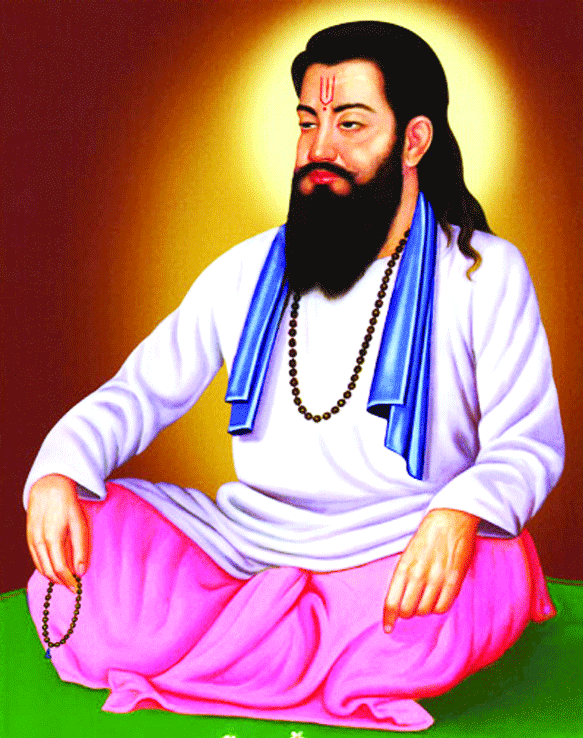
Guru Ravidass was one of the most influential spiritual saints of medieval India. He lived during the 15th-16th century, a period marked by rigid caste hierarchies, social inequality, and religious divisions. Through his life and teachings, Guru Ravidass challenged these injustices and offered a powerful vision of a society based on equality, dignity, and spiritual unity. His philosophy, deeply rooted in devotion (bhakti) and social reforms, continues to inspire millions today. Central to his thought is the concept of Begampura, an ideal society free from suffering and discrimination.
Life of Guru Ravidass
Guru Ravidass was born around 1450 in Seer Govardhanpur, near Varanasi, in present-day Uttar Pradesh. He was born into a family traditionally associated with leatherwork, a profession considered “low” within the caste system. Despite facing social exclusion from an early age, Ravidass showed a deep spiritual inclination and compassion for humanity.
Rather than seeking formal education or religious authority, Guru Ravidass chose the path of inner devotion and service. He earned his livelihood through honest labour, emphasizing the dignity of work. His life itself became a message: spiritual greatness is not determined by birth, caste, or wealth, but by purity of heart and devotion to God.
Guru Ravidass became a prominent figure within the Bhakti movement, which emphasized personal devotion to God and rejected ritualism and caste discrimination. He was a contemporary of saints like Kabir and is traditionally regarded as the spiritual teacher (guru) of Mira Bai, the famous Rajput princess and devotee of Krishna. This relationship symbolized his rejection of social hierarchies and his belief that spiritual wisdom transcends caste and class.
Teachings and Philosophy
The teachings of Guru Ravidass revolve around oneness of God, equality of all human beings, and inner devotion. He rejected the dominance of divisive rituals. Instead, he taught that sincere devotion, moral living, and remembrance of God’s name were the true paths to liberation.
Guru Ravidass strongly opposed caste-based discrimination. He taught that all humans are created by the same divine power and therefore deserve equal respect. In his hymns, he repeatedly criticized social divisions and called for a society based on love, justice, and compassion.
His spiritual compositions were written in simple language, making them accessible to common people. Many of his hymns are included in the Guru Granth Sahib, the sacred scripture of Sikhism, highlighting his lasting spiritual influence. Through poetry and songs, Guru Ravidass conveyed deep philosophical truths while remaining grounded in everyday human experience.
The Concept of Begampura
One of Guru Ravidass’s most powerful and revolutionary ideas is the concept of Begampura. The word “Begampura” literally means “the city without sorrow” (from begam meaning sorrowless and pura meaning city). This concept represents an ideal society where there is no pain, fear, inequality, or injustice.
In his famous hymn describing Begampura, Guru Ravidass envisioned a land where there is:
No caste or class discrimination
No taxes or economic exploitation
No fear, suffering, or oppression
Complete freedom of movement and dignity for all.
Begampura is not just a heavenly realm to be attained after death; it is a social and moral vision meant to inspire change in the real world. Guru Ravidass imagined a society where human worth is not measured by birth or occupation, but by ethical conduct and devotion.
This vision was radical for its time. In an era when social mobility was almost impossible, Begampura represented hope for the oppressed and marginalized. It challenged the existing power structures and offered a blueprint for a just and compassionate society.
Relevance of Begampura Today
The idea of Begampura remains deeply relevant in the modern world. Issues such as caste discrimination and economic inequality, continue to affect many societies. Guru Ravidass’s vision encourages us to question unjust systems and work toward inclusivity and equality.
Begampura can also be interpreted as a spiritual state, a condition of inner freedom where fear, ego, and hatred are eliminated. Thus, it connects personal transformation with social reform, reminding us that a just society begins with transformed individuals.
In nutshell, Guru Ravidass was not only a saint and poet but also a profound social reformer. Through his life, he demonstrated the power of humility, devotion, and moral courage. His teachings challenged oppressive traditions and uplifted the marginalized, offering a message of hope and dignity.
The concept of Begampura stands as the heart of his philosophy, a timeless vision of a society rooted in equality, justice, and compassion. As long as humanity strives for a world without discrimination and suffering, the teachings of Guru Ravidass and his dream of Begampura will continue to guide and inspire.
 Follow our WhatsApp channel
