

 Inderjeet  S.Bhatia "Prince "
paramedicalcounciljammu@gmail.com
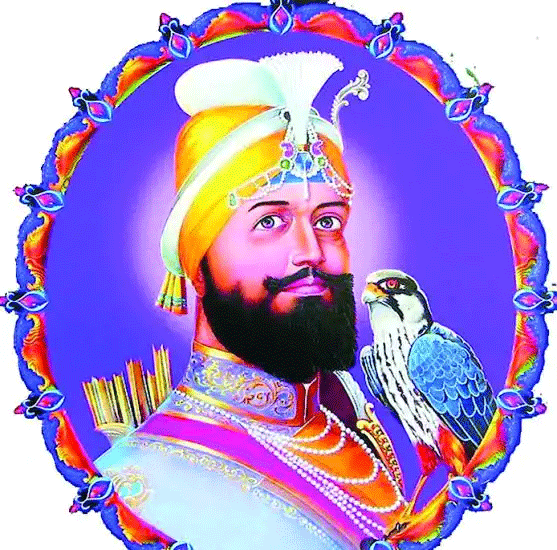
Guru Gobind Singh Ji, the tenth Sikh Guru, stands as one of the most dynamic and transformative personalities in Sikh history. Born as Gobind Rai on December 22, 1666, in Patna (present-day Bihar), Guru ji emerged at a time of grave political and religious turmoil in the Indian subcontinent. Guru ji inherited the mantle of Guruship at an extraordinary young age, following the martyrdom of his father, Guru Tegh Bahadur Ji, and went on to reshape Sikh identity forever.
EARLY LIFE AND ASCENSION TO GURUSHIP
Guru Gobind Singh Ji was just nine years old when he became the tenth Sikh Guru after his father’s courageous sacrifice. Guru Tegh Bahadur Ji had stood up against forced religious conversions under the Mughal ruler Aurangzeb, ultimately paying with his life. Upon his father’s martyrdom, the young Gobind Rai was anointed Guru—imbued with the combined legacy of spiritual depth and fearless resistance. By this age, Guru ji had already mastered multiple languages including Punjabi, Braj, Persian, and Sanskrit and was trained in martial arts—a rare accomplishment that foreshadowed his future role as both a spiritual leader and military commander.
A POLYMATH AND POET — THE” DASAM GRANTH “,
One of Guru Gobind Singh Ji’s lasting contributions to Sikh literature is the Dasam Granth, a voluminous text composed in various languages such as Braj, Hindi, Punjabi, and Persian. It contains a wide range of material: philosophical musings, spiritual hymns (shabads), mythological narratives, and autobiographical elements. Among these is “BACHITTAR NATAK”, an account of his life up to his early thirties, interwoven with reflections on duty, valor, and divine justice. The Dasam Granth also includes compositions that articulate the Sikh ideal of righteous resistance against oppression. These writings have been studied and revered for their lyrical intensity and spiritual depth, influencing generations of Sikhs and scholars.
THE BIRTH OF THE KHALSA: A NEW SIKH IDENTITY
The most defining moment of Guru Gobind Singh Ji’s life came on Baisakhi Day, March 30, 1699, at Anandpur Sahib. Confronted by growing hostility from imperial forces and punitive demands on his community, the Guru Sahib called Sikhs to gather for a gathering unlike any before. There, Guru ji posed a challenging question to the assembly: who was willing to give his head for the sake of truth. One by one, five men stepped forward, each ready to make the ultimate sacrifice.
According to Sikh tradition, the Guru led each into a tent, and though the congregation heard the clash of steel, all five volunteers emerged unharmed, dressed in saffron garments—THE FIRST “PANJ PYARE”, or the “Five Beloved Ones.” Guru Gobind Singh Ji had tested their faith, and then followed a sacred initiation ritual (KHANDE KA PAHUL) in which he baptized them with” AMRIT “(holy nectar) prepared with a double-edged sword. He himself was then baptized by the PANJ PYARE, binding himself within the community he had sanctified. With the KHALSA as the guiding force of the re constituted Sikh army, Guru Gobind Singh Sahib Ji told his followers as,
“Deh Siva Bar Mohe eh hey Shubh Karman Te Kabhu Na Taru,
Na Daron Arr Seo Jab Jaye Laron ,
Nischey Kar Apni Jeet Karu”
(“Dear God, grant my request so that I may never deviate from doing good deeds,that I shall have no fear of the enemy when I go in to the battle field and with determination I will be victorious “) With this act, the Guru gave birth to the KHALSA PANTH, or the “PURE ONES ”—a collective identity of SAINT-SOLDIERS committed to justice, courage, and ethical living. Men were given the surname Singh (Lion) and women Kaur (Princess), breaking caste hierarchies and ensuring dignity for all. This bold reformation created a cohesive Sikh identity that was both spiritual and martial—rooted in equality, discipline, and readiness to defend the oppressed.
STRUGGLES AND SACRIFICES:
THE MARTYRDOMS OF CHAAR SAHIBZADE
The early 18th century saw relentless conflict between the KHALSA and the Mughal establishment. After extended sieges and battles—most notably the betrayals following the Siege of Anandpur
GURU GOBIND SINGH JI’S FAMILY WAS TORN APART BY WAR AND TREACHERY
. In December 1704, during fierce fighting at the Battle of river Sarsa and about to follow deception of “safe passage,” the Guru’s two elder sons, Baba Ajit Singh (18) and Baba Jujhar Singh (14), laid down their lives in the Battle of Chamkaur, showing extraordinary courage despite overwhelming odds. Their younger brothers, Baba Zorawar Singh (9) and Baba Fateh Singh (6), were betrayed by a servant and captured. When they refused to renounce their faith, they were executed by cruel means,Nawab ordered CHHOTTE SAHIBZAADE to be bricked alive in Sirhind—a sacrifice that remains etched into the collective memory of the Sikh community. These four sons, known as the CHAAR SAHIBZADE, exemplify unshakeable faith and self-sacrifice. As noted by contemporary commentators, their martyrdom is often described as among the “greatest sacrifices in world history,” inspiring admiration and reverence beyond religious boundaries.
FINAL YEARS AND THE ETERNAL GURU
Despite grievous personal loss, Guru Gobind Singh Ji continued his mission. Guru ji wrote the ZAFARNAMAH, a powerful epistle to Emperor Aurangzeb condemning deceit and affirming ethical conduct even in war, emphasizing moral over political authority. In 1708, after sustaining mortal wounds from an assassin’s blade in Nanded, Maharashtra, the Guru made his final and most profound spiritual declaration: the GURU GRANTH SAHIB JI —the Sikh scripture compiled by his predecessors—would henceforth be the eternal Guru of the Sikhs. This decision placed the authority of the Sikh tradition not in a person but in a sacred text, enshrining Guru Nanak Dev Ji’s and other saints’ teachings for all time.
HISTORIANS ON GURU GOBIND SINGH JI
Scholars widely acknowledge that Guru Gobind Singh Ji not only revitalized Sikh institutions but also articulated a universal vision of the entire humanity. In the words of Macauliffe ,a renowned historian, Guru Gobind Singh Sahib Ji was,an architect who transformed a persecuted religious group in to a confident ,organised and morally driven community. Arnold J.Toynbee, the world famous British historian & philosopher of history, “”The creation of the KHALSA BY Guru Gobind Singh Sahib Ji was an event of far reaching importance in the history of mankind “Prof.Harbans Singh ,the eminent Sikh scholar wrote as ,” Guru Gobind Singh Sahib Ji gave the Sikhs a distinct identity, a code of conduct and a mission that blended spirituality with social responsibility “Guru ji redefined the concept of authority within the Sikh community, giving it a new religious and political vision. Guru ji insistence on righteous resistance against tyranny resonates across centuries. Experts emphasize that the creation of the KHALSA was not merely a ritual but a radical restructuring of social identity—promoting equality, courage, and an unyielding commitment to protect the oppressed.
LEGACY AND RELEVANCE
Guru Gobind Singh Ji’s legacy endures in every Sikh home and gurdwara around the world. Guru ji’s life embodies a unique confluence of spirituality and valor. By institutionalizing equality and moral resistance and by placing eternal authority in the Guru Granth Sahib ji, Guru ji ensured that the Sikh community would always be guided by timeless spiritual wisdom rather than by mutable human leadership.
 Follow our WhatsApp channel
