

Tsewang Rigzin
rigzinhimalaya@gmail.com
The growing demand for Ladakh’s inclusion under the Sixth Schedule of the Indian Constitution stems from a pressing need to protect its fragile ecology, unique cultural identity, and traditional livelihoods from unchecked development. Nothing illustrates this urgency more than the looming renewable energy mega project proposed in Skyangchu-Thang-a vast, windswept pastureland in eastern Ladakh that has, for centuries, sustained the Changpa nomads and their prized herds of pashmina goats. As local communities express deep concern over the potential displacement and ecological impact of this 13-gigawatt solar-wind hybrid project, it becomes increasingly clear that only constitutional safeguards like the Sixth Schedule can ensure that Ladakh’s land, people, and traditional systems are not sidelined in the name of national development. For nearly seven months a year, thousands of animals graze in these high-altitude meadows, producing the world’s finest wool and anchoring a way of life passed down through generations-now at risk without meaningful local control over land and resources.
Now, this landscape and way of life stand at a crossroads. The Government of India has identified Skyangchu-Thang as the site for one of its most ambitious renewable energy initiatives – a 13-gigawatt hybrid power project combining 9 GW of solar and 4 GW of wind energy. The proposed project, to be executed by the Solar Energy Corporation of India (SECI), is expected to span approximately 48,000 acres (38,400 kanals) of traditional grazing land. This is being touted as a major step toward making Ladakh the clean energy capital of India.
To facilitate the evacuation of electricity from Ladakh to Haryana, work on the backbone of this green energy dream – a ?22,000-crore “Green Energy Corridor” – has already begun. The Power Grid Corporation of India Limited (PGCIL) is laying the transmission infrastructure near Pang, as part of a 713-kilometre line connecting Kaithal in Haryana to Phyang near Leh. Officials say Ladakh’s solar potential – with more than 310 sunny days a year at elevations above 4,000 metres – is a natural advantage that cannot be ignored.
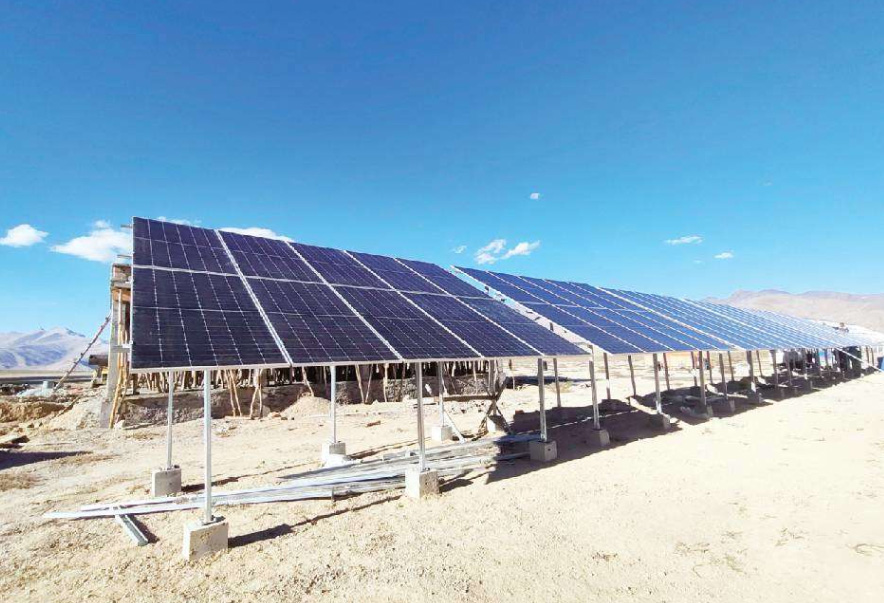
To demonstrate that renewable energy can coexist with traditional pastoralism, the Ladakh Renewable Energy Development Agency (LREDA), in collaboration with the University of Ladakh, has launched a pilot project over 40 kanals of land at Skyangchu-Thang. Raised solar panels are being installed in a way that is intended to allow livestock to graze beneath them. Officials including Leh Hill Council Chairman Tashi Gyalson and Ladakh’s Chief Secretary Dr. Pawan Kotwal have assured that only if this demonstration succeeds will the full-scale project move forward. They have publicly stated that no project will be imposed at the cost of nomadic livelihoods.
Despite these assurances, scepticism runs deep among those whose lives are tied to the land. Many nomads say they were never consulted before their traditional pastures were designated for development. “This area has been our grazing land for centuries and Rupsho-Samad alone has around thirty thousand pashmina goats,” says Rinchen Targais, the 50-year-old Goba (headman) of Rupsho. “If our land is taken for the solar project, where will we go?” he asks. Rinchen says villagers already expressed their refusal to give land in a meeting with officials last year, but they remain unsure if their objections will be respected. He is also doubtful about the technical claims of the pilot project. “How will grass grow beneath solar panels without sunlight?” he wonders.
Tashi Dolma, another resident, echoes similar sentiments. She points out that the nomads in the area do not own farmland. Their only source of livelihood is livestock, a practice that has been passed down through generations. “For centuries we have been grazing in this area, from generation to generation. Where will we go?” she asks, while spending the summer in Ngorchen along with fellow herders Paldan and Rinchen.
Their concerns are not only about the loss of physical space but also about the disruption of a deeply intertwined cultural and economic system. Generations of Changpa have survived in this high-altitude cold desert through careful seasonal migration across fragile ecosystems, a practice known as transhumance. Their movements involve 8 to 10 camps per year, depending on snow cover, grass growth, water availability, and other climate-related factors. Displacing them could undermine the very foundation of Ladakh’s pashmina industry, which sustains thousands of families and plays a crucial role in India’s textile exports.
Environmentalists and activists, including Sonam Wangchuk-who is currently lodged in Jodhpur Central Jail under the National Security Act-have voiced strong opposition to the proposed project, questioning the government’s intention to allocate vast stretches of traditional nomadic pasturelands to corporate interests at the expense of the region’s pastoral way of life. They argue that the seemingly barren expanses of Skyangchu-Thang are not empty wastelands, but ecologically rich and culturally significant grazing grounds that have sustained generations of Changpa nomads. During last year’s ‘Delhi Chalo’ pad yatra led by Wangchuk, participants walked through these very grasslands to draw national attention to the urgent need to preserve Ladakh’s free grazing lands and protect the rights of its indigenous herding communities.
Former Executive Councillor of the Ladakh Autonomous Hill Development Council (LAHDC), Leh, and former Councillor of Korzok, Gyurmet Dorjay, recalls that the project was originally proposed at Hanley with conditions that Ladakhis would receive free electricity for life, and that both skilled and unskilled jobs would go to locals. That site had to be cancelled after villagers strongly resisted, fearing the loss of their pasturelands. Dorjay now says land for the new site could be considered only if each affected household receives 30 to 40 kanals of land in a commercial area as compensation.
Meanwhile, the sitting Councillor from Korzok, Karma Namdak, maintains that no land has yet been allocated for the renewable project. He clarifies that the current construction activity relates only to the Power Grid Substation, which is part of the transmission line connecting Ladakh to the national grid via Bilaspur. Namdak says nomads will be assured of the creation of pasture reserves and pasturedevelopment in the Detailed Project Report. He argues that if Ladakh aspires for statehood someday, it must also explore viable sources of revenue – and renewable energy could be a path forward. He added that since Skyangchu-Thang does not fall under a wildlife sanctuary, clearance from the wildlife department is not required.
Ladakh’s Chief Secretary, Dr. Pawan Kotwal, further explains that the meadow between Kharnak-Diring and Pang – amounting to 48,000 acres – can be used for a solar-wind hybrid project due to its immense renewable potential. He stated that experts have been consulted to explore the feasibility of growing grass under solar panels, and that the demonstration project at Pang is being closely monitored by Ladakh University. According to him, grass might actually grow better under raised panels due to improved moisture retention in the soil.
However, activists and local leaders continue to point out that despite the promises, the project lacks both an Environmental Impact Assessment (EIA) and a Social Impact Assessment (SIA). They argue that proceeding without these studies in such an ecologically and culturally sensitive region would be reckless. Many also connect the issue to the broader demand for Sixth Schedule status for Ladakh – which would grant greater autonomy and control to local communities over land, natural resources, and development decisions.
Even if the government considers going ahead with this dream project, the voices of the people – particularly the nomads whose livelihoods are directly at stake – must be heard. Informed consent, proper assessments, and genuine community participation are not just procedural formalities, but ethical necessities. What’s at stake is not just a pasture, but a centuries-old way of life, an ecosystem finely balanced by tradition, and a cultural identity at risk of being lost in the race for energy.
– This story has been produced with support from Earth Journalism Network
 Follow our WhatsApp channel
