

*Rs 5,000 cr losses if implementation delayed
Sanjeev Pargal
JAMMU, June 13: The Government today said there were enough “safeguards” in the State Goods and Services Tax (SGST) to uphold “fiscal autonomy” of Jammu and Kashmir, the copies of which would be made available to all political parties before or during the Special Assembly Session for discussion on the bill before approval of the Legislature.
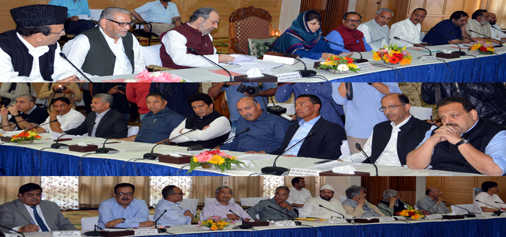
“All relevant documents pertaining to the SGST and broader features of the legislation, which the Government proposed to introduce during Special Session of the Legislature on June 17, will be made available to representatives of all political parties,” the Government said at the All Party Meeting (APM) that lasted four and a half hours at the SKICC Srinagar this evening, which had been called by Chief Minister Mehbooba Mufti to build consensus on the GST, which is proposed to be rolled out countrywide on July 1.
Sources told the Excelsior that barring National Conference and some Kashmir-centric individuals like Engineer Rashid, Independent MLA, majority of political parties including the Congress supported implementation of GST in Jammu and Kashmir but wanted that the Government should make certain issues clear especially the safeguards it proposed for “fiscal autonomy” and “special position” of the State in the legislation.
The Government, according to sources, made it clear at the APM that the State could lose Rs 5000 crores a year if it didn’t implement the GST apart from facing complete chaos as all States of the country would have one taxation system.
“There would be complete chaos if we defer implementation of GST beyond July 1 as trade of outgoing and incoming goods would be badly hit,” they said.
Majority of political leaders, who attended the meeting, admitted that the Government wasn’t able to respond to their queries especially the “safeguards” it has proposed in the SGST for “protecting fiscal autonomy” and “special position” of the State.
Sources said the PDP and BJP were on the same page that there was no alternate but to implement the GST from July 1.
Sources said former Finance Minister and PDP MP Muzaffar Hussain Baig allayed fears of the political parties on erosion of autonomy of the State saying this was for the first time when the Centre was giving autonomy to States in form of the GST. “The States will benefit from the GST while the Centre is a loser, to some extent,” he told the APM while justifying implementation of the GST with all necessary safeguards.
Deputy Chief Minister and veteran BJP leader Dr Nirmal Singh told the Excelsior that majority of political parties were in favour of implementation of the GST but just wanted the “proposed safeguards” for “upholding special position” of the State, which will be given to them before or during the Assembly session for debate on the legislation before passing it.
Dr Singh said every issue can be discussed and debated during Special Session of the Legislature from June 17-20 and all queries of the legislators would be replied and they would be satisfied before adopting the GST.
Congress Legislature Party (CLP) leader Nawang Rigzin Jora said the Congress, in principle, supported adoption of the GST but wanted that there should be “no further erosion” of J&K’s special position as there were allegations that the State’s special status was being continuously eroded.
Asserting that the GST was Congress initiative, Jora said applicability of the jurisdiction of Election Commission and Supreme Court to Jammu and Kashmir has helped J&K people in getting justice and getting rid of rigged polls. However, he said, the Government didn’t seem to be on one page and wanted it to come clear on certain issues raised by the political parties at the APM.
Jora attended the APM along with veteran party leaders including Aijaz Ahmad Khan, Ghulam Nabi Monga and Usmaan Majeed.
Sources said the Congress has supported the GST countrywide as it was their idea during the UPA regime and it only wanted that issues of the people and traders should be addressed before adopting the legislation in sensitive State like Jammu and Kashmir.
BJP spokesperson Sunil Sethi, who joined the APM with State party chief Sat Sharma ‘CA’ and Arun Gupta, said the BJP wanted the GST to be implemented in Jammu and Kashmir at any cost on July 1 like all other parts of the country. He said the State would be a “big loser” if applicability of the GST was delayed.
“The inter-State trade will completely come to a halt if implementation of the GST was delayed in J&K,” Sethi said, regretting that few Kashmir-centric politicians tried to “politicize GST” at the APM as they had no “solid reason” to oppose the “people and trade-friendly GST”.
Click here to watch video
Sources said two former Finance Ministers and NC veterans-Abdul Rahim Rather and Mohammad Shafi Uri took the Government to task for “completely lacking clarity” on the GST legislation by not responding to the queries raised by the Opposition members.
They added that Rather, who had himself served as GST Council Chairman, wanted to know from the Government the “safeguards” on “special status” of J&K.
National Conference leader and MLA Nagrota Devender Singh Rana had heated exchanges with Finance Minister Dr Haseeb Drabu when the latter charged NC with eroding autonomy of Jammu and Kashmir by switching over to Ways and Means Facility with Reserve Bank of India from Overdraft Facility of J&K Bank. Rana counter the charge stoutly saying Drabu, who was then Chairman of Jammu and Kashmir Bank, had supported the proposal of Ways and Means with RBI before Vijay Kelkar, who was then Chairman of the Finance Commission.
Rana charged Drabu with trying to further erode autonomy of J&K Bank with proposal to appoint non-State subjects as Directors of Jammu and Kashmir Bank at the scheduled AGM of the Bank few days later.
NC leader and former Minister Nasir Aslam Wani said his party made it clear at the APM that they can’t support the legislation as the Government was unable to show them the draft legislation, list of amendments and taxations etc.
He reiterated the party demand to defer the Special Session of the Legislature as well as implementation of GST in J&K.
CPM leader MY Tarigami said it was good that the Government has called the APM but they must respond to the queries of people’s representatives on Applicability of Application 101 of 2016 Constitutional amendment.
“What the Government proposed to do? How it wants to implement the bill? What are the safeguards for State’s fiscal autonomy and special position?” Tarigami asked at the meeting but said the Government members were not in a position to respond.
Nationalist Panthers Party (NPP) member Harshdev Singh said his party welcomed implementation of the GST as it would boost Gross Domestic Product (GDP). Moreover, he pointed out that GST has already been implemented by 160 countries.
Harshdev, however, questioned the Government as to how it go ahead with Lakhanpur Toll Plaza as there would be single taxation in the country as well as the State in the form of GST. He also demanded that taxes of some of the items should be lowered.
An official handout said: “broader consensus seemed to have emerged, during the All Party Meeting convened in Srinagar today, on bringing Jammu and Kashmir under the ambit of Goods and Service Tax (GST) regime.
The four and half hour marathon meeting, chaired by the Chief Minister Mehbooba Mufti, was also attended by Deputy Chief Minister, Dr Nirmal Singh, Minister of Finance, Dr Haseeb Drabu, Minister for Revenue, Abdul Rehman Veeri, Minister for RDD, Abdul Haq, Minister for Social Welfare, Sajad Gani Lone and Minister for Health and Medical Education, Bali Bhagat.
Chief Secretary, B B Vyas, Principal Secretary to Chief Minister, Rohit Kansal and Commissioner/Secretary Finance, Navin K Chaudhary were also present in the meeting.
During the meeting, all the political parties broadly agreed that the State of Jammu and Kashmir is likely to be on the loser’s side if it is not brought under GST regime which will be rolled out on July 1. However, they argued that the extension should not come at the cost of compromising the State’s fiscal autonomy
Minister of Finance, Dr Drabu, highlighted the broader contours of the new tax regime and the benefits that it will accrue to Jammu and Kashmir. He said staying away from GST is not a realistic option for the State.
“The meeting was called to give broad sense and discuss the issues with the new tax regime. There is a lot of wisdom and experience in this room. It is not only the Government but the opposition is also responsible for harmonizing the law so that the special status of the state is safeguarded while implementing GST regime,” he said.
He said J&K Legislature can enact a comprehensive GST law where tax will be levied corresponding to aggregate SGST and CGST. “We will harmonize GST in J&K by extension of only such limbs of Constitutional Amendment 101 which are already applicable to JK, thereby keeping special status and fiscal autonomy intact,” he said.
“In the event of non-participation by J&K, the State will become isolated having a closed door economy with all negative consequences and cascading tax which will adversely impact the economy and trade in the state,” Dr Drabu said.
He said in case J&K Government doesn’t extend GST regime to the state, it will double the taxes on commodities and no one will do business with traders of the state. “Share of taxes in indirect taxes will be zero causing a loss of Rs 5000 crore to J&K,” he said while making a power point presentation in the All Party Meeting on the new tax regime.
He said the GST is the most favoured indirect tax system running in the world which has few tax rates and exemptions, broadens tax base, reduces prices and establishes a transparent tax system.
“The State of Jammu and Kashmir derives its authority to tax from Section-5 of the Constitution of J&K, so there is no question of surrendering the state’s fiscal autonomy,” he said.
Senior PDP leader and Member of Parliament, Muzaffar Hussain Baig and BJP’s state president, Sat Sharma, and PDP vice-president, Sartaj Madni, were also present in the meeting.
The National Conference was represented in the meeting by Mohammad Shafi, Abdul Rahim Rather, Devinder Singh Rana and Nasir Aslam Wani. From the Congress, the meeting was attended by Nawang Rigzin Jora, Usman Majid and Ghulam Nabi Monga. CPI (M) General Secretary MY Tarigami, Ghulam Hassan Mir of DPN, Hakim Mohammad Yasin of PDF, Nizamuddin Bhat, Abdul Rashid, Pawan Kumar Gupta and Harsh Dev Singh were also present.
In her opening remarks, Chief Minister Mehooba Mufti said the idea behind convening the All Party Meeting was to evolve a broad based consensus on adopting any tax regime in the State. She appealed the representatives of all political parties to come forward with their suggestions and remarks on the subject so that a view, which represents the aspirations of all sections of the society, is taken by the Government.
Thanking the members of all political parties for having made it to the All Party Meeting, Mehbooba said the implementation of GST regime in the State is a subject matter of collective decision by every section of society and not of Government alone. She hoped that fruitful discussions on the subject would be held in the Assembly during forthcoming special session.
Addressing the participants, the Chief Minister said the Government is open to suggestions from all sections including political quarters and business class. She hoped the participants would discuss the provisions of proposed laws in detail and come up with concrete suggestions and recommendations by which the fiscal and political autonomy of the State is not affected if the proposed law is decided to be enacted.
 Follow our WhatsApp channel
