

Measure to boost conservation
Irfan Tramboo
SRINAGAR, Jan 21: In what could be a pivotal step towards conserving Kashmir’s majestic heritage tree- the Chinar- Government has geo-tagged nearly 29,000 Chinar trees across the region, with more to follow.
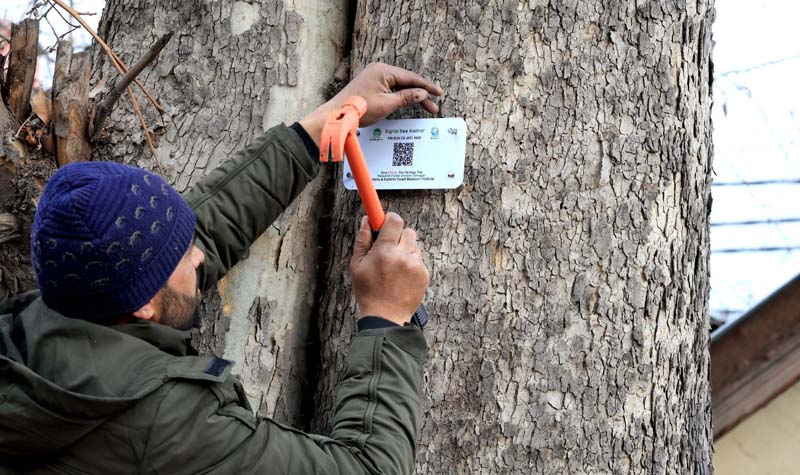
According to officials, the project, initiated by the Jammu and Kashmir Forest Department, in collaboration with the J&K Forest Research Institute (FRI), in 2021 involves a GIS-based and QR-enabled survey as a starting point to determine the total number of Chinar trees in Kashmir and their characteristics.
“We have visited every single Chinar across Kashmir’s districts, devised a methodology, and established a system to tag these trees district-wise to ensure an accurate count,” Dr Syed Tariq, Project Coordinator at FRI, told Excelsior.
The survey aimed not only to establish the number of Chinar trees but also to record vital details of each tree under the Chinar Tree Record Form (CTR-25).
The geotagging process involves mapping the exact locations of Chinar trees across the region, providing a comprehensive database for their management.
QR codes attached to each tree offer detailed information about its health, age, and growth patterns, enabling researchers and conservationists to track changes over time.
“Using CTR-25, we recorded 25 characteristics of each surveyed tree and made the data available to the department. These details are also accessible to the public by scanning the QR code affixed to the trees,” Dr Tariq said.
The recorded characteristics include geographical location, tree status, health, height, Diameter at Breast Height (DBH), circumference, and additional remarks on necessary measures to maintain the trees’ health.
Dr Tariq noted that previously, exact data on the number of Chinar trees was unavailable.
“Now, not only do we have the numbers-even though many smaller Chinar trees have yet to be surveyed-but we also have detailed characteristics of the established trees,” he said.
The collected data will undergo further analysis to identify newly planted Chinar trees, that have died and those requiring urgent attention. This will facilitate better conservation efforts.
Dr Tariq revealed that nearly 29,000 Chinar trees have been surveyed, with the highest numbers in Ganderbal, followed by Srinagar and Anantnag.
Ganderbal also has the honour of hosting the largest Chinar tree in Kashmir, which is the world’s third-largest, with a girth of 74 feet.
“We have several trees with a girth of 50 feet or more. In the coming days, we will issue a list of the top 20 Chinars in terms of girth across Kashmir,” he added.
Phase-I of the project involved the survey and geo-tagging of trees. The next phase will include uploading the collected data to a dedicated website for Chinar trees in Kashmir.
Over the next year, officials plan to geotag an additional 10,000 Chinar trees, each assigned a scannable QR code containing detailed information.
“Next, we also aim to determine the age of the trees and address the risk factors associated with them, particularly Chinar trees,” Dr. Tariq said.
To this end, the department plans to establish a facility for tree risk assessment using a USG-based gadget capable of determining risk levels without human intervention.
“The gadget will assess risk factors, eliminating the need for manual evaluation,” officials said.
 Follow our WhatsApp channel
