

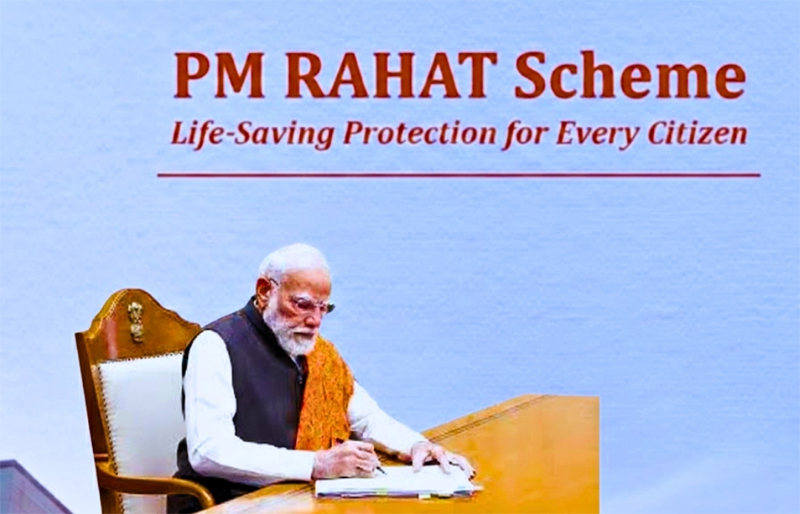
The launch of the PM-Road Accident Victims Hospitalisation and Assured Treatment (PM-RAHAT) Scheme marks a significant intervention in India’s road safety and emergency healthcare framework. At its core, the scheme addresses a long-standing and critical gap: the delay in providing immediate medical care to accident victims due to financial uncertainty and systemic inefficiencies. By ensuring cashless treatment up to Rs 1.5 lakh for seven days across more than 140 designated hospitals, the initiative has the potential to transform survival outcomes-particularly in regions like Jammu and Kashmir, where terrain and accessibility pose additional challenges.
The concept of the “Golden Hour” is central to understanding the scheme’s importance. Medical science has consistently underscored that the first hour after a traumatic injury is crucial. It is within this narrow window that timely intervention-control of bleeding, stabilisation of vital parameters, and rapid transfer to a medical facility-can mean the difference between life and death. Unfortunately, in many accident cases, this window is lost not due to lack of willingness to help, but because of hesitation, confusion, and, above all, concern over who will bear the cost of treatment. This is precisely where PM-RAHAT emerges as a game changer. By removing the immediate financial burden from both victims and Good Samaritans, the scheme directly targets one of the biggest deterrents to prompt medical assistance. Passersby are often the first responders in accident scenarios, and while many do step forward to help, the uncertainty surrounding hospital expenses frequently leads to dangerous delays. The assurance of cashless treatment eliminates this hesitation, enabling quicker decision-making and faster evacuation of victims to healthcare facilities.
Equally noteworthy is the provision for incentivising “Rah-Veers”-individuals who assist accident victims. The Rs 25,000 reward, along with a Certificate of Appreciation, is not merely a monetary incentive but a policy signal that recognises and institutionalises civic responsibility. In a country where bystander intervention has often been hindered by legal and financial anxieties, such recognition can gradually reshape public behaviour.
For Jammu and Kashmir, the relevance of PM-RAHAT is even more pronounced. The Union Territory’s rugged topography, coupled with long stretches of highways cutting through mountainous terrain, often results in severe accidents where immediate medical access is limited. In such conditions, the distance from the nearest tertiary care hospital can prove fatal. The empanelment of 140 hospitals under the scheme offers a decentralised network of emergency care, reducing dependence on a few overburdened Government institutions and bringing critical services closer to accident sites.
However, while the scheme’s framework is robust, its success will depend heavily on implementation and awareness. The next logical step must be an aggressive public outreach campaign. Citizens need to know not only that such a scheme exists but also which hospitals are empanelled. Without this awareness, the very objective of saving time during the Golden Hour could be undermined. Clear signage on highways, integration with police control rooms, and dissemination through digital and traditional media are essential to bridge this gap. Interdepartmental coordination will also play a decisive role. The scheme mandates close cooperation between transport, health, police, and district administrations. In practice, this must translate into seamless communication channels, real-time response systems, and accountability at every level. Emergency helplines, ambulance services, and hospital readiness must function as a synchronised chain rather than isolated units.
Another aspect that warrants attention is data monitoring and evaluation. Given the high incidence of road accidents in Jammu and Kashmir, the scheme offers an opportunity to generate valuable data on response times, treatment outcomes, and mortality reduction. Within months of implementation, trends should begin to emerge, enabling policymakers to refine and expand the programme based on empirical evidence. It’s a lifesaver initiative, long overdue.
In essence, PM-RAHAT is more than a healthcare initiative-it is a statement of governance intent. It reflects a shift towards proactive, citizen-centric policymaking that prioritises life-saving interventions over procedural constraints. By addressing both the financial and behavioural barriers to emergency care, the scheme has the potential to significantly reduce accident-related fatalities. For a place like Jammu and Kashmir, where every minute lost can cost a life, this initiative may indeed prove to be the thin line that turns tragedy into survival.
 Follow our WhatsApp channel
