

Brig Dr Vijay sagar Dheman
Motivatedvijay128@gmail.com
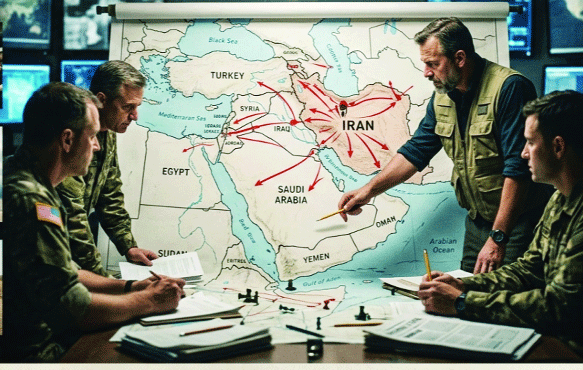
As the global energy market feels the impact from the closure of the Strait of Hormuz, a common question arises everywhere from the boardrooms of New Delhi to the fuel stations of Jammu. Why can’t we just find alternative sources for our oil? According to energy strategists and maritime specialists, the honest answer is a firm and cautionary “no.”
The 15-Million-Barrel Per Day Void
Every day, about 20 million barrels per day of crude oil pass through the narrow Hormuz chokepoint. While Saudi Arabia and the UAE have bypass pipelines, together they can only handle around 5 million barrels per day. This means there’s a gap of about 15 million barrels per day, around 15% of the world’s total consumption, with nowhere for that oil to go. Such a huge hole can’t be easily or quickly rationalised. To make up for 15 million barrels a day, spare capacity that’s three times over is required, which simply isn’t feasible.
The Failure of Alternatives
There is hope that producers like the United States, Venezuela, or Russia could help bridge the oil supply gap, and many hope they will. However, industry experts often see these hopes as’ mathematical fiction, ‘ expressing scepticism about quick solutions. The U.S. faces a bottleneck: Although it remains a top producer, its shale rigs are running at near full capacity. Boosting daily production by millions of barrels would take six to twelve months of drilling, a timeline that the global economy can’t afford right now. The chemistry crisis adds another layer of complexity: Crude oil quality varies around the world. Gulf crude tends to be’ heavy and sour,” whereas U.S. oil is usually’ light and sweet.” Most Asian refineries are optimised for Gulf crude, and forcing an abrupt switch could cause technical problems and significantly cut diesel and gasoline output. Additionally, logistical gridlock complicates matters: Even if Venezuela or Russia had extra oil to export, the current global tanker fleet is already dedicated to existing routes. Redirecting ships to South America or West Africa would take months and sharply raise freight insurance costs.
Asia at Ground Zero
The impact is felt most strongly in Asia, where over 80% of the oil passing through the Strait is received. In India, the situation is particularly concerning. Besides crude oil, nearly 90% of the country’s LPG (used for cooking) and a large portion of its LNG go through this narrow passage. The Indian government has stepped in with its Strategic Petroleum Reserves (SPR) to keep petrol prices relatively stable for now. In Jammu, petrol is close to ?96 per litre, but the bigger concern isn’t just the price, it’s the fear and panic that could spread. We have roughly 60 to 70 days of stock cover, but if the public treats every day like it’s the last day of fuel, that buffer will vanish.”
The Verdict
The world is currently living on borrowed time. As strategic reserves are released to provide a temporary buffer, the hard reality remains: there is no “Plan B” for the Strait of Hormuz. Without a diplomatic or military resolution to reopen the waterway, the global economy is facing an unprecedented era of rationing and industrial slowdown.
(The author is Convenor IIJSA Jammu)
 Follow our WhatsApp channel
