

Harsha Kakar
kakarharsha@gmail.com
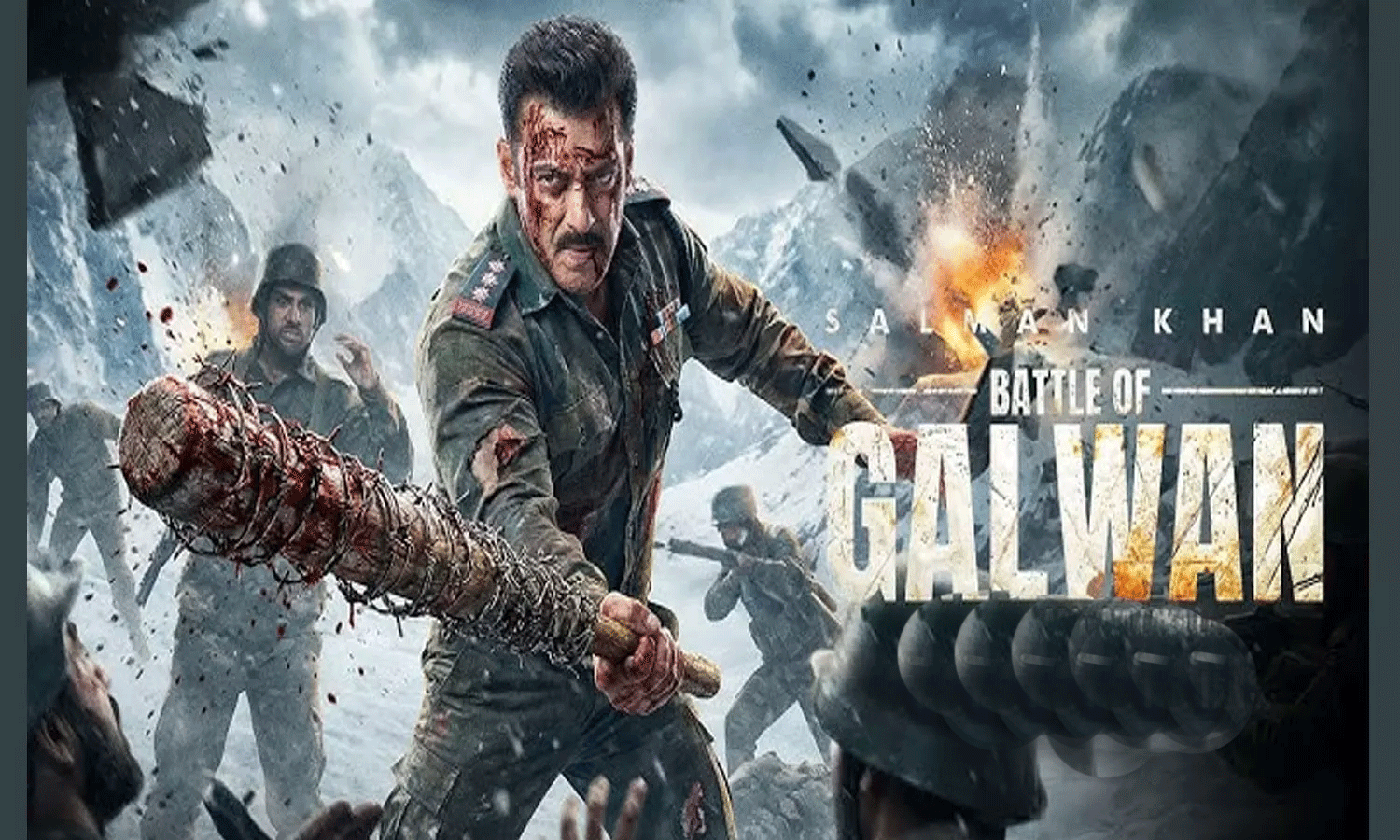
Salman Khan’s upcoming movie, Battle of Galwan, the teaser of which was recently released, has brought the infamous Galwan clash of 16 Jun 2020 back into focus. The cause of tensions in 2020 was Indian construction of infrastructure in Eastern Ladakh, which the Chinese assumed as a threat to its supposed claims. Since then, Indian infrastructure build-up has continued unabated.
The film is scheduled for release on 17th Apr 2026. China fears that the movie, based on a detailed historical study of Galwan as also the clash, would bring to fore facts behind the incident, which China had been lying about all along. Its government mouthpiece, The Global Times wrote a scathing article just on the teaser.
Not only the Global Times, but also Chinese paid mouthpieces and bots on social media are screaming against the teaser claiming it is not factual. They are posting fake videos hoping to convince the public that what would come in the movie would not be the truth. All this only on the release of a teaser. Wonder what they would do when the movie is shown in theatres across the globe.
The Global Times article mentioned, ‘The film’s theme and timing are inappropriate, as it presents only a one-sided Indian narrative and stokes antagonistic sentiment, at a time when China-India relations have only recently shown hard-won signs of easing.’ The Chinese rag also attempted to project Salman Khan as an actor who plays ‘roles that appear too invincible, with plots too simplistic, and visual effects so exaggerated that make the drama seem unreal.’ The article appeared to highlight that China expects the film to project them in bad light.
The Global Times article possibly had a two-fold purpose. The first was to defend the Chinese position that Galwan was on their side of the LAC and it was Indian troops which crossed and initiated the scuffle. It extensively quotes their spokesperson who had defended the Chinese narrative, which India has disagreed to.
It is known that China infiltrated across the LAC and built a post in Galwan, which was subsequently earmarked as a buffer zone, post discussion between commanders on both sides. It was to enforce its destruction and vacation by Chinese soldiers that Col Santosh Babu led his men to Galwan. His intent was peaceful and the soldiers unarmed. However, they were ambushed and the clash that followed was orchestrated by the PLA, in which, Indian troops who were waiting behind rushed to join. The fighting was furious with casualties on both sides.
The second purpose was that China announced, after months of silence, that it suffered only four casualties, questioned by many, including its own bloggers, who were arrested and are currently undergoing long prison sentences, on grounds of insulting the PLA. The number of Chinese helicopters ferrying their dead and wounded throughout the night itself indicates far more casualties. Global estimates vary from 45-100 Chinese dead and wounded. A few days later there were unconfirmed reports of the PLA covering its casualty figures by mentioning deaths of soldiers in a fake bus accident.
The CCP has been struggling to hide their losses in every war or clash that involves its PLA. Even after decades, it fears releasing true losses. The reason is that the Chinese are averse to receiving body bags, especially as most families continue with the one-child norm. Further, admitting true losses in Galwan, which are higher than India, would impact the global standing of the PLA.
The Indian government’s response to the Chinese screaming on the teaser was mature. A spokesperson mentioned, ‘India is a country with freedom of expression, and cinematic expression is an integral part of it. Indian filmmakers are free to make films as per this artistic freedom. Those who may have concerns on this particular film are free to approach India’s Ministry of Defence for any clarifications. Government has no role to play in this film.’ The Chinese are bound to raise their concerns on the movie through diplomatic channels as the release date draws close, which will be ignored.
If just a trailer could cause such panic, wonder what would be the reaction of Chinese mouthpieces and fake social media activists when the film is finally released. It would task every single social media influencer and YouTuber on its payroll as also its proxy writers in western media to discredit the film. Pakistan paid handles would join the game. The end result would be the same as with the recently released film Dhurandhar. Those paid to criticize it, including social media influencer Dhruv Rathee, only pushed the film at the box office.
While the film would be banned in all Chinese territories as also nations where it has a major hold, it is likely to do well in other parts of the world, including the west, as also subsequently on OTT. Chinese overseas citizens would watch the same and convey their inputs to relatives back home. This would expose Chinese lies on the incident. It was concern of truth emerging that compelled China to play the bonhomie and normalization card as an excuse to have the film banned.
Indians, especially after the Chinese screaming and howling, eagerly await the film’s release. It is likely to be the next blockbuster, thanks to Chinese media. The makers of the film must ultimately thank the Chinese for their success. It will be interesting to watch Chinese mouthpieces commenting on the film, soon after its release, many even without watching it.
The author is Major General (Retd)
 Follow our WhatsApp channel
