

Dr Bharti Gupta
bharti.ttm@cujamm.ac.in
The history of Jammu and Kashmir, often narrated through chronicles of kings, conquests, and political upheavals, carries within it another equally compelling narrative – that of women who shaped the region’s political, spiritual, and moral landscape. From formidable queens who governed with authority, to mystic saints who redefined spirituality, poetesses whose lyrical voices continue to echo through centuries, academician and social activist who touched life of many not only through intellect but also compassion, women have played a profound role in the historical evolution of this Himalayan region. Their contributions, though sometimes overshadowed in mainstream historiography, remain integral to understanding the cultural and civilizational fabric of Jammu and Kashmir.
The royal authority and political acumen were represented by Yashovati, Sugandha and Didda. Chronologically, the trajectory moves from symbolic early authority (Yashovati) to transitional regency (Sugandha) to assertive sovereign monarchy (Didda). Yashovati belongs to the early traditional accounts of Kashmir’s dynastic history, often linked to the Gonanda lineage. Her narrative is embedded in mytho-historical tradition, where legend and history overlap. Her authority is portrayed as stabilizing succession during uncertain times. She represents the conceptual acceptance of female rulership within early political imagination, even if historical details remain limited. While the historical details surrounding her life are interwoven with legend, her mention reflects the longstanding cultural memory of female sovereignty in the region.
Sugandha, who assumed power in the early 10th century following the death of her husband, King Shankaravarman. She initially ruled as regent for her minor son. After his death, she sought to continue as independent ruler. Her authority was more concrete than Yashovati’s but remained politically fragile. She faced resistance from feudal elites and was eventually deposed. Queen Sugandha occupies a distinctive place in the early medieval history of Jammu and Kashmir. Though her reign was brief, her assertion of power marked a significant moment in the region’s political evolution and contributed meaningfully to the historical understanding of women’s leadership in Kashmir.
Among the most powerful women in Kashmir’s early history stands Didda (10th-11th century CE). Often described as one of the most formidable monarchs in the region’s history, Didda ruled first as regent for her minor son and later as sovereign in her own right. Her reign reflects centralized control and political consolidation rather than symbolic or temporary power. Despite physical disability and political opposition, she consolidated power with strategic intelligence and administrative skill. Chronicled in Kalhana’s Rajatarangini, Didda emerges as a figure of both controversy and competence – a ruler who understood the complexities of court politics and statecraft. Her reign demonstrated that governance in medieval Kashmir was not exclusively a male domain. She demonstrated remarkable strategic intelligence in neutralizing rival nobles and strengthening central authority. Despite opposition from powerful feudal lords, Didda succeeded in curbing aristocratic dominance and reinforcing the monarchy.
These queens were not symbolic placeholders. They exercised authority, issued decrees, and influenced the political destiny of the kingdom. Their reigns complicate simplistic assumptions about women’s exclusion from power in early Indian polities and illustrate the distinctive socio-political texture of Kashmir’s past.
If queens shaped the political sphere, mystic women transformed the spiritual consciousness of the region. Foremost among them is Lalleshwari, popularly known as Lal Ded (14th century). A Shaivite mystic, Lal Ded composed vakhs – short, aphoristic poetic utterances that articulated profound metaphysical insights in the Kashmiri language. Rejecting rigid ritualism and social orthodoxy, she emphasized direct spiritual experience and inner realization.
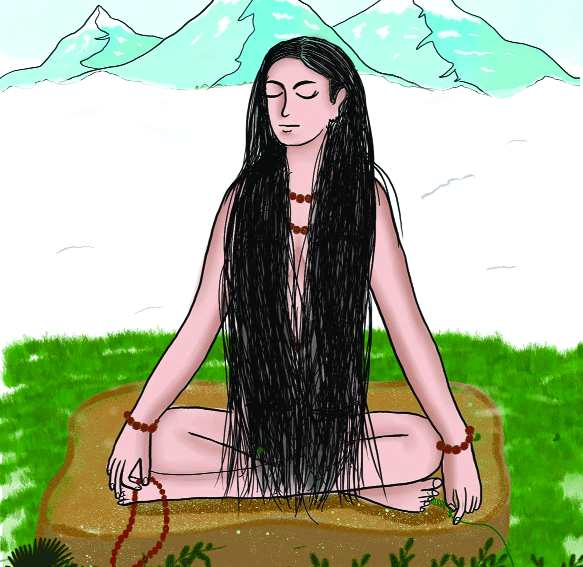
Lal Ded occupies a unique position in Kashmir’s history because she transcends religious boundaries. Revered by both Hindus and Muslims, her teachings influenced not only Kashmiri Shaivism but also early Sufi traditions in the Valley. Her poetry speaks of universal truths – the search for self, the futility of external dogma, and the unity of the divine. In a deeply patriarchal medieval society, her public spiritual voice was revolutionary.
Following Lal Ded in poetic and spiritual resonance was Habba Khatoon (16th century), often remembered as the “Nightingale of Kashmir.” Born as Zoon, she rose from humble beginnings to become queen consort of Yusuf Shah Chak. Her lyrical poetry, marked by themes of love, separation, and longing, captures both personal grief and collective memory. After her husband’s exile by the Mughals, Habba Khatoon’s verses transformed into poignant expressions of loss, symbolizing Kashmir’s own political sorrow.
These mystic and poetic voices demonstrate how women articulated philosophical reflection, emotional depth, and socio-political consciousness through literature. Their contributions were not confined to devotional expression but engaged with existential and communal realities.
The literary tradition of Jammu and Kashmir continued to carry forward the legacy of women’s voices into the modern period. Among the most significant figures is Padma Sachdev, whose work in the 20th century marked a renaissance for the Dogri language. Although belonging to a later historical phase, her presence in the continuum of regional literature connects ancient poetic traditions to contemporary expression.
Padma Sachdev became the first modern woman poet of Dogri to receive the Sahitya Akademi Award, bringing national recognition to the language of the Duggar region. Her poetry celebrates the rhythms of rural life, feminine sensibility, and regional identity. In many ways, she carried forward the courage and lyrical intensity of earlier women like Lal Ded and Habba Khatoon, ensuring that women’s literary voices remained central to cultural discourse.
Alongside literary figures, the modern history of Jammu and Kashmir has also witnessed women who have shaped society through social reform and cultural preservation. Among the most distinguished is Ved Kumari Ghai, a renowned scholar, educationist, and social activist from Jammu. Her work represents a vital bridge between intellectual scholarship and grassroots social engagement. A respected Sanskrit scholar and former academic associated with the University of Jammu, Ved Kumari Ghai has been widely recognized for her efforts in promoting education, women’s empowerment, and cultural awareness in the region. Beyond academia, she has actively engaged in social work, advocating for the preservation of linguistic and cultural traditions while simultaneously encouraging progressive social change.
In the broader historical narrative of Jammu and Kashmir, Ved Kumari Ghai represents the modern extension of the region’s long tradition of influential women. Just as queens like Didda exercised political authority and mystics like Lal Ded shaped spiritual consciousness, contemporary figures such as Ved Kumari Ghai demonstrate how women continue to influence society through scholarship, activism, and cultural leadership.
The region’s complex political history has often overshadowed its rich cultural heritage. By foregrounding women’s contributions, we gain a more holistic understanding of its past – one that acknowledges resilience, creativity, and moral courage.
These remarkable figures stand not merely as historical personalities but as enduring symbols of women’s empowerment in Jammu and Kashmir. At a time when women in the region are increasingly participating in governance, academia, literature, arts, and social leadership, the legacy of these pioneering women acquires renewed relevance. From queens who exercised political authority, to mystics who illuminated spiritual paths, poets who gave voice to the emotional soul of the land, and modern scholars and social activists such as Ved Kumari Ghai who continue to guide social thought, they collectively represent a rich continuum of courage, wisdom, and resilience. Their lives remind us that the history of Jammu and Kashmir has been shaped not only by political events and rulers, but also by women whose intellect, creativity, and moral strength have profoundly influenced the region’s cultural and social consciousness. In this sense, their legacy transcends time, serving as a powerful reminder that the quiet yet transformative contributions of women often strengthen the moral and intellectual foundations of society.
(The author is Professor, Department of Tourism and Travel Management, Central University of Jammu)
 Follow our WhatsApp channel
