

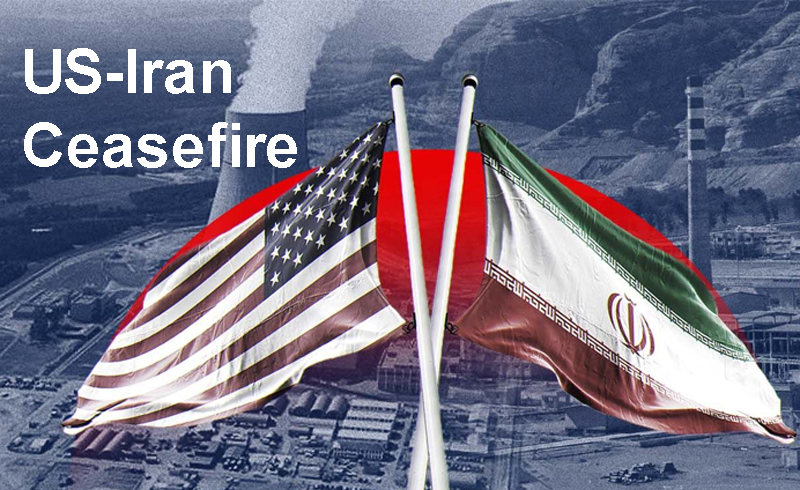
After 39 days of a war that shocked the world in its ferocity, spread and sheer economic devastation, the United States and Iran agreed to a two-week ceasefire – a fragile, contested and deeply provisional pause that, nonetheless, represents the most significant diplomatic development since hostilities erupted on 28th February. Better sense has prevailed, even if only partially. The initiative deserves acknowledgement, even as the world holds its breath about what comes next. This was never a conventional war. What began as a declared act of punishment – the US and Israel framing their assault on Iran as the long-overdue settling of accounts over Tehran’s nuclear ambitions, its ballistic missile arsenal and its network of regional proxies – swiftly transformed into something far messier and more consequential. Within days of the opening salvos, the Strait of Hormuz, through which 20 per cent of the world’s oil and natural gas passes, was strangled. From that moment, the war ceased to be primarily a geopolitical confrontation and became an economic emergency for the entire planet. The world’s supply chains convulsed. Freight rates soared. Energy markets went haywire. Stock markets shed billions in a matter of days. What started as a punitive campaign ended, in effect, as a desperate scramble to reopen a waterway.
The human and material toll is staggering. With millions displaced and the death toll yet to be calculated, the miseries are far from over. Across the Gulf Arab states, oilfields, gas processing facilities and critical infrastructure have been gutted by Iranian missile and drone attacks. When historians eventually tally the final accounting, the economic damage – across shattered oil fields, paralysed shipping lanes, collapsed investment sentiment, and pulverised Government finances – will run into the trillions of dollars. Every nation touched by the Strait’s closure has bled.
The ceasefire announcement brought oil prices down and Asian stock markets up within hours – a testament to just how badly the world economy needed any signal of de-escalation. Yet the relief is tempered by the extraordinary ambiguity of the terms, or indeed the lack of them. Washington and Tehran appear to be operating from different scripts. President Trump initially praised an Iranian ten-point plan as “workable” before calling it fraudulent without elaboration. Pakistan, which emerged as a mediator, declared the ceasefire immediate and inclusive of the Lebanon front – only for Israel’s Prime Minister Netanyahu to repudiate that interpretation within hours, vowing to continue operations against Hezbollah. As the ceasefire was being announced, missile alerts sounded across the UAE, Saudi Arabia, Bahrain and Kuwait. A gas facility in Abu Dhabi was ablaze. In Tehran, hardline demonstrators burnt American and Israeli flags and chanted, “Death to compromisers.”
The thorniest unresolved question concerns the Strait itself. Iran has announced that transit will resume under Iranian arrangement, with Tehran and Oman to levy tolls on passing vessels – ostensibly to fund reconstruction. This is an extraordinary assertion of sovereignty over one of the world’s most critical international waterways, one that upends decades of established practice. Whether the Gulf Arab states will accept this arrangement is highly doubtful. Whether Washington can persuade its regional allies to swallow an Iranian toll booth on the Hormuz Strait – with American warships, as Trump puts it, “hanging around” – is equally unclear. The Petrodollar order is already under strain: Iran has begun trading oil in Chinese yuan, and the coming months will reveal whether this represents a lasting structural shift or a temporary expedient.
The deeper questions are even harder. None of the core issues – Iran’s nuclear programme, its ballistic missile capabilities, its proxy network, its frozen assets, and the future of US forces in the region – have been remotely resolved. Washington and Tel Aviv went to war over these matters; they remain precisely as contested as they were on 27th February. The two-week window is a pause, not a settlement. What happens when it expires is anyone’s guess.
For India, the ceasefire brings a measure of relief that is real but insufficient. New Delhi had no direct involvement in the conflict, yet it suffered grievously. Billions were wiped from Indian equity markets. Both imports and exports were disrupted, with freight costs escalating sharply and supply chains for energy and commodities thrown into disarray. The Indian Government has wisely advised its citizens in Iran to use the ceasefire window to return home – a prudent precaution given how fragile the truce remains. Now, with Iran ready to resume oil supply, there is a strategic opportunity for New Delhi to renegotiate its energy partnerships, diversify its supplier base, and accelerate investments in storage capacity. The war’s central lesson for India – indeed for any open economy – is the catastrophic vulnerability that comes from over-reliance on a few trading corridors or single energy partners.
The conflict has exposed several other uncomfortable truths. NATO demonstrated alarming fractures: few member states showed any appetite for direct involvement, and the alliance’s cohesion – never unassailable – looked threadbare throughout. Iran’s military doctrine, built around drone warfare, missile salvoes and the strategic leveraging of the Hormuz chokehold, proved a sophisticated and effective deterrent as well as an offensive instrument – a case study in asymmetric statecraft that analysts and defence planners will be studying for years. Israel’s presumed invincibility was punctured, not broken, but the myth of effortless regional dominance is harder to sustain after 39 days of grinding attrition. And the United States, for all its military firepower, found itself manoeuvring – ultimately – to contain rather than conclude a war that it launched.
Both Washington and Tehran will claim victory, as protagonists invariably do. Both claims will be partly true and largely hollow. The Strait’s toll regime, if it holds, represents a tangible Iranian gain-but the reconstruction burden facing Tehran is enormous. Little has been truly won; much has been irreparably damaged. The world will not quickly return to where it stood before 28th February. Freight rates will remain elevated for weeks. Essential supply chains will require months of patient realignment. The geopolitical map has shifted: old alliances have been tested, new fault lines have appeared, and the architecture of Middle Eastern security will need to be substantially renegotiated. The clouds of uncertainty have not lifted – they have merely thinned enough to let a pale light through. That thin light matters. For now, the guns are largely silent. Reconstruction – of cities, of economies, of diplomatic relationships – can begin. The world hopes that those who pulled back from the brink on Wednesday will find, in the days and weeks ahead, sufficient wisdom and sufficient courage to stay back. One thing is certain: the world that emerges from this war will not be the one that entered it.
 Follow our WhatsApp channel
