

Excelsior Correspondent
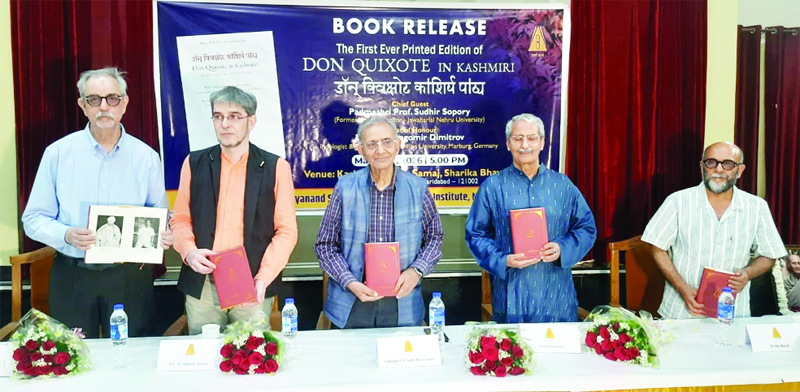
JAMMU, Mar 9: Nityanand Shastri Kashmir Research Institute (NSKRI), New Delhi, released the book “Don Quixote a Spanish Novel in Kashmiri” at Faridabad.
The programme was anchored by Ramesh Manwati. Archana Sopory recited the invocation prayer. This was followed by the traditional Kashmiri Vanavun by Archana Sopory, Pammi Dhar and Kiran Premi. The book was a tribute to the first Kashmiri spiritual saint – Laleshwari, popularly known as Lal Ded.
C L Kaul, a distinguished author on Kashmir and its traditions, delivered the welcome address.
The book is the first ever Kashmiri edition of the 17th century classic – Don Quixote which has the world record of having been translated into 700 languages worldwide. Noteworthy is that this Kashmiri translation was done as early as 1935-36 by the two eminent Sanskrit scholars of Kashmir – Prof Nityanand Shastri and Prof. Jagaddhar Zadoo.
The textulising assignment was taken up by Dr Surindar Nath Pandita, the grandson of Prof Nityanand Shastri, and Uma Kant Kachru. A significant value addition to the work was done by Prof (Dr) Dragomir Dimitrov, a well-known Indologist from Philips University, Marburg, Germany.
The book was released by Padmashri Prof. Sudhir Kumar Sopory, former Vice-Chancellor, Jawaharlal Nehru University who was the chief guest, Prof. (Dr) Dragomir Dimitrov and the eminent Kashmiri artist, Veer Munshi.
Anand Malviya – great-grandson of Pt. Madan Mohan Malviya – the great Indian Nationalist of the freedom Movement and the founder of Banaras Hindu University; Nitin Gupta – grandson of the former Prime Minister of J&K, Justice Mehar Chand Mahajan; the three grandsons of Nityanand Shastri – Brigadier Autar Krishen Pandita, Commodore Lalit Shankar and Sushil Kumar Pandita.
While speaking at the function, Dr Surindar Nath Pandita detailed the historical journey of the manuscript of the translation from 1936 until its release date on March 8.
Uma Kant Kachru gave the overview of the standardised Devanagari script, now being used on Google keyboard, Windows and iOS devices which is UNICODE compliant and is seamlessly transportable across digital devices.
The audience was overawed by Prof Dragomir’s presentation on the history and evolution of the special Schlegel font in the last two hundred years and his contribution to make it available in the digital form in collaboration with Kishor Patil of C-DAC, Pune.
The function concluded with a vote of thanks by Uma Kant Kachru.
 Follow our WhatsApp channel
