

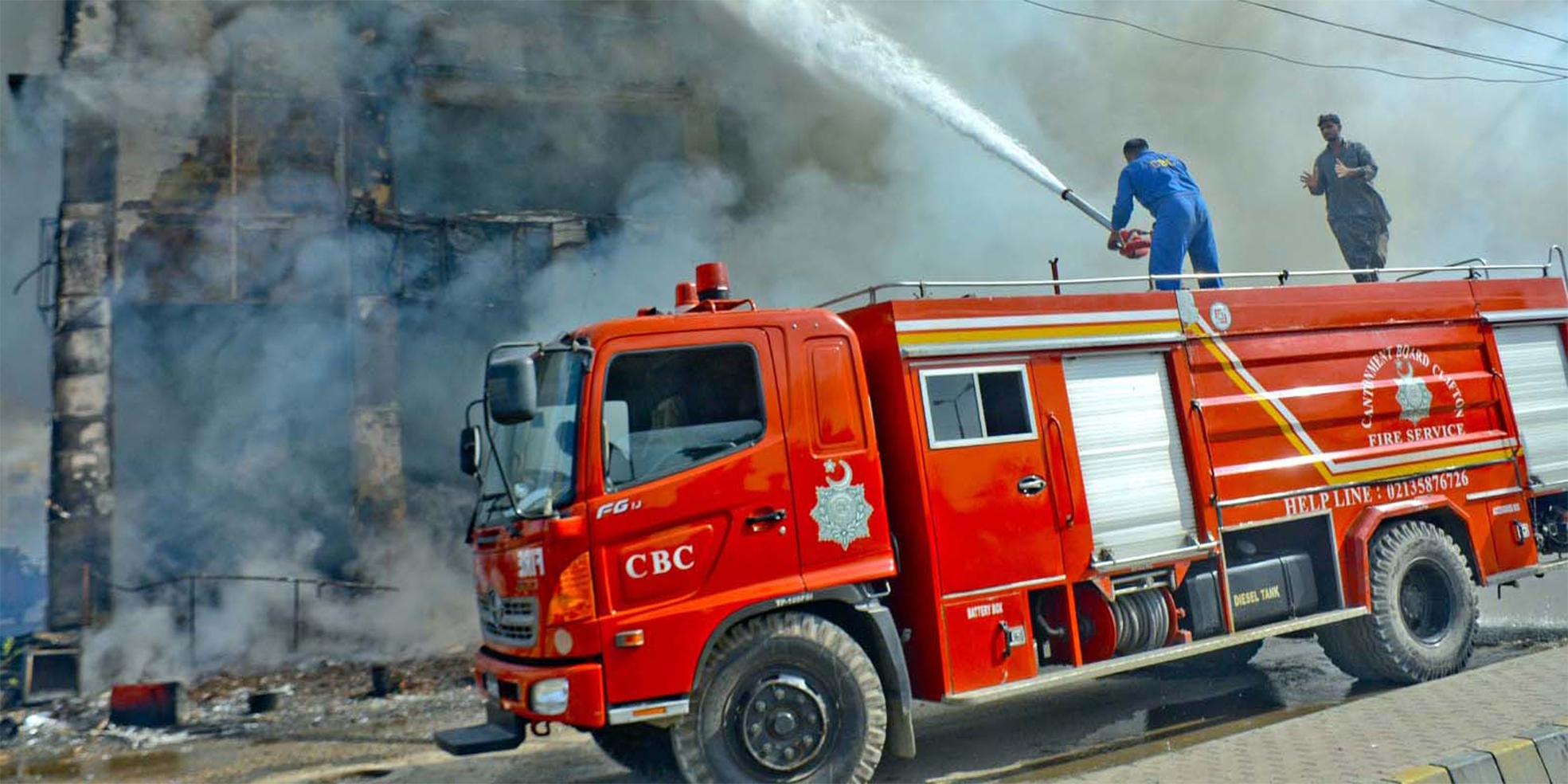
Karachi, Jan 21: Humayun Khan, Chief Fire officer in Pakistan’s Karachi, has seen several emergencies in his more than three decades long career but said on Wednesday the Gul Plaza tragedy that claimed 30 lives affected him deeply.
“This incident has shaken me deeply,” Khan from the Karachi Metropolitan Corporation’s fire brigade, said as he monitored the rescue operations three days after the inferno almost brought down the multi-storey building.
The fire broke out in the basement of the Gul Shopping Plaza, a wholesale and retail market, and quickly spread to the rest of the building in the Saddar area on Saturday night. The fire was brought under control only after nearly 36 hours.
Sindh police surgeon, Dr Summaiya Syed confirmed that the death toll from the fire had risen to 30 as two more bodies were recovered on Wednesday from the rubbles of the nearly 45-year-old building.
“We have been able to identify just 10 bodies as yet as the remaining bodies are badly burnt,” she said.
For years citizens, civil activists, doctors, jurists, the media and opposition politicians have talked about the lack of proper civic facilities in the city but a few weeks after every tragedy, everything is forgotten.
Karachi, a vibrant financial capital of Pakistan with over 20 million people is spread over 3,530 square kilometers but has just 57 fire engine trucks, 28 fire stations and five ladder trucks to deal with any fire emergencies.
“Everyone blames the fire services but we are working with only 28 fire stations and 57 fire engine trucks,” Khan told PTI on Wednesday.
“I am not a political person and I have no agenda but we are running 28 fire stations on a budget of 21 stations… Where we need hundreds of fire engines and ladder trucks, we have to manage with dozens,” Khan lamented.
He believes that more fire engines, ladder trucks and snorkels, modern equipment and more trained manpower would allow them to deal more efficiently with fire emergencies like the one in Gul Plaza.
“As a result, we have been working with what we have and since Saturday my men and rescue teams have not gone home,” he said.
Khan cautioned that it could take another 10-15 days before the rescue operation to locate missing persons is completed at the perished Gul Plaza Shopping Mall. The building has been destroyed, there is rubble everywhere and at many places, it is still very hot.
The cooling period will take a long time and this will hamper rescue operations, he said.
“They are people trapped inside because we have seen flashlights from some parts totally buried by rubble and even screams and we are trying to get to them first,” he added.
But it is not just the lack of manpower that led to the huge toll. Rescue workers also point out the lack of fire protocol at such places that see massive footfalls.
Fawad Memon, who is among the hundreds of workers involved in the rescue operations, said the shopping plaza had 28 exits but when the fire broke out around 10.00 pm on Saturday night, as many as 25 exits were closed as this was a routine for the building staff.
“People who were still inside and the shopkeepers used just three open exits. Perhaps if people had been more attentive and opened the other doors, casualties could have been much lower and more people rescued quickly,” he rued.
The Gul shopping plaza is not the first fire tragedy witnessed in Karachi. In 2012, nearly 260 people were killed when a fire broke out in a garments factory in Baldia town.
Independent investigations into the horrific incident confirmed the factory lacked proper safety fire measures, fire fighting emergency equipment, proper exits and also had an unsafe electrical system which is a common problem with most commercial buildings in Karachi.
The plaza was a popular shopping destination for every class of people as it offered wholesale and retail prices and housed multi items from traveling bags to garments. It had shops for decorations, furniture, kitchen items, shoes, perfumes, flowers etc.
Common people and small shop owners had already started shopping and bulk buying ahead of the holy month of Ramazan a month away.
A visit by this correspondent to the site, once a hustling-bustling commercial centre on Wednesday at about 3.00 pm, showed fire continued in some parts of the building with heavy smoke still coming out of the rubble and ruins of the old, dillapidated building.
Police and paramilitary Rangers have cordoned off the roads in front of the perished plaza but anxious families of those missing or unaccounted for are not willing to move from there.
Chacha Yaqoob, (52), is waiting anxiously to find out if his three sons aged between 17 and 13 are still alive as they worked at two shops in the plaza.
“Their mother has stopped eating or drinking water. All three brothers were at the plaza when the fire broke out. We just want to know whether they are dead or alive,” he said, tears welling up.
Ume Kulsoom had come with her husband to find out if she could recover anything from the rubbles from a garments and decoration shop she and her husband had been running in the plaza for the last 15 years.
“We had got stocks worth lakhs of rupees recently because of the Eid season and all of it perished,” she said.
Kulsoom, however, said she is thankful to Allah that she along with her husband and two children was able to get out of the building on time. The family had shut their shop for the day and were about to leave when heavy smoke started building up in many parts of the plaza.
“We were on the first floor and we were finding it difficult to breathe. We left everything else, just took our children and found the nearest exit,” she recalled the horrifying moments. (Agencies)
 Follow our WhatsApp channel
