

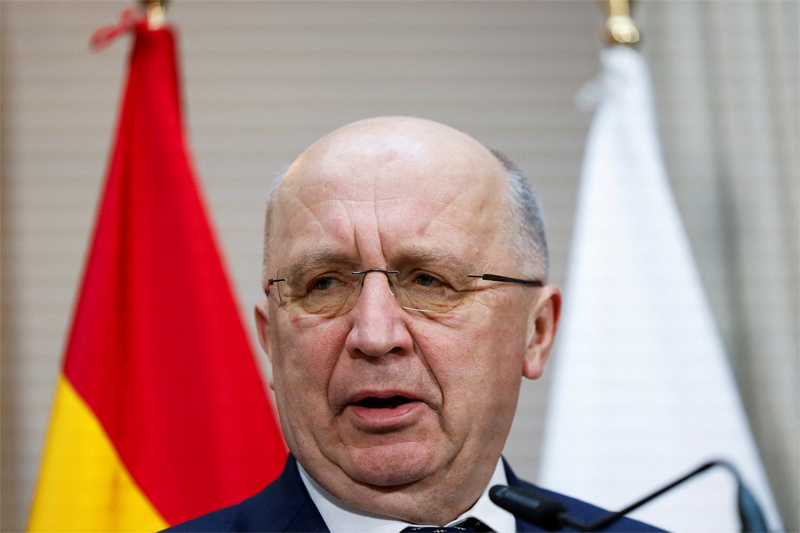
BRUSSELS, Sep 24: Amid renewed calls from the European members of the NATO for the construction of a ‘drone wall’ – in light of Russian breaches into Lithuania, Estonia, and Poland – EU Defence Commissioner Andrius Kubilius said that Europe currently lacks the capability for drone detection, calling construction of any such wall now unrealistic.
Speaking to Euroactiv, he argued that the EU could significantly improve its drone detection capabilities within a year but it will take much longer to develop a full network across land and sea able to even track them, and maybe longer for neutralising targets.
The concept of a European “drone wall” gained rapidly massive traction following calls by European Commission President Ursula von der Leyen for its construction, making the proposal a centrepiece of her September State of the union speech, stressing the urgency of closing the gaps in Europe’s air defences.
“We need to understand that we lack capabilities to detect drones,” Andrius Kubilius said at the launch of Euractiv’s new daily defence newsletter, Firepower, on Tuesday.
“Maybe we have good capability to detect air fighters and missiles, but drones have specificity – they are flying very low, they are small.”
The first step is to “quickly” get detection systems, which he said can be done. Experts say such a system could be ready in “somewhere around a year” to be ready to fend off Russian attacks and “provocations”, he said.
Kubilius pointed to Ukraine’s military – which he said should be used by the EU as a model for this purpose – calling to attention its use of acoustic sensors to identify incoming unmanned aerial vehicles that evade traditional radar.
Lasers, he added, could offer a cost-effective means of destroying drones once detected, though a comprehensive system capable of tracking and neutralising them on the ground would take longer to develop.
The need for European maritime security was noted to be of paramount importance, amid Monday night’s drone incursions into Norwegian and Danish airspace, which only highlighted the sheer scope of the challenge ahead.
Investigations into those latest incursions have not yet revealed a perpetrator, with the Danish police saying only that they must have been carried out by a “capable actor”.
Even so, Copenhagen has been added to the Commissioner’s call list alongside eastern frontier states to be consulted on the Commission’s drone defence plan.
A proper detection system could be done quite quickly: “somewhere around a year”. But it will take much longer to develop a system that can track and destroy targets on the ground, he said.
Financing remains central to the project. Robert de Groot, vice president of the European Investment Bank with responsibility for defence and security, told the event that discussions were underway on prioritising funds for eastern member states.
Investments, he said, would need to cover not only drone detection systems but also wider military infrastructure, including bases and logistics.
“We need to get the stuff from one side of Europe to the other side of Europe, mostly from west to east but also from north to south,” De Groot stressed, highlighting the importance of improving military mobility for tanks, equipment and troops.
The proposed “drone wall” thus combines immediate detection measures with a longer-term push to strengthen Europe’s military backbone, reflecting a broader recognition that the bloc must adapt quickly to new security threats.
(UNI)
 Follow our WhatsApp channel
