

Excelsior Correspondent
NEW DELHI, Nov 26: Union Minister of State for Science & Technology; Minister of State (Independent Charge) for Earth Sciences; MoS PMO, Personnel, Public Grievances, Pensions, Atomic Energy and Space, Dr. Jitendra Singh today reiterated the growing popularity of the “Entrepreneur-in-Residence” (EIR) Programme among young Startups, innovators and researchers, calling it a cornerstone initiative that is reshaping India’s biotechnology innovation ecosystem.
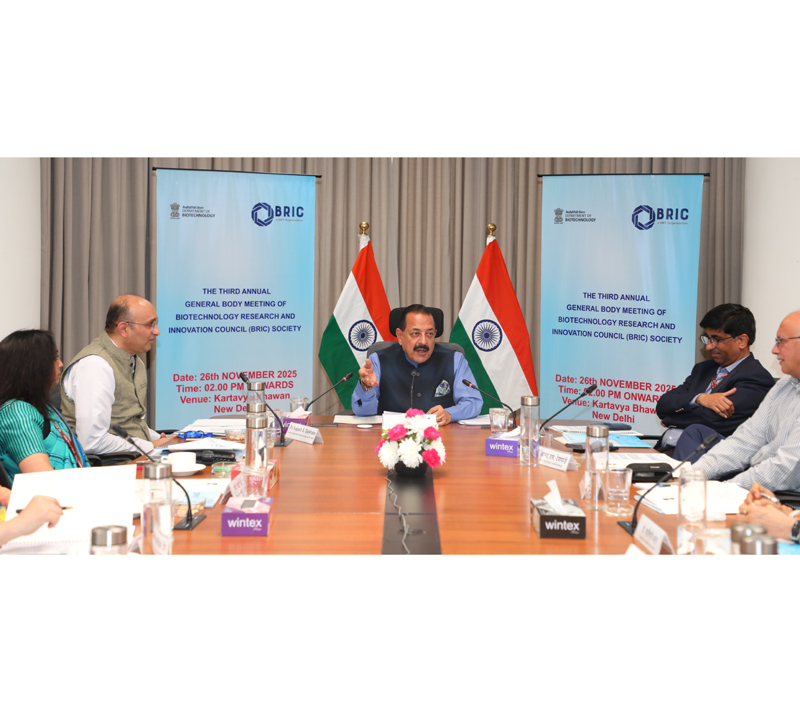
Speaking at the third Annual General Meeting of the Biotechnology Research and Innovation Council (BRIC) held in New Delhi, Dr. Jitendra Singh said the EIR initiative is successfully cultivating a new generation of scientist-entrepreneurs who combine academic excellence with a problem-solving, market-oriented approach to research.
The Minister emphasised that the EIR programme, designed to bridge the gap between research and enterprise, has attracted active participation from the private sector and venture capital investors, catalyzing technology translation, and startup creation from within India’s public R&D ecosystem. “The Entrepreneur-in-Residence programme has given a new momentum to the entrepreneurial culture within our research institutions. It encourages young scientists not just to discover but to deliver- to transform their ideas into innovations that touch lives and contribute to India’s biotech growth story,” he remarked.
Emphasizing BRIC’s role as a model of institutional collaboration, the Minister said that the Council’s creation has been one of the most successful structural reforms in India’s scientific ecosystem. “BRIC was the first experiment in the entire government setup of bringing together multiple research institutes under a unified umbrella,” he noted, adding that this collaborative framework has now inspired similar initiatives across other scientific ministries.
Dr. Jitendra Singh also emphasised the importance of expanding interdisciplinary and cross-sectoral partnerships to accelerate discovery and innovation. He suggested extending BRIC’s training programs to include intra-science, extra-science, and extended collaborations, linking not only various branches of science but also educational institutions and private industry partners. He cited ongoing trials and projects being conducted in partnership with non-government entities like Christian Medical College and Apollo Hospitals as successful examples of such integration.
Highlighting the integration of Artificial Intelligence (AI) into biological research, Dr. Jitendra Singh said India is already aligning with global best practices in AI-driven biosciences. He encouraged researchers to enhance outreach and collaboration by preparing informative content and strengthening digital communication between institutes.
The Minister appreciated the progress made through BRIC’s i3c PhD Programme, which is now in its second year with over 120 students trained to address challenges in healthcare, agriculture, industrial biotechnology, and green energy. He noted that the programme embodies the spirit of “Team Science” by nurturing problem-solving skills and an innovation-driven mindset among doctoral researchers.
The Minister concluded with a call for continued collaboration and proactive engagement among research institutions, the private sector, and global partners to make India a true Vishwa Bandhu in biotechnology. He also released the ‘BRIC Annual Report 2025’ and a booklet titled ‘Catalyzing Innovation: BRIC Networked Interdisciplinary Research Programs’, highlighting the council’s achievements and future roadmap.
 Follow our WhatsApp channel
