

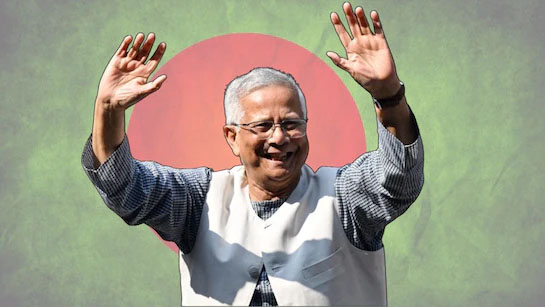
DHAKA, Mar 3: Bangladesh’s former interim government chief Dr Muhammad Yunus, is not at ease even after leaving office. President Mohammad Shahabuddin has brought allegations against him not only of establishing mob rule but also of violating the Constitution. Serious irregularities, inconsistencies and the creation of mobs have also been alleged against several of his advisers. Political turmoil erupted after the publication of the interview in a national daily. Demands have been raised for filing cases against Yunus and his associate advisers on charges of constitutional violation. A fresh debate over Yunus has begun in Bangladesh.
In two recent rounds of interviews, President Md Shahabuddin raised a number of allegations. The ruling Bangladesh Nationalist Party (BNP), however, has not spoken publicly on these issues. Instead, Prime Minister Tarique Rahman was seen meeting the President.
According to analysts, the President’s remarks are not merely administrative dissatisfaction; rather, they raise serious questions about the constitutional legitimacy and operational methods of the interim government. The interim government led by Muhammad Yunus not only exceeded procedural limits but also effectively attempted to render the constitutional position of the President ineffective. The President was virtually confined for 18 months. He was not allowed to undertake foreign visits. His photographs were removed, and he was humiliated. There was even an attempt to take control of the President’s residence. He handled everything with patience and composure, and spoke out only after Yunus’s departure.
The President has alleged that during Yunus’s rule the Constitution was not properly followed. After the dissolution of Parliament, ordinances are to be promulgated through the President. But according to him, several ordinances were issued without his full consultation or adherence to formal procedures – an unprecedented and negative example. He was not even informed about procurement-related agreements with the United States.
The President was allegedly kept “in the dark” regarding all state affairs. He was not allowed to hold programmes on national days. He was prevented from offering Eid prayers at the National Eidgah. His personal press wing was withdrawn.
As Head of State, being informed about foreign policy, high-level appointments, administrative restructuring or security-related decisions is part of constitutional decorum. Yet he was not informed about important policy steps. This was not merely a lack of coordination in the state structure, but could be considered a deliberate attempt to curtail the President’s role – something a Chief Adviser cannot do.
The gravest allegation is that attempts were made to force the President to resign. He hinted that a certain quarter was planning alternatives regarding his office. The office of the President is constitutionally defined, and the process for removal is clearly specified. If any attempt was made to bypass formal procedures through political or administrative pressure, that would be a direct violation of constitutional order. By placing the Head of State in uncertainty, any government calls its own legitimacy into question. For this reason, many are demanding trial of Dr Yunus and his legal adviser.
Another allegation concerns pressure to declare a state of emergency. According to the President, amid intense political unrest, he was asked to proclaim emergency rule. In South Asian political history, emergency provisions have often been used as tools for centralising power. If such pressure indeed came from within the interim administration, it indicates an abnormal consolidation of authority. The President claims he did not walk that path.
The political significance of these allegations is profound. Many say that Dr Yunus, though internationally well-known, changed after assuming power. He allegedly encouraged extremism in Bangladesh and played an authoritarian role. The interim government formed under his leadership crossed constitutional boundaries in exercising power. For this reason, many are now demanding his trial and calling for the President’s allegations to be taken seriously.
Writer Taslima Nasrin wrote on social media that former Chief Adviser Dr Muhammad Yunus and criminals like him should be in prison. She questioned why cases were not being filed against him on charges of sedition, attempting to erase the history of the Liberation War, colluding with Pakistan – the enemy of 1971 – and threatening to seize the Seven Sisters.
Yunus has now become a controversial chapter in Bangladesh. His 18 months in power severely damaged the state structure.
He began his journey by pressing a “reset button” and allegedly attempting to turn Bangladesh back into East Pakistan. He created mob rule and destroyed the rule of law.
Taslima Nasrin was right, many argue. The 18-month tenure of Dr Muhammad Yunus was experienced by the people as a land of mobs. There was no rule of law during this time. By creating mobs, anything could be done – murder, robbery, looting, land grabbing – and no one would question it. Accountability and rule of law disappeared. Extremist activities also continued during this period.
According to a Dhaka daily, three advisers of Yunus created these mobs to prolong their hold on power. Through mob mobilisation they wanted to remain in office. Ultimately, their conspiracy did not succeed. They had to relinquish power, bringing an end to the Yunus-era of mob rule.
In 2024, Yunus deliberately delayed assuming office. Between the announcement of responsibility on August 5 and the formal assumption of office on August 8, Bangladesh remained without a government for three days. During this administrative vacuum, law and order deteriorated drastically. Incidents of looting, killings, arson and attacks on opponents occurred. Many believe the interim leadership’s delayed role contributed to the situation.
Dr Yunus became Chief Adviser on the proposal of students. For this reason, critics say, he tolerated all their wrongdoings. He made no effort to restore normalcy in educational institutions after the movement and allowed street-based mob culture to continue. Incidents of lynching and organised violence created public panic. Human rights organisations reported a worrying increase in mob violence between 2024 and 2026.
Sharp controversy also arose over economic policies. Measures concerning his long-associated institution, Grameen Bank – including tax benefits, tax holidays and ownership restructuring – were allegedly taken in his own interest. The matter has been viewed as unethical or a conflict of interest for a powerful individual.
Soon after assuming office, he allegedly ensured financial benefits for his own institution. This created public suspicion about the connection between his personal past and official decisions. It is alleged that Yunus obtained 20 commercial licences, including in manpower export and universities, in the name of companies under his ownership – an unprecedented move.
He failed to establish rule of law. In 18 months, he accomplished no exemplary work, critics say. The country’s security situation remained concerning throughout. Attacks on police personnel, arson at police stations, looting of arms and violence against political activists made headlines. Allegations of attacks on minority homes and vandalism of places of worship drew international discussion. Journalists, writers, artists, poets and teachers were not only jailed, but records of false cases were allegedly set against them. Journalists were the worst victims of harassment. Questions were also raised about freedom of expression.
Dr Yunus acted whimsically in many matters. Though his chapter has ended, controversy has not. A Nobel laureate, after assuming power, complicated the rule of law, economic ethics, political tolerance and state continuity. By executive order, he banned the country’s main political force from politics. By keeping them out of elections, he left Bangladesh in a prolonged political crisis.
(UNI)
 Follow our WhatsApp channel
