

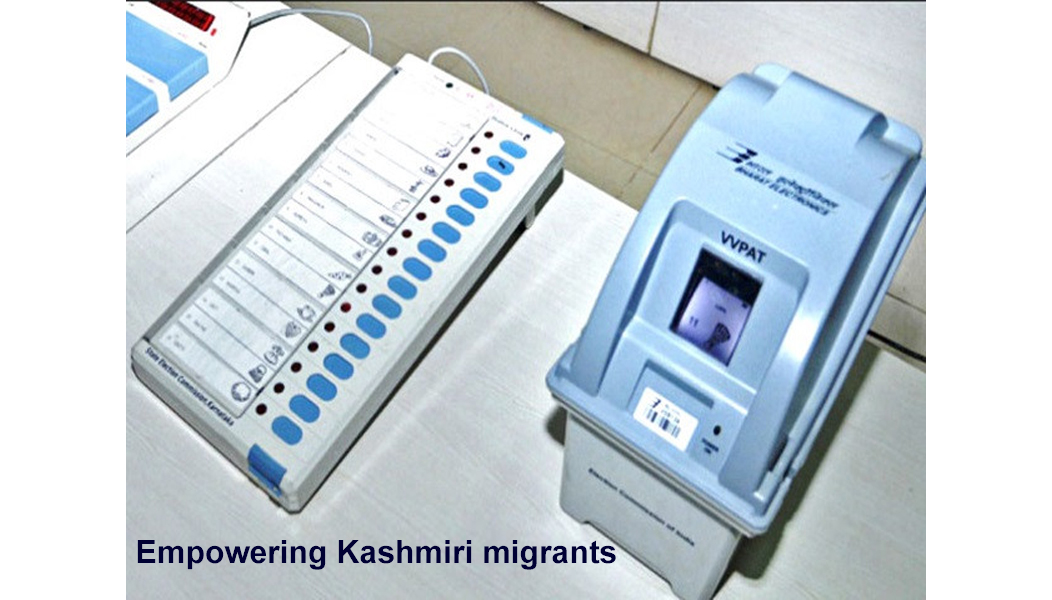
The decision by the Election Commission of India (ECI) to abolish the cumbersome M-Form procedure for Kashmiri migrants is a significant stride towards ensuring the democratic rights of all sections of society. This move, aimed at making the electoral process more inclusive and hassle-free, signifies a crucial shift towards recognizing and addressing the challenges faced by Kashmiri migrants in exercising their right to franchise. For decades, Kashmiri migrants have grappled with complex bureaucratic procedures, particularly the requirement of filling out M Forms, which often acted as barriers to their participation in the electoral process. The necessity of such forms not only posed logistical challenges but also symbolized systemic neglect of the voting rights of Kashmiri migrants. However, the recent decision by the ECI heralds a new era of inclusivity, where the voices of Kashmiri migrants are acknowledged and respected.
Under the modified voting scheme, Kashmiri migrant electors residing in various camps and zones in Jammu and Udhampur will no longer need to go through the arduous process of filling out M Forms. Instead, they will be mapped with special polling stations based on their registered zones of residence, streamlining the voting process and eliminating unnecessary bureaucratic hurdles. This pragmatic approach by the ECI not only simplifies the voting procedure but also demonstrates a commitment to address the concerns of Kashmiri migrants. Furthermore, the decision to allow self-attestation for filling out Form M for migrants residing outside Jammu and Udhampur, such as in Delhi or other parts of the country, is another progressive step towards ensuring accessibility to the electoral process. By replacing the earlier requirement of certification by Gazetted Officers with self-attestation, the ECI has removed an additional layer of administrative burden, thereby empowering Kashmiri migrants to exercise their voting rights more conveniently.
Moreover, the continuation of the postal ballot facility through Form 12C ensures that all migrants, regardless of their place of residence, have the option to vote by postal ballot. This provision not only caters to the diverse needs of Kashmiri migrants but also reflects the ECI’s commitment to accommodating various voting preferences and circumstances. The amended arrangement, which maps special polling stations to specific zones, underscores the ECI’s meticulous approach towards ensuring equitable access to polling stations for Kashmiri migrants. By ensuring that each zone has at least one special polling station and delineating intra-zonal jurisdictions, the ECI has prioritised the convenience and accessibility of electoral facilities for Kashmiri migrants.
The decision by the ECI comes in response to longstanding demands from Kashmiri migrants and advocacy efforts by various stakeholders, including political leaders and social activists. Sincere efforts, coupled with constructive dialogue with election authorities, have culminated in a significant policy change that addresses the concerns of Kashmiri migrants and fosters greater democratic participation. By eliminating barriers to voting for Kashmiri migrants, the ECI has sent a powerful message of inclusivity and equity in the electoral process. This decision reaffirms the commitment of Indian democracy to uphold the rights of all its citizens, irrespective of their geographical location or circumstances.
After the ECI’s progressive decision, it is incumbent upon all stakeholders, including political parties, civil society organizations, and the media, to ensure that Kashmiri migrants are effectively informed and facilitated to exercise their voting rights. According to records from the last election, although 17,000 M forms were issued, only 7 percent of those who received them actually voted. This low turnout is of great concern and must be thoroughly examined. Voting represents the most effective means to choose our representatives, and given the narrow victory margins witnessed in certain cases, the votes of Kashmiri migrants can potentially be decisive. The politicians, stakeholders, and ECI have diligently fulfilled their responsibilities by implementing necessary procedural changes. Now, it is incumbent upon Kashmiri migrants to seize this opportunity and exercise their valuable right to vote.
 Follow our WhatsApp channel
