

Situation under control: Officials
Suhail Bhat
SRINAGAR, Dec 14: A prolonged dry spell that began in early November has pushed Kashmir’s wetlands to significantly lower water levels, prompting authorities to take emergency measures to retain water in key habitats that host hundreds of thousands of migratory birds every winter.
Since November 5, Jammu and Kashmir has had virtually no rain, resulting in an 85.8% rainfall deficit. The Valley was supposed to receive 43.1 mm of rain during this time, but it received “almost nothing,” according to the Meteorological Department. Natural streams and springs that supply water to the wetlands have low discharge as the dry days persisted.
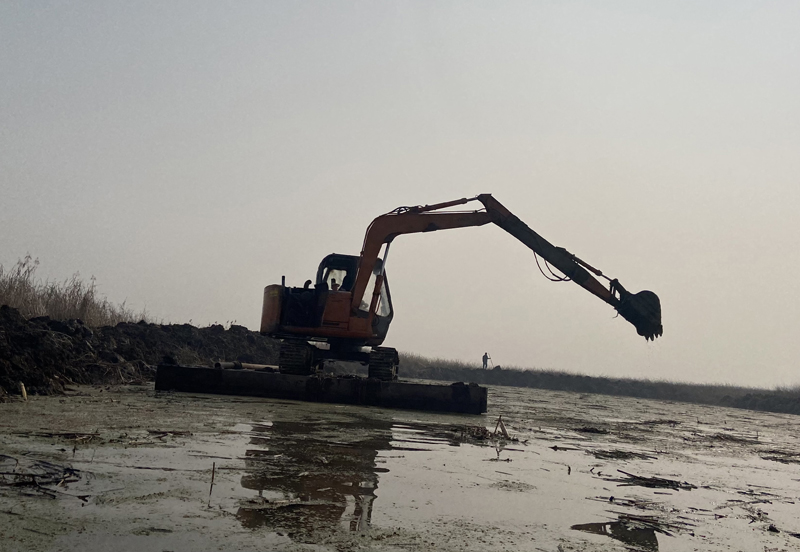
By the end of November, stress was evident in a number of wetlands. The wetland at Mirgund was “almost dry,” according to officials, as feeding channels dried up or became clogged. To stabilize the wetlands, wildlife officials took a number of immediate actions. To retain as much water as possible, all outlet gates at Hokersar, the biggest Ramsar site in the Valley, were shut early.
At Shalbugh and Hygam, authorities removed obstacles and sealed breaches in a similar manner. “We have 2 to 3 feet of water at the Ramsar sites after these measures,” Wildlife Warden Altaf Hussain said. “Mirgund is almost dry, and a restoration plan to revive its feeding channels is being prepared,” he added.
The migration starts in late September or early October and according to officials, Hokersar has already received close to 50,000 birds and has 7 to 8 feet of water. The birds have also started to arrive at other wetlands of the valley.
Long-term trends, however, continue to be concerning. In comparison to 2023, when the wetlands were home to 4.14 lakh and 4.96 lakh birds, respectively, the 2024 bird census found 4.21 lakh birds at Hokersar and 4 lakh at Hygam.
Environmentalists claimed that the Valley’s wetland ecology is changing as a result of human pressures, habitat degradation, and dry weather. They caution that during the past ten years, Kashmir’s wetlands have drastically changed.
According to an environmentalist, “There should be 70% water and 30% land, but it is the opposite now.” He listed the main causes of the change as decreased snowfall, retreating glaciers, dry springs, and unpredictable winters.
“Trash dumping near wetlands has also created new threats, attracting vultures and stray dogs that disturb migratory birds,” he said. He added that wetlands are the “kidneys of the biosphere,” and their boundaries should be clearly marked.
Authorities said extensive restoration under the Integrated Management Action Plan (2022-27) is in progress, targeting siltation, weed growth, encroachment, and pollution. But environmentalists argued that unless surrounding communities are made central to conservation efforts, long-term protection will remain difficult.
 Follow our WhatsApp channel
