

Excelsior Correspondent
JAMMU, Apr 4: Renowned orthopedic surgeon Dr Ranjit Singh has once again highlighted advancements in knee replacement surgery by successfully performing a rapid procedure using his innovative AI-powered 3D Robolens technique at IVY Hospital.
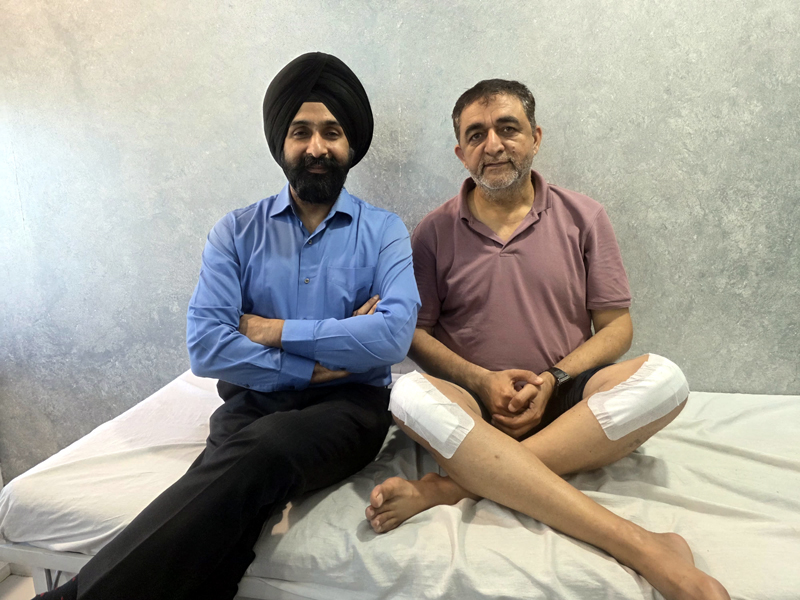
The latest case involved a 65-year-old patient, Pradeep Kumar from Jammu, who had previously sought treatment from multiple orthopedic specialists before consulting Dr Singh. Assuring a precise and effective outcome through the 3D Robolens method, the surgeon carried out the procedure in a remarkably short duration of just 20 minutes, marking a significant shift from conventional surgical timelines.
The patient’s recovery has been notably swift and encouraging. He reportedly began walking the very next day after surgery and resumed his normal daily routine within a week. Medical experts noted that such outcomes are uncommon in traditional knee replacement procedures, which often involve extensive muscle cutting, higher blood loss, and prolonged recovery periods.
Dr Ranjit Singh, who has an experience of performing nearly 20,000 surgeries over a span of 15 years, emphasized that the Robolens technique minimizes surgical trauma. According to him, the procedure involves minimal blood loss and avoids damage to muscles, enabling faster healing and reduced post-operative discomfort. Patients undergoing this technique are often able to stand and walk within two to three hours after surgery, with almost no visible pain, and can regain mobility, including climbing steps, within a few days.
Another major advantage of the 3D Robolens technique is that it does not require pre-operative CT scans or MRI imaging, making it more convenient and time-efficient for patients. Additionally, the risk of complications such as damage to blood vessels, nerves, or fractures is significantly reduced.
In contrast, conventional robotic knee replacement surgeries may involve insertion of long metallic pins into the bones, which can sometimes lead to complications and slower recovery. With its promising clinical outcomes and patient-friendly approach, the 3D Robolens technique is increasingly being adopted by surgeons worldwide.
 Follow our WhatsApp channel
