

Excelsior Correspondent
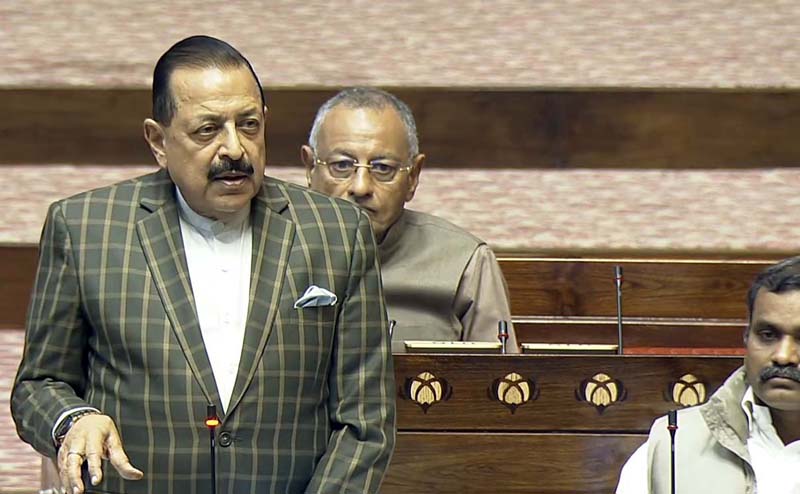
NEW DELHI, Dec 18: Following the passage of The Sustainable Harnessing and Advancement of Nuclear Energy for Transforming India (SHANTI) Bill, 2025 by the Lok Sabha, Union Minister of State (Independent Charge) for Science & Technology, Earth Sciences, and Minister of State in the PMO, Personnel, Public Grievances, Pensions, Atomic Energy and Space, Dr Jitendra Singh today participated in an extensive discussion on the Bill in the Rajya Sabha, clarifying key provisions, addressing concerns raised by Members, and firmly underlining that nuclear safety, national sovereignty and public accountability remain non-negotiable.
Dr Singh explained that the Bill consolidates and rationalises provisions from the Atomic Energy Act, 1962, the Civil Liability for Nuclear Damage (CLND) Act, and now accords statutory status to the Atomic Energy Regulatory Board, making it part of the parent legislation. This, he said, strengthens regulatory oversight rather than diluting it, and reflects India’s commitment to global best practices in nuclear governance.
Highlighting the changing global and technological context, Dr Jitendra Singh said that objections raised to nuclear reforms in 2010 must be viewed in the light of today’s realities, where technology, safety systems and global energy demands have transformed dramatically. Concepts such as Small Modular Reactors and Bharat Small Reactors, he noted, were unimaginable fifteen years ago, but are now emerging as safe, efficient, and flexible solutions for clean, 24×7 power generation.
Addressing safety concerns, the Minister categorically stated that nuclear safety standards remain unchanged and uncompromised, governed by the same stringent principles enshrined in the Atomic Energy Act of 1962- “safety first, production next.” He detailed the rigorous inspection regime, including quarterly inspections during construction, biannual inspections during operation, five-yearly licence renewals, enhanced powers to the now-statutory Atomic Energy Regulatory Board, and oversight aligned with International Atomic Energy Agency parameters. He further reassured the House that India’s nuclear plants are geographically located far from seismic fault zones and that radiation levels at Indian reactors are many times below prescribed global safety limits.
Dr Jitendra Singh also addressed public health apprehensions, stating that there is no scientific evidence of carcinogenic impact from Indian nuclear reactors. He cited radiation emission data in micro-sieverts, demonstrating that levels at facilities such as Kudankulam, Kalpakkam, Rawatbhata and Tarapur are far below permissible limits. He added that India has significantly upgraded cyber security safeguards in the nuclear sector, including encryption, secure coding, regular audits, malware filtering, and multi-layered digital protection, reflecting new-age threat preparedness.
He reiterated that the SHANTI Bill pertains strictly to civilian nuclear energy, with uranium enrichment levels limited to reactor requirements and completely unrelated to weapons-grade activities.
Outlining India’s long-term nuclear energy roadmap, the Minister stated that the country has already achieved nearly 9 GW of nuclear capacity, with targets of 22 GW by 2032, 47 GW by 2037, 67 GW by 2042 and 100 GW by 2047, contributing nearly 10% of India’s total energy needs.
Concluding his address, Dr Jitendra Singh said the SHANTI Bill reflects India’s confidence, scientific maturity, and readiness to lead responsibly in the global clean energy transition.
 Follow our WhatsApp channel
