

Excelsior Correspondent
NEW DELHI, July 30 : Union Minister of State (Independent Charge) for Science and Technology; Earth Sciences, and Minister of State for PMO, Department of Atomic Energy, Department of Space, Personnel, Public Grievances and Pensions, Dr. Jitendra Singh today congratulated scientists from ISRO and NASA on the successful launch of the NISAR satellite from the Satish Dhawan Space Centre, Sriharikota.
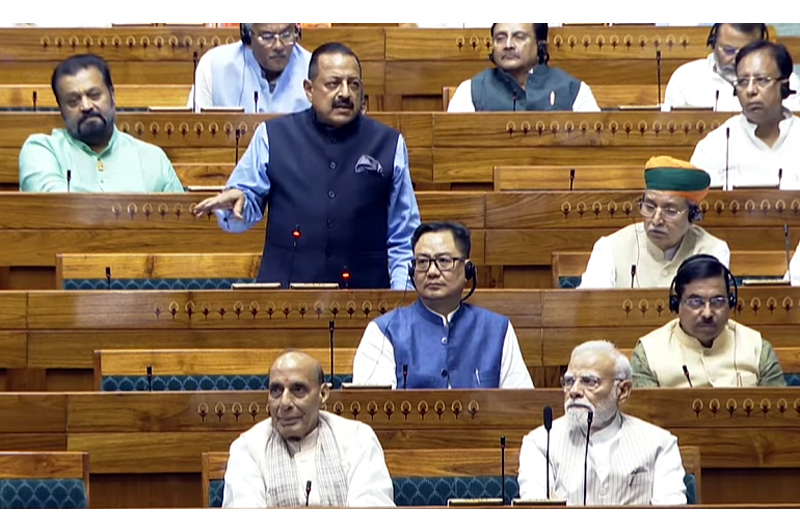
Earlier, while speaking in the Lok Sabha in response to a discussion on the Space sector, Dr Jitendra Singh said, “NISAR will be a game-changer in handling disasters, aviation, shipping etc”. It will deliver high-resolution, all-weather, day-and-night imagery of Earth’s land and ice surfaces, revisiting each location every 12 days, said the Minister.
Though Parliamentary responsibilities kept him in New Delhi, Dr. Jitendra Singh joined senior officials and scientists at the CSIR Auditorium to witness the historic launch via live telecast and applauded the flawless lift-off of the satellite aboard the GSLV-F16 rocket.
Describing NISAR as a “global benchmark” in Indo-US scientific collaboration, Dr. Jitendra Singh said the mission symbolizes the power of partnership between the world’s two largest democracies. “NISAR is not just a satellite; it is India’s scientific handshake with the world,” he said.
While NISAR’s applications in disaster management, climate monitoring, glacier tracking, and agriculture are well documented, Dr. Jitendra Singh emphasized that the satellite’s impact will extend far beyond.
“NISAR marks a striking shift in how we approach critical sectors such as aviation safety, maritime navigation, coastal management, and urban infrastructure planning,” he said. “The data from NISAR will serve as a backbone for smarter, science-driven decisions in shipping routes, air traffic systems, and even national infrastructure planning,” he added.
Dr. Jitendra Singh concluded by stating that under the visionary leadership of Prime Minister Narendra Modi, India’s space programme is evolving from utility-based missions to knowledge-based initiatives. “From Chandrayaan to NISAR, we are not only launching satellites-we are launching new possibilities for global science, sustainability, and shared progress,” he added.
 Follow our WhatsApp channel
