

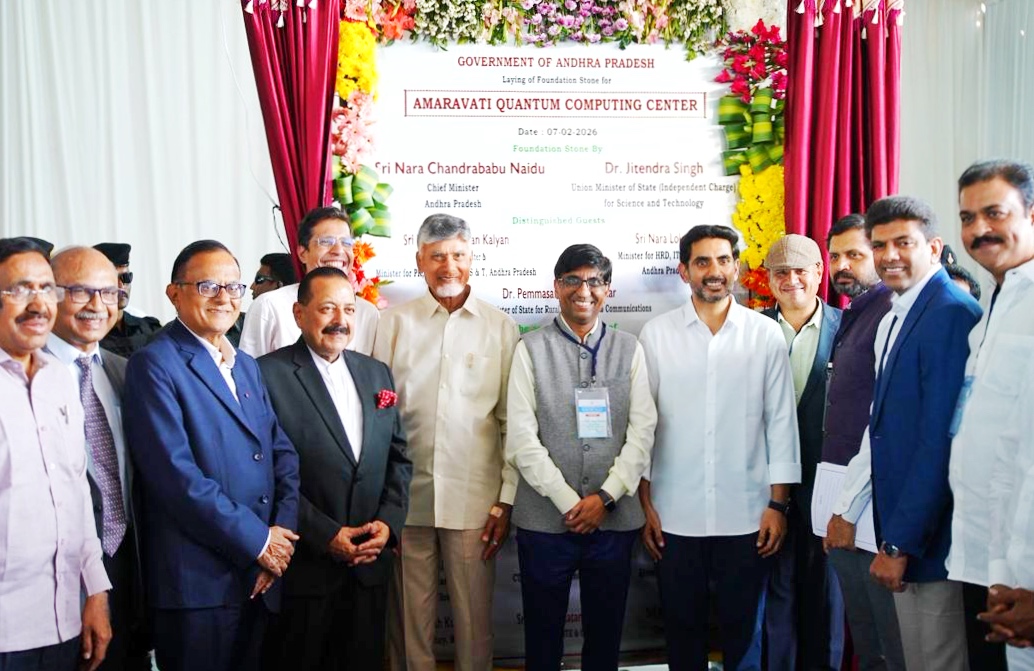
AMARAVATI, Feb 8 : Union Minister of State (Independent Charge) for Science & Technology, Earth Sciences, and MoS PMO, Personnel, Public Grievances, Pensions, Atomic Energy and Space, Dr Jitendra Singh today declared that “this is not merely the foundation stone of a building, but the foundation stone of India’s quantum future,” as he addressed the Foundation Ceremony of Amaravati Quantum Valley in Amaravati, Andhra Pradesh.
Describing quantum technology as a strategic necessity rather than an option, the Minister said India has no choice but to lead in this domain if it seeks to secure its communication systems, defence architecture, healthcare innovation and global technological standing in the coming decades.
The Foundation Ceremony of Amaravati Quantum Valley was attended by the Chief Minister of Andhra Pradesh N. Chandrababu Naidu, State Minister for IT, Electronics and Education Nara Lokesh, Principal Scientific Adviser to the Government of India Prof. Ajay Kumar Sood, Secretary, Department of Science & Technology Prof. Abhay Karandikar, Prof. V. Kamakoti, Director IIT Madras, senior industry leaders including Dr Amit Singhee (IBM Research India), Dr Harrick Vin (TCS), Mr M. V. Satish (L&T), senior state officials, faculty members and students. The event featured the unveiling of the foundation plaque, launch of the Amaravati Quantum Valley logo, launch of IBM and TCS Quantum Cloud Services, establishment of the IBM–TCS Quantum Innovation Centre, announcement of a Quantum Talent Hub, Quantum Reference Facility by SRM University, Quantum-Safe Applications initiative, and exchange of multiple MoUs with nine industry partners, marking a coordinated industry–academia–government partnership.
Dr Jitendra Singh expressed deep appreciation for the leadership of Chief Minister Shri N. Chandrababu Naidu, describing him as a leader who “lives in tomorrow and dreams of the day after tomorrow.” Recalling his early exposure to the Chief Minister’s technology-driven governance during the first term in Hyderabad’s Hi-Tech City, he said the rapid progress seen in Andhra Pradesh over the past year reflects the true spirit of cooperative federalism and what Prime Minister Shri Narendra Modi describes as the “double-engine” approach — alignment between the Centre and the State.
Referring to his visit to Visakhapatnam last week, the Minister cited the long-pending National Centre for Ocean Sciences project, conceived in 2006 and stalled for nearly two decades, which was completed within months after the present state government assumed office. The Centre will serve as a critical node for India’s Deep Ocean Mission, further strengthening the Blue Economy vision announced by the Prime Minister from the Red Fort.
Dr Jitendra Singh noted that India today stands among a select group of nations with a dedicated National Quantum Mission. With an allocation of approximately ₹6,000 crore, the Mission spans 43 institutions across 17 States and 2 Union Territories, organised through four thematic hubs focusing on Quantum Computing, Quantum Communication, Quantum Sensing and Metrology, and Quantum Materials and Devices. The national objectives include developing quantum computers with up to 1,000 physical qubits within eight years, establishing secure ground-to-ground quantum communication networks, enabling long-distance quantum communication, and achieving inter-city Quantum Key Distribution across 2,000 kilometres.
Addressing students present at the event, the Minister explained why quantum technology is central to the next industrial transformation. He stated that conventional computing and cybersecurity systems would remain vulnerable in a world where adversaries possess quantum computing capabilities. Quantum encryption, he explained, would make data virtually impossible to breach, potentially requiring astronomical timeframes to decode. In defence and cybersecurity, this offers unprecedented strategic protection.
He also spoke about transformative healthcare applications, including precision radiation therapies capable of targeting tumours without collateral damage, adapting dynamically to organ movement and enabling faster patient recovery. Quantum technology, he said, will similarly redefine satellite communication, secure communications infrastructure, and advanced sensing capabilities.
Dr Jitendra Singh observed that India may have entered the IT revolution later than some nations, but it will not repeat that delay in emerging technologies. With parallel missions in Artificial Intelligence, Biotechnology, Space and Deep Ocean exploration, India is positioning itself at the forefront of the next global technological wave. He referred to the recently announced BioPharma Shakti initiative and noted that the global economy is steadily transitioning toward biotechnology, regenerative cycles, genetic sciences, software-driven systems and quantum computing.
The Minister informed that India has already introduced B.Tech minors in Quantum Technology and is preparing to expand into M.Tech programmes. He discussed with the Chief Minister the possibility of launching structured quantum academic programmes in Andhra Pradesh, supported by trained faculty and institutional collaboration. He added that advanced fabrication facilities and central research infrastructure are being established and will be accessible to startups, researchers and academic institutions. He also acknowledged the pioneering Research Park model initiated by IIT Madras, now being replicated across the country.
Dr Jitendra Singh emphasised that the era of working in silos is over. The success of Amaravati Quantum Valley lies in integrating government, industry, academia and startups into a unified national effort. Opening the space sector to private players five years ago and expanding private participation in nuclear energy demonstrate the confidence of the present government in collaborative growth. India’s space economy has already grown from a fractional share to an $8 billion sector, with projections reaching $45 billion in the coming years due to this integrated approach.
Concluding his address, the Minister declared that India’s quantum journey begins from the sacred city of Amaravati and that Andhra Pradesh will serve as a springboard in India’s march towards Viksit Bharat. He assured full support from the Government of India for states that align their innovation ecosystems with national missions and reaffirmed that the collaboration between the Centre and Andhra Pradesh will accelerate India’s emergence as a global quantum leader.
 Follow our WhatsApp channel
