

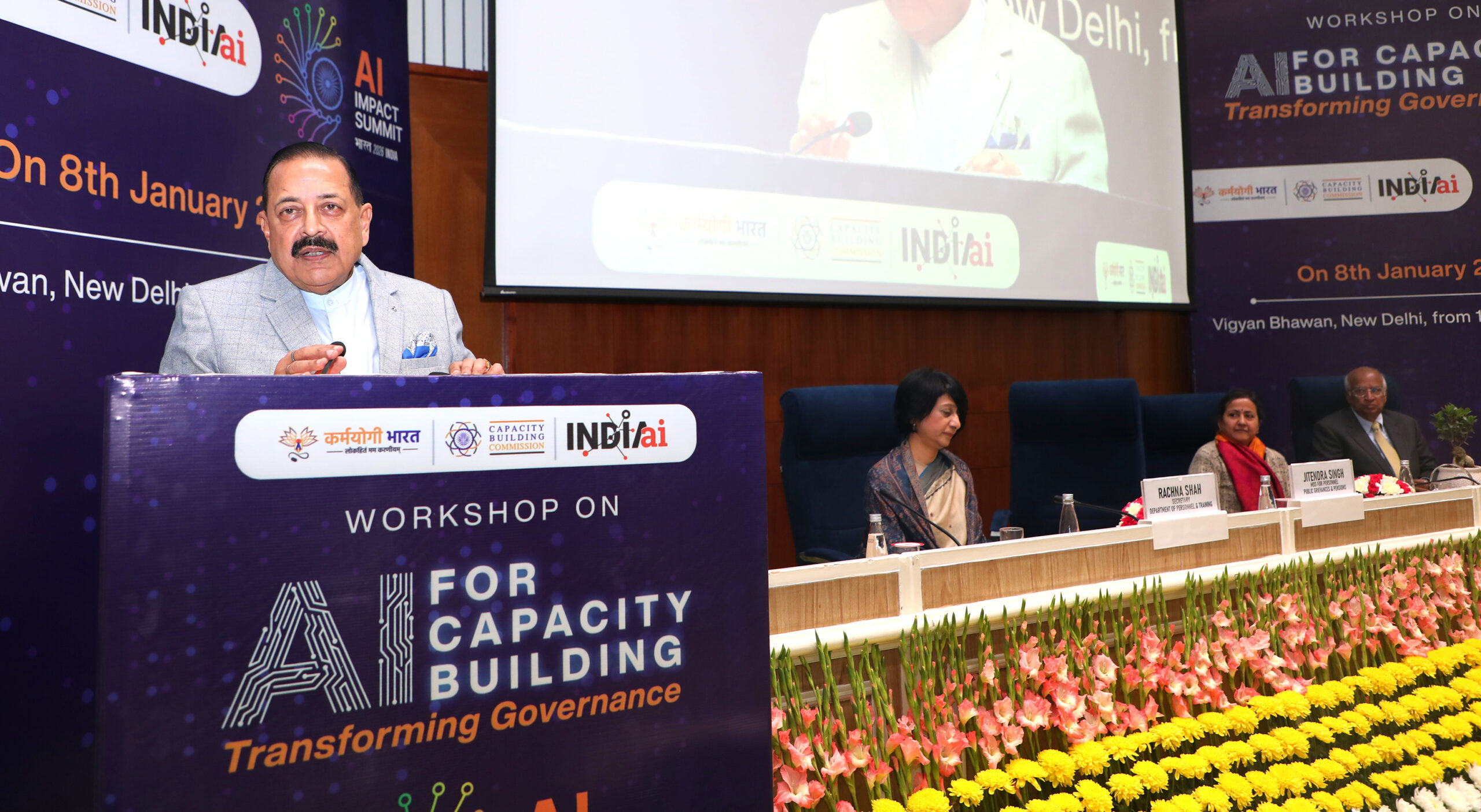
NEW DELHI, Jan 8 : Emphasising that capacity building in government must be a continuous and role-oriented process, Dr. Jitendra Singh, Minister of State for Personnel, Public Grievances and Pensions, said that the institutional framework for capacity building being implemented today is rooted in the vision of Prime Minister Narendra Modi, who recognised the need for a structured mechanism to prepare government officials for dynamically changing responsibilities.
These remarks were made at the event on “AI for Capacity Building: Transforming Governance”, organised by the Capacity Building Commission (CBC) and Karmayogi Bharat, in partnership with the IndiaAI Mission.
Dr. Jitendra Singh said that governance can no longer be confined to silos and rule-bound procedures alone. He said the iGOT Karmayogi platform represents a decisive shift from “rule to role”, enabling officers to approach their assignments with greater clarity, accountability and outcome-orientation. He underlined that while traditional systems helped officers qualify for service, they did not always prepare them for the actual responsibilities they assume, often across multiple sectors during their careers.
The Minister highlighted that Mission Karmayogi has evolved steadily, beginning with civil servants and gradually expanding to cover officials across ministries, departments and levels. He said the initiative has also been extended to newly recruited officers through Mission Karmayogi Prarambh, which is being offered along with appointment letters issued during Rozgar Melas, allowing officers to prepare themselves for real-world administrative challenges from the very beginning of their service.
Referring to the integration of Artificial Intelligence into the capacity building ecosystem, Dr. Jitendra Singh said that under the leadership of Smt. Radha Chauhan, Chairperson, Capacity Building Commission, the iGOT platform has adopted AI-driven tools such as AI Saarthi, AI Tutor and AI-based Capacity Building Plans. These tools, he said, are enabling personalised learning pathways, faster planning and improved delivery across ministries and departments. He emphasised that artificial intelligence must function as an enabler, working in tandem with human intelligence through a hybrid approach to strengthen governance outcomes.
The event was attended by senior dignitaries including Smt. Rachna Shah, Secretary, Department of Personnel & Training; Smt. Radha Chauhan, Chairperson, Capacity Building Commission; and Shri Subramanian Ramadorai, Chairperson, Karmayogi Bharat, along with senior officers from the Centre and States, representatives from academia, industry, training institutions and capacity building units across ministries.
Setting the context for the workshop, Smt. Chhavi Bhardwaj, CEO, Karmayogi Bharat, highlighted that iGOT has emerged as the foundational digital infrastructure for public sector capacity building, with over 1.5 crore learners and more than 6.7 crore course completions. Smt. Rachna Shah, Secretary, DoPT, emphasised that AI can significantly strengthen transparent, responsive and citizen-centric governance by improving relevance, timeliness and personalisation in capacity building, while underscoring the importance of ethical safeguards and inclusive access.
A key highlight of the event was the launch of “Karmayogi Classroom”, a new AI-enabled feature on the iGOT Karmayogi platform designed to enhance contextual, interactive and personalised learning for civil servants. The programme also featured live demonstrations and thought leadership sessions by leading AI ecosystem partners, showcasing AI tutors, AI-driven capacity building plans, competency mapping tools and indigenous AI solutions tailored for public administration.
Concluding his remarks, Dr. Jitendra Singh said that learning must remain a constant process in governance, as administrative challenges, citizen expectations and technological tools continue to evolve. He underlined that artificial intelligence should be seen as a powerful means, not an end in itself, and must always be guided by human judgement and responsibility. He added that a hybrid model combining Artificial Intelligence with human intelligence will be critical to building a future-ready, responsive and effective public administration.
 Follow our WhatsApp channel
