

Excelsior Correspondent
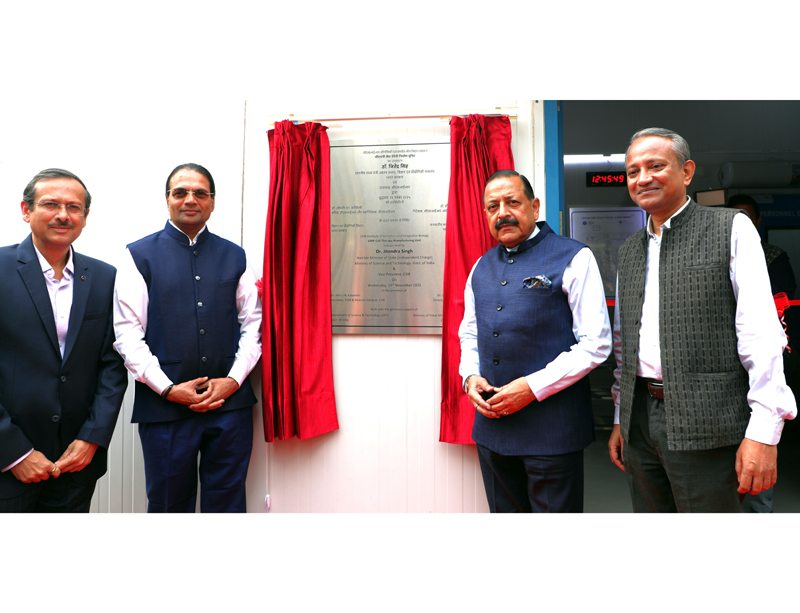
NEW DELHI, Nov 19: Union Minister of State (Independent Charge) for Science & Technology; Earth Sciences; MoS PMO, Personnel, Public Grievances, Pensions, Atomic Energy and Space, Dr. Jitendra Singh today launched India’s first indigenous “CRISPR” based gene therapy for Sickle Cell Disease, which particularly affects India’s tribal population. The therapy, named “BIRSA 101” is dedicated to Bhagwan Birsa Munda, whose 150th anniversary was observed a few days back and who is remembered as a great tribal freedom fighter..
While announcing this, the Minister said that India has formally begun its decisive journey towards becoming a Sickle Cell Disease-free nation, marking a historic turning point in the country’s public health and genomic medicine landscape.
The Minister said that with the development and transfer of India’s first indigenous CRISPR-based gene therapy, the nation has taken a major step toward fulfilling the Prime Minister Sh Narendra Modi’s vision of a Sickle Cell-Free India by 2047, while simultaneously advancing the goal of Atmanirbhar Bharat in frontline medical technologies.
Dr. Jitendra Singh emphasised that the breakthrough, developed at CSIR-Institute of Genomics & Integrative Biology (IGIB), has demonstrated India’s capability to produce pathbreaking therapies at a fraction of global costs, potentially replacing treatments priced at ?20-25 crore overseas. He underlined that this innovation carries deep national significance, especially for tribal communities in central and eastern India, where the disease burden is highest.
The event was attended by senior leadership from India’s scientific ecosystem, including Dr. N. Kalaiselvi, Director General, CSIR; Dr. Souvik Maiti, Director, CSIR-IGIB; Dr. Umesh Shaligram, Executive Director, Serum Institute of India(SIIPL); and faculty, researchers, and scientists from IGIB, along with invited guests and members of the media.
Addressing the gathering, Dr. Jitendra Singh said that the indigenous CRISPR platform, named BIRSA 101 in honour of Bhagwan Birsa Munda- marks a scientific milestone that positions India among global leaders in advanced therapeutics. Explaining the gene-editing approach in simple terms, he said the technology works like a “precise genetic surgery”, capable not only of curing Sickle Cell Disease but also transforming treatment pathways for several hereditary disorders.
He urged scientific institutions to communicate breakthroughs in simple language through infographics and social media, ensuring the public fully understands the significance of these advancements.
During the visit, Dr. Jitendra Singh inaugurated a new advanced research and translational facility at CSIR-IGIB. He interacted with scientists, reviewed work across genomic medicine programmes, and highlighted the need for integrated national models such as One Week- One Theme, enabling collaborative research across CSIR, DBT, and partner institutes.
Speaking on the occasion, Dr. Umesh Shaligram, Executive Director, Serum Institute of India, expressed heartfelt gratitude and reaffirmed the organisation’s commitment to translating IGIB’s innovation into real-world impact. He said:
“Globally, gene therapies cost over three million dollars and are beyond the reach of even the wealthy. Our mission is to take Indian innovation and make it accessible for the poorest of the poor. Serum has saved over 30 million lives through affordable vaccines, and we are fully committed to supporting the Prime Minister’s vision of a Sickle Cell-Free India by 2047. With the energy and encouragement from the Minister, we will dedicate all efforts to translate this technology into saving lives.”
 Follow our WhatsApp channel
