

Excelsior Correspondent
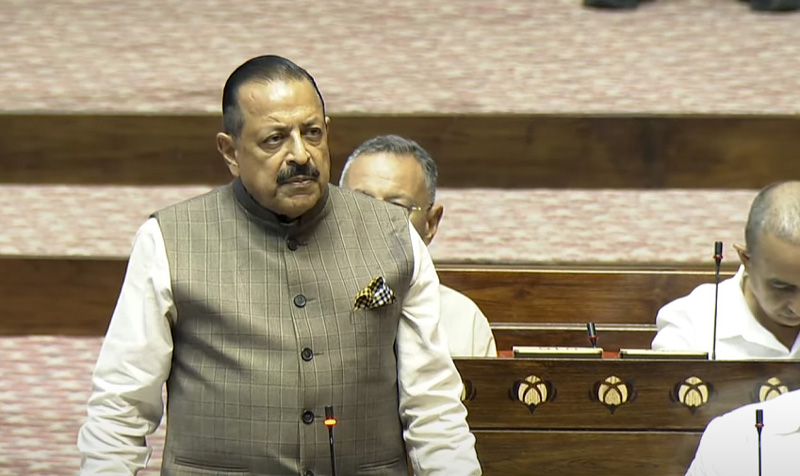
NEW DELHI, July 31 : Union Minister of State (Independent Charge) for Science & Technology, Earth Sciences, MoS PMO, Personnel, Public Grievances, Pensions, Atomic Energy and Space, Dr. Jitendra Singh, informed the Rajya Sabha today that India’s first human space mission, ‘Gaganyaan’, is scheduled to be launched in 2027, most likely in the first quarter of the year. He made this announcement while responding to a query to an answer given by him in the Parliament.
The Gaganyaan Programme, being implemented by the Indian Space Research Organisation (ISRO), aims to demonstrate human spaceflight capability by launching a crew of Indian astronauts into Low Earth Orbit and ensuring their safe return.
According to the Minister incharge Space, the Gaganyaan Programme has achieved several key milestones. The Human Rated Launch Vehicle (HLVM3) has completed development and ground testing. Propulsion systems for both the Crew and Service Modules, along with the Environmental Control and Life Support System (ECLSS) engineering model, have been developed and tested. Five types of Crew Escape System (CES) motors have been successfully developed and static tested.
The Minister further informed that the critical infrastructure has also been established, including the Orbital Module Preparation Facility, Gaganyaan Control Centre and Control Facility, Crew Training Facility, and modifications to the Second Launch Pad. A test vehicle developed to validate the CES was successfully flight-tested during the TV-D1 mission. The ground network for flight operations and communication has been finalized, with IDRSS-1 feeder stations and terrestrial communication links established. Additionally, recovery assets have been identified and a comprehensive crew recovery plan has been formulated.
Dr Jitendra Singh further stated that the first uncrewed mission (G1) is progressing well. The C32-G stage and CES motors have been realized. The HS200 motors and CES Fore-end, up to the Crew Module Jettisoning Motor, have been stacked. The structures for the Crew Module and Service Module have been realized, and Phase-1 checks on the Crew Module have been completed.
Dr. Singh informed the Parliament that ISRO has selected the first batch of astronauts from a pool of qualified test pilots from the Indian Air Force. These four astronauts hail from various states, including Uttar Pradesh. They successfully underwent generic spaceflight training at the Gagarin Cosmonaut Training Centre (GCTC) in Russia between February 2020 and March 2021. They are currently undergoing Gaganyaan mission-specific training at the Astronaut Training Facility (ATF) in Bengaluru. This training is structured in three semesters, two of which have already been successfully completed, with the third semester commencing shortly.
Reaffirming Gaganyaan as the first step toward establishing a sustained human spaceflight programme for India, Dr. Singh emphasized that following the success of Gaganyaan, India will set up its own space station-Bharatiya Antariksh Station (BAS). BAS will serve as a platform for advancing national capabilities in pharmaceuticals, biotechnology, health, and agriculture, while also enabling global collaborations with other space agencies as a contributing partner.
 Follow our WhatsApp channel
