

Excelsior Correspondent
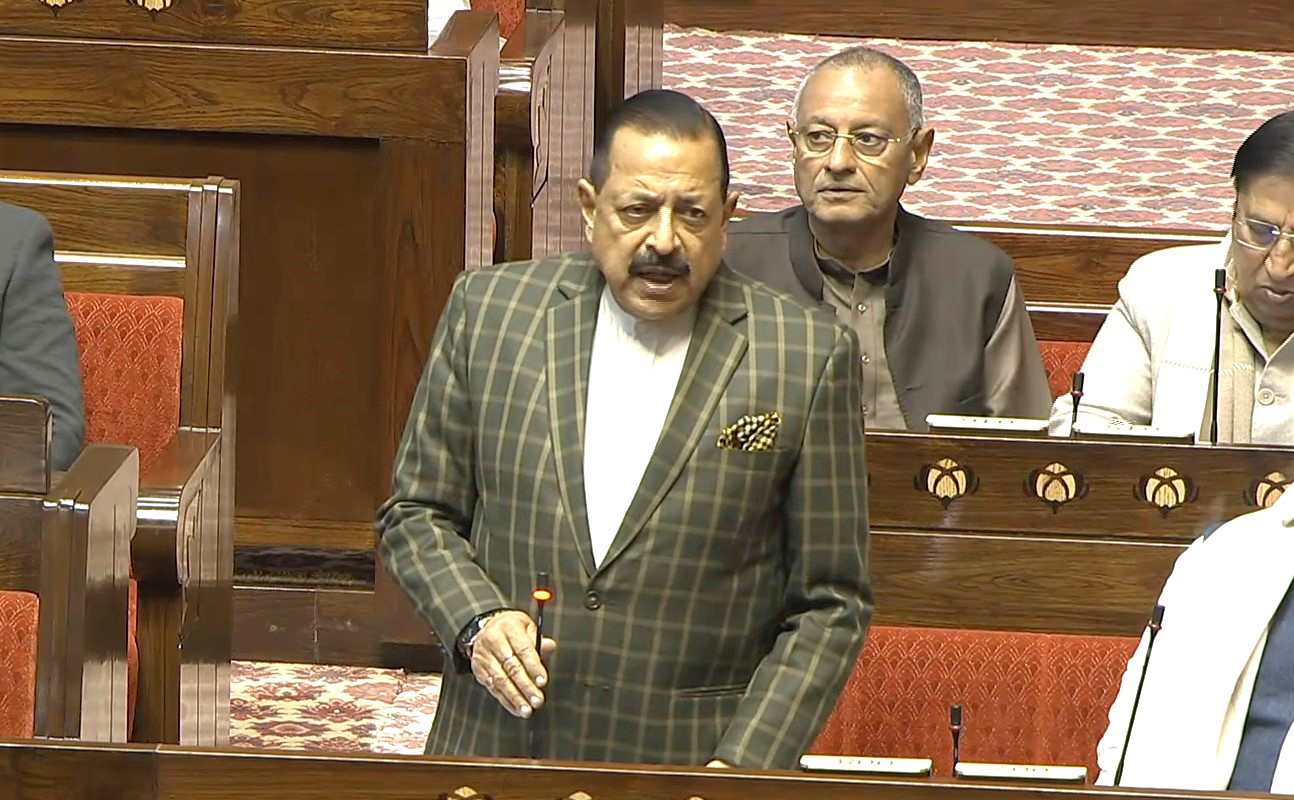
NEW DELHI, Dec 4: Union Minister of State (Independent Charge) for Science & Technology; MoS PMO, Department of Atomic Energy, Dr. Jitendra Singh, informed the Rajya Sabha that the Government has set an ambitious target of achieving 100 GW of nuclear power capacity by 2047, marking a decisive step toward building a Viksit Bharat and meeting India’s commitment of Net Zero by 2070.
Sharing this information in the Rajya Sabha today, the Minister stated that the Nuclear Energy Mission, announced in Budget 2025 with an outlay of Rs 20,000 crore for Small Modular Reactor (SMR) research, is central to India’s clean energy transition and long-term energy security.
Dr. Singh explained that nuclear power will play a crucial role in augmenting India’s low-carbon base-load energy supply, reducing dependence on fossil fuels, and increasing the share of clean, reliable, and indigenous power in the national energy mix. To achieve the 100 GW target, India is implementing a two-pronged strategy that includes the rapid expansion of large indigenous reactors, such as 700 MWe Pressurised Heavy Water Reactors (PHWRs) and imported Light Water Reactors (LWRs), and parallel development of next-generation small reactors, including the 200 MWe Bharat Small Modular Reactor (BSMR-200) and 55 MWe SMR-55. These small reactors are being designed for repurposing retiring thermal power plants, serving energy-intensive industries, and meeting off-grid requirements in remote areas. The Minister emphasised that India already possesses significant technological capability for deploying both large and small reactors, with most of the equipment manufacturable domestically and supported by BARC’s technological leadership.
The Minister further informed the House that the roadmap to 2047 has been jointly prepared by experts from the Department of Atomic Energy (DAE), Ministry of Power, and Central Electricity Authority. In line with this roadmap, NPCIL has accelerated sanctioning processes for PHWR-based projects at existing and approved sites, while also identifying potential new sites. NPCIL has issued a Request for Proposal (RFP) for Bharat Small Reactors (BSR) aimed at decarbonising hard-to-abate industries, and has extended the proposal submission deadline to 31 March 2026. India’s current nuclear capacity of 8780 MW (from 24 reactors) will rise considerably with 8 reactors under construction adding 6600 MW, including the indigenous 700 MW PHWRs RAPP-8 and GHAVP-1 & 2, and internationally-collaborated LWRs KKNPP 3-6. Additionally, 10 sanctioned reactors under pre-project activities will add another 7000 MW, enabling India’s nuclear capacity to reach 22,480 MW by 2031-32.
Dr. Jitendra Singh highlighted that India’s long-term nuclear growth also rests on the development of Indigenous Fast Breeder Reactors (FBRs), which form the second stage of India’s unique three-stage nuclear programme aimed at optimal utilisation of limited uranium and abundant thorium resources. The Government is also expanding international cooperation for advanced SMRs, fuel supplies, and nuclear services to strengthen India’s strategic capabilities. As per the roadmap, about 58 GW of the future nuclear capacity will be implemented through NPCIL, BHAVINI and joint ventures with PSUs, while 42 GW is expected to come through enhanced private sector participation, supported by an enabling legal and regulatory framework.
 Follow our WhatsApp channel
