

Excelsior Correspondent
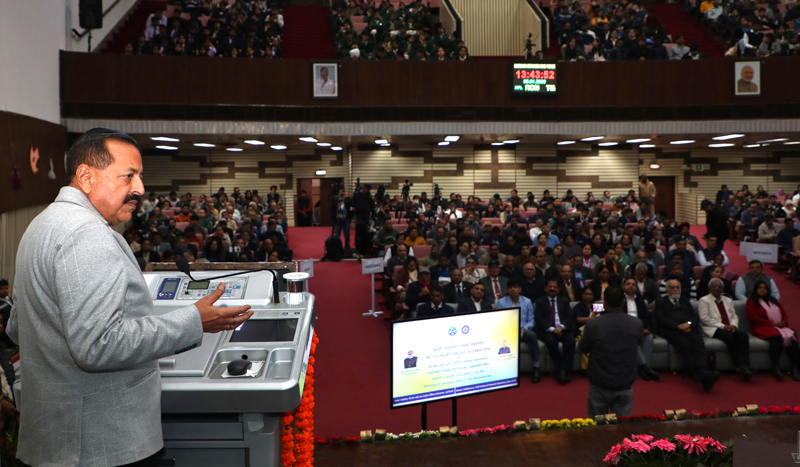
NEW DELHI, Jan 5: Union Minister of State (Independent Charge) for Science & Technology, Earth Sciences, PMO, Department of Space and Department of Atomic Energy, Dr Jitendra Singh today inaugurated the world’s second “National Environmental Standard Laboratory” and the world’s fifth “National Primary Standard Facility for Solar Cell Calibration” at the CSIR-National Physical Laboratory (NPL).
Addressing the 80th Foundation Day celebrations of CSIR-NPL here, the Minister said, while the “National Environmental Standard Laboratory” marks for India a major leap in Environmental Governance, the “National Primary Standard Facility” makes India a member of Elite Global League in Solar Metrology.
Describing India’s premier scientific institutions as “monuments of 20th and 21st century India,” Dr. Jitendra Singh said that laboratories like the CSIR-National Physical Laboratory embody India’s scientific journey from pre-Independence foundations to global technological leadership.
The Minister said that science and technology reforms will be the key drivers shaping India’s socio-economic future.
Recalling the unique legacy of CSIR-NPL, Dr. Jitendra Singh noted that the laboratory was already operational before Independence and later became an integral pillar of India’s post-Independence scientific architecture. He said CSIR itself is older than independent India, making NPL one of the earliest “siblings” among the 37 CSIR laboratories. Highlighting its historic significance, the Minister recalled that the laboratory was mentored by eminent national leaders including Dr. Syama Prasad Mukherjee and Sardar Vallabhbhai Patel, calling NPL a rare institution where history and science intersect.
“For decades, half the nation synchronised its watches with the atomic clock housed at NPL,” the Minister said, underscoring the laboratory’s role in establishing Indian Standard Time (IST). He said that this contribution quietly but profoundly shaped everyday life in India and remains a symbol of national integration through science. Emphasising public outreach, he suggested that such institutions must be showcased to students and citizens, much like historical monuments, to inspire scientific curiosity and help young minds discover their aptitude for science and innovation.
On the occasion, Dr. Jitendra Singh inaugurated the National Environmental Standard Laboratory, describing it as a critical step towards strengthening India’s environmental governance framework. He said that reliable, India-specific calibration and certification of air pollution monitoring systems was long overdue and would now enable transparent, traceable, and accurate environmental data. The facility will support regulatory bodies, industries, and startups by ensuring that monitoring instruments are tested under Indian climatic conditions, thereby improving policy enforcement under programmes such as the National Clean Air Programme.
The Minister also inaugurated the National Primary Standard Facility for Solar Cell Calibration (Solar Energy Complex), terming it a “future-ready facility” that places India among a select group of global leaders in photovoltaic measurement standards. Developed in collaboration with PTB, Germany, the laser-based Differential Spectral Responsivity (L-DSR) system achieves the lowest uncertainty globally at 0.35% (k=2) for reference solar cell calibration. Dr. Jitendra Singh said the facility would reduce India’s dependence on foreign certification agencies, save foreign exchange, shorten turnaround time for calibration and enhance investor confidence in the country’s rapidly expanding solar sector.
Addressing the gathering, N. Kalaiselvi, Director General, Council of Scientific & Industrial Research, congratulated the NPL fraternity on completing 80 years of service to the nation. She highlighted that the laboratory now houses the world’s fifth-largest environmental calibration facility and the world’s second-best solar cell calibration facility, and urged the institution to set its sights on becoming world number one in a chosen domain. She also underlined the strategic importance of NPL’s atomic clocks, stating that they would continue to support national timekeeping even under GPS-denied scenarios.
 Follow our WhatsApp channel
