

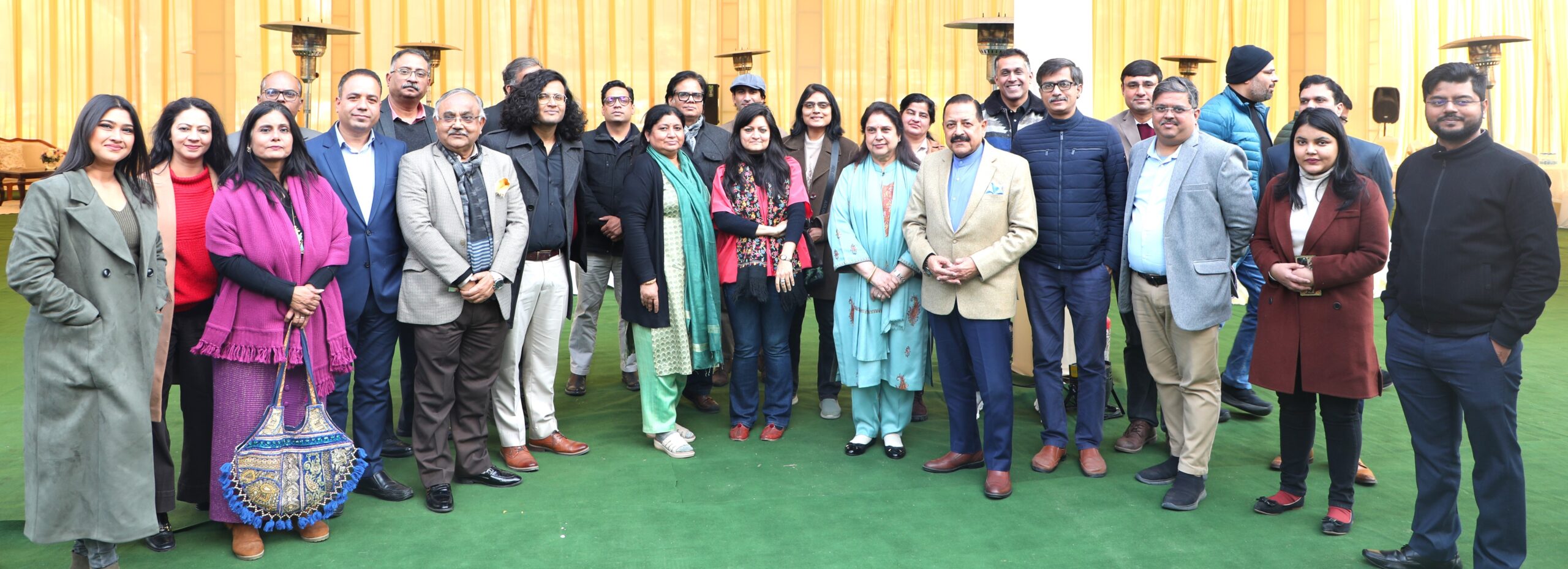
NEW DELHI, Jan 10 : Union Minister of State (Independent Charge) for Science and Technology; Earth Sciences and Minister of State for PMO, Department of Atomic Energy, Department of Space, Personnel, Public Grievances and Pensions, Dr. Jitendra Singh today hosted an informal luncheon get -together for journalists and media persons at his residence here today.
The Minister has been, over the last one decade, hosting such periodic informal luncheon get-togethers for the media at his residence, from time to time. Today’s was the first one in the New Year.
The luncheon provided an opportunity for candid interaction and exchange of views on a wide range of contemporary issues relating to science, technology, governance reforms and national development. Journalists from print and electronic media shared their perspectives and offered informal feedback on policy initiatives and emerging areas of public interest.
During the interaction, Dr. Jitendra Singh discussed key legislative and policy developments, including aspects related to SHANTI Act, the role of Small Modular Reactors (SMRs) in India’s clean energy transition, and the status of upcoming nuclear power projects at various locations across the country. He underlined that nuclear energy will continue to play a critical role in ensuring India’s long-term energy security while meeting climate commitments.
Highlighting the government’s reform agenda, the Minister said that science reforms are expanding in scope and scale, while governance reforms are increasingly technology-driven. He referred to digital platforms such as CPGRAMS as examples of how technology is improving transparency, accountability and citizen-centric governance. He also noted the growing international interest in India’s governance innovations, citing the increasing number of foreign students coming to study Indian administrative and digital governance models.
Dr. Jitendra Singh spoke about major citizen-oriented initiatives, including the Digital Life Certificate (DLC) campaign, which has significantly eased the process for pensioners, and other digital reforms aimed at improving ease of living and ease of working. He emphasized that these initiatives reflect the government’s commitment to leveraging technology for inclusive and efficient governance.
On the research and innovation front, the Minister referred to the recently announced ₹1 lakh crore Research, Development and Innovation (RDI) funding initiative, describing it as a landmark step to strengthen India’s innovation ecosystem, promote private sector participation in R&D, and accelerate the journey from idea to impact.
Discussing space sector developments, Dr. Jitendra Singh highlighted the growing role of space applications in improving the lives of ordinary citizens, particularly in areas such as communication, weather forecasting, disaster management, agriculture and navigation. He also shared updates on upcoming space missions, including Chandrayaan-4 and Chandrayaan-5, which will further advance India’s lunar exploration and scientific capabilities.
The Minister also touched upon science-led socio-economic initiatives such as the Lavender Revolution and similar mission-mode programmes, which are generating livelihood opportunities, especially in rural and hilly regions, by integrating science, technology and local entrepreneurship.
Throughout the interaction, Dr. Jitendra Singh underscored the importance of continuous engagement with the media, describing journalists as key partners in communicating complex policy initiatives and scientific achievements to the public. He appreciated the media’s role in fostering informed public discourse and constructive feedback.
The luncheon concluded in an atmosphere of open dialogue and mutual appreciation, reaffirming the shared commitment of the government and the media to nation-building through informed discussion, transparency and collaboration.
 Follow our WhatsApp channel
