

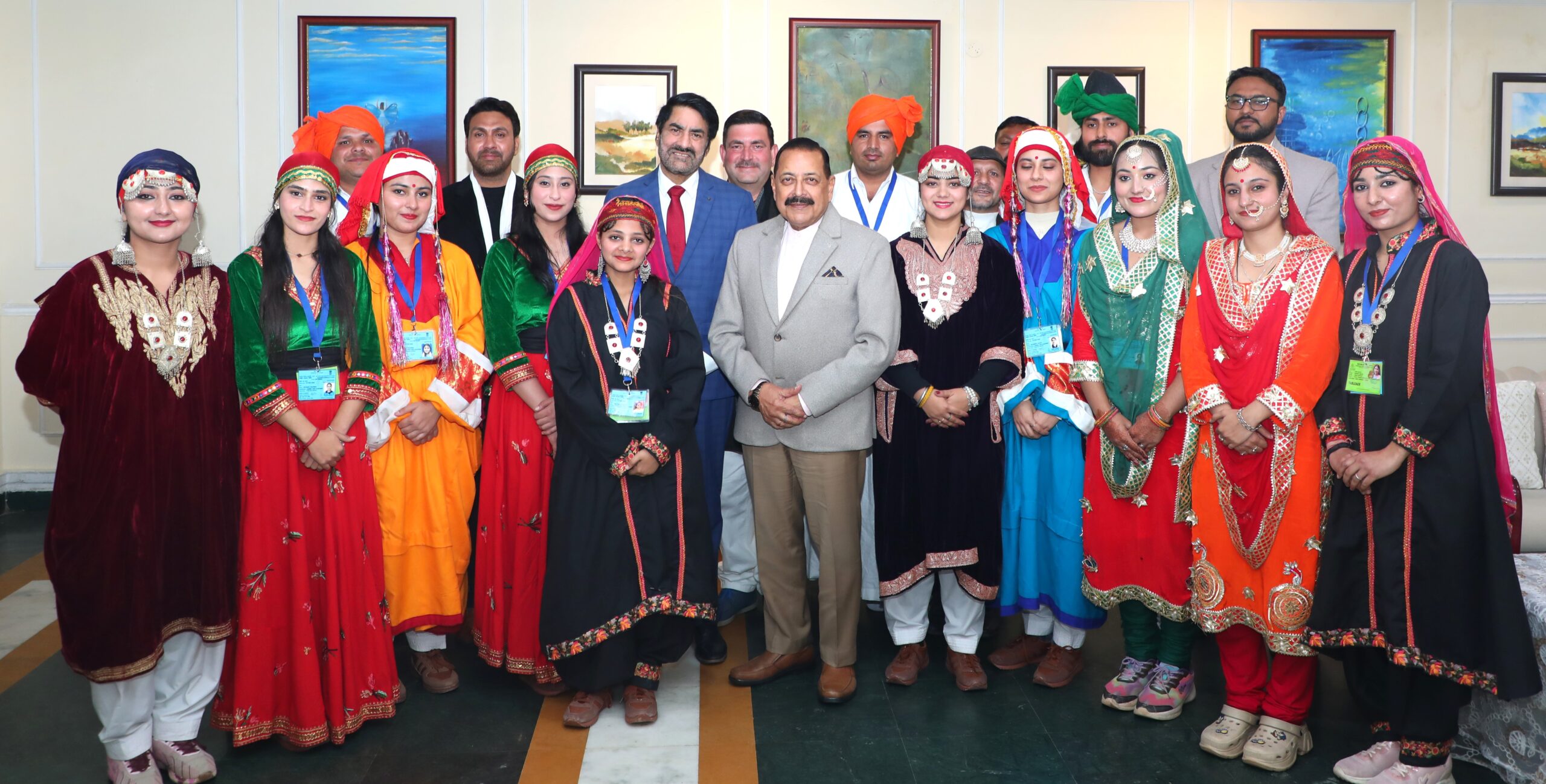
NEW DELHI, Jan 27 : Union Minister of State (Independent Charge) for Science & Technology and Earth Sciences, and Minister of State in the Prime Minister’s Office, Personnel, Public Grievances & Pensions, Atomic Energy and Space, Dr Jitendra Singh, today hosted a high-tea get-together for the Jammu & Kashmir tableau team which had performed at the Republic Day celebrations at Kartavya Path yesterday.
A day after the Jammu & Kashmir tableau received widespread appreciation during the Republic Day Parade for its evocative and immersive portrayal of the region’s cultural diversity, the Minister engaged in an extensive interaction with the performing artists, both individually as well as collectively. The tableau presented Jammu and Kashmir as a seamless cultural continuum, where heritage, community life and artistic expression blended into a coherent and compelling visual narrative.
Interacting with the artists, performers, designers, and officials associated with the tableau, Dr Jitendra Singh congratulated them for their disciplined presentation and collective effort on Kartavya Path. He said the tableau succeeded in conveying the cultural depth of Jammu & Kashmir to audiences across the country, allowing even those seated far away to connect with the region’s traditions, colours, and rhythms.
The Minister remarked that such cultural representations align with the broader national vision articulated by Prime Minister Narendra Modi, where India’s development journey is rooted in its civilisational heritage. He said that showcasing local traditions, crafts and community life on national platforms reflects the idea that cultural confidence and development must progress together.
Referring to the tableau’s visual elements, the Minister spoke about the depiction of the purple fields of lavender, the intricate miniature art of Basholi, and the vibrant folk-dance traditions, which together reflected the artistic richness and cultural continuity of Jammu and Kashmir. He said these elements highlighted how regional identities contribute to the larger national fabric.
The visual narrative of the tableau opened with a grand engraved Samovar symbolising Kashmiri hospitality, followed by representations of traditional wooden architecture and houseboat imagery. At the centre, a Dogra Chhajja performance staged on a village Thadda portrayed community life and continuity of traditions in the Jammu region. Spirited folk dances such as Rouf, Kud, Jagarna, Pahari, Gojri and Dumhal added movement and energy, while the concluding display of colourful papier-mâché artefacts arranged in a willow basket presented Jammu and Kashmir as a living canvas of creativity and craftsmanship.
During the interaction, the Minister encouraged the contingents to continue preserving and promoting traditional art forms while adapting them to contemporary platforms. He said that India’s journey towards Viksit Bharat @2047 would be shaped not only by economic growth and technological advancement, but also by the strength of its cultural roots and community participation.
The meeting concluded on a warm note, with the Minister expressing confidence that platforms such as the Republic Day Parade would continue to play an important role in presenting India’s cultural diversity as a source of strength, unity, and inspiration in the country’s long-term development journey.
 Follow our WhatsApp channel
