

Excelsior Correspondent
THIRUVANANTHAPURAM, Oct 15 : Making a strong case for innovation driven economy with larger participation of private sector, Union Minister for Science and Technology Dr. Jitendra Singh today said that India’s transformation from a technology importer to an innovation-driven exporter is being powered by institutions like the CSIR-National Institute for Interdisciplinary Science and Technology (NIIST), which combine scientific research with sustainability and entrepreneurship.
The Minister, while speaking at the Grand Finale of the Golden Jubilee Milestone Observation Program of CSIR-NIIST at Thiruvananthapuram, recalled that 50 years ago the institute was envisaged with the objective to harness vast natural resources of the southern peninsula for scientific advancement.
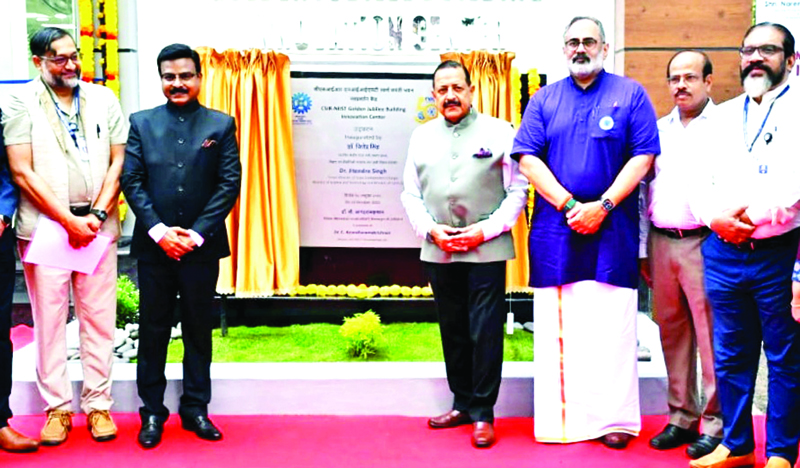
Marking 50 years of the institute’s establishment, Dr. Jitendra Singh inaugurated the new Golden Jubilee Building and the CSIR-NIIST Innovation Centre, designed to convert research ideas into viable products and startups. “From agriculture to artificial intelligence, the Innovation Centre will nurture startups, support entrepreneurs, and fuel an innovation-led economy,” he said, noting that the first cohort of ten startups has already completed incubation.
The Minister informed that the Government of Kerala had allotted land at Thonnakkal for a proposed Center for Innovation, Technology, and Entrepreneurship within the Bio 360 Life Sciences Park. “This facility will accelerate translational research in biotechnology and life sciences, turning lab breakthroughs into life-changing realities,” he added.
Highlighting key achievements of the institute, Dr. Jitendra Singh cited four innovations with national significance – a biomedical waste conversion rig installed at AIIMS Delhi that turns infectious waste into non-toxic material; the development of a “designer rice” suitable for diabetic and pre-diabetic populations; indigenous Vaccine Vial Monitors (VVMs) to reduce import dependency; and research on sustainable packaging alternatives to plastics. “These initiatives reflect science with social impact,” he said, adding that such technologies directly support national missions including Swachh Bharat, Ayushman Bharat, and Atmanirbhar Bharat.
Dr. Jitendra Singh, who also serves as Vice President of CSIR, lauded NIIST’s performance despite being a relatively small institute. Over the past two years, its institutional budget has increased by 1.5 times to over ?120 crore, with half spent on R&D. The lab has transferred 28 technologies, signed 65 industry agreements, and achieved record levels of external funding and research output, reflecting what the Minister described as “purposeful excellence.”
Calling for stronger collaboration among government, industry, and academia, Dr. Jitendra Singh emphasized that the “whole-of-government” and “whole-of-nation” approach envisioned by Prime Minister Narendra Modi is key to India’s scientific progress. “We must move from Government dependence to self-sustaining ecosystems with greater private sector participation,” he noted. He underscored the need for closer coordination across ministries and scientific institutions, calling it integration of “interdisciplinary” woth “inter-governmental” approach.
Citing ongoing collaborations between CSIR and the Department of Biotechnology, and the government’s decision to open up the space and nuclear sectors to private players, he said this integrated model represents the future of India’s innovation framework.
Linking science to the national growth story, Dr. Jitendra Singh noted that India’s Global Innovation Index ranking has improved from 81 in 2014 to 38 this year, reflecting the country’s emergence among the world’s top innovation performers. Nearly 55 percent of patents filed from India are now resident patents, he said, underscoring growing domestic capacity and confidence. With rising R&D investments and greater industry participation, India’s scientific institutions are poised to become major contributors to sustainable growth and innovation-led economic resilience.
 Follow our WhatsApp channel
