

Excelsior Correspondent
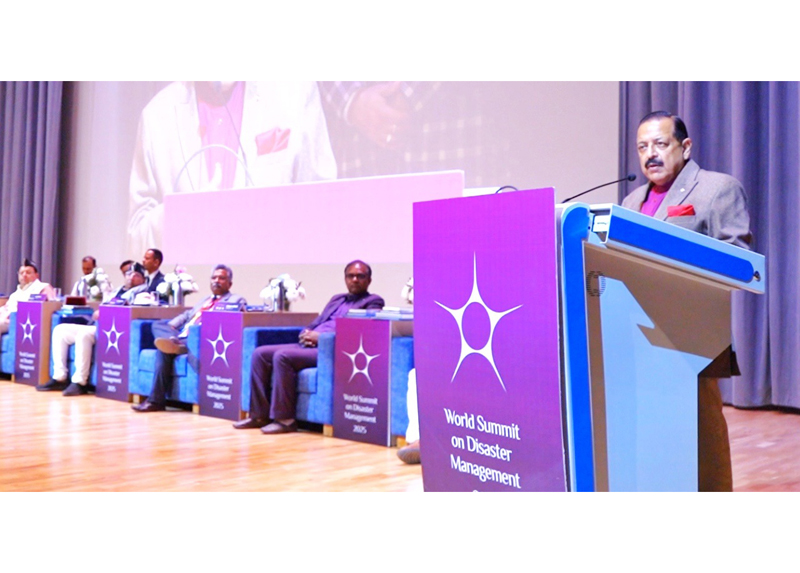
DEHRADUN, Nov 30: Union Minister of State (Independent Charge) for Science & Technology; Minister of State for Earth Sciences; and MoS PMO, Personnel, Public Grievances, Pensions, Atomic Energy and Space, Dr. Jitendra Singh announced here today that in Uttarakhand, while three Weather Radars have already been installed at Surkanda Devi, Mukteshwar and Lansdowne, three more radars will soon be commissioned at Haridwar, Pantnagar and Auli, thus further strengthening real-time forecasting capability for the region.
Addressing the “World Summit on Disaster Management”, the Earth Sciences Minister described Uttarakhand as the most natural and appropriate venue for a global discussion on disaster resilience given its lived experiences, geographical sensitivities, and Himalayan ecosystem.
The summit was graced by Uttarakhand Chief Minister Pushkar Singh Dhami, Member of Parliament Naresh Bansal, NDMA Member Agarwal, Secretary, Science and Technology Secretary Ittarakhand Nitish Kumar Jha, Chairman of Graphic Era University Prof. Kamal Ghanshala, DG Durgesh Pant, SDMA Vice Chairman Rohila, along with faculty, experts, and students.
Speaking on the occasion, Dr. Jitendra Singh said that Uttarakhand’s journey over the past 25 years, coinciding with its Silver Jubilee celebrations, has given the State a distinct identity in disaster response and governance. He recalled that the successful Silkyara Tunnel rescue operation, completed exactly two years ago, will remain a historic benchmark in global disaster management literature. He noted that future research on Himalayan disasters will invariably refer to Uttarakhand and to the leadership displayed by Chief Minister Pushkar Singh Dhami during critical moments. He emphasised that organising a global summit of this scale in a State that has both cultural richness and acute vulnerability gives the event profound symbolic significance.
The Minister highlighted that hydrometeorological hazards in Uttarakhand have risen sharply over the past decade, with the 2013 Kedarnath cloudburst and the 2021 Chamoli disaster marking decisive turning points. He said that scientific analyses point to a combination of climate change impacts, rapidly retreating glaciers, glacier-lake outburst risks, the fragile Himalayan Mountain system, deforestation, and man-made encroachments that obstruct natural drainage paths. He added that terms like “cloudburst” and “flash flood”, which were rarely used twenty-five years ago, have now become part of everyday vocabulary because of the growing frequency of such extreme events.
Dr. Jitendra Singh elaborated that the Government of India has significantly expanded Uttarakhand’s meteorological and disaster-monitoring infrastructure over the last ten years. He informed that 33 meteorological observatories, a network of radio-sonde and radio-wind systems, 142 automatic weather stations, 107 rain gauges, district-level and block-level rainfall monitoring systems, and extensive app-based outreach programmes for farmers have been established to improve early warning dissemination.
He said that three weather radars have already been installed at Surkanda Devi, Mukteshwar and Lansdowne, and announced that three more radars will soon be commissioned at Haridwar, Pantnagar and Auli, further strengthening real-time forecasting capability for the region.
Expressing concern over the lack of compliance in some regions with IMD alerts, Dr. Jitendra Singh highlighted the need for stricter administrative response. He recalled a recent incident in Jammu & Kashmir where a newly appointed IAS officer prevented a major tragedy by immediately shutting down the highway following a red alert issued by IMD, demonstrating how timely action can save lives.
He said that land-use regulations issued jointly by NDMA, the Ministry of Environment and the Urban Development bodies must be implemented with absolute seriousness to prevent long-term ecological and infrastructural damage. He also warned that illegal mining along riverbeds and near newly constructed highways is becoming a dangerous man-made threat, eroding foundations and amplifying flash flood impacts, and urged communities to recognise that short-term gains often lead to long-term destruction.
 Follow our WhatsApp channel
