

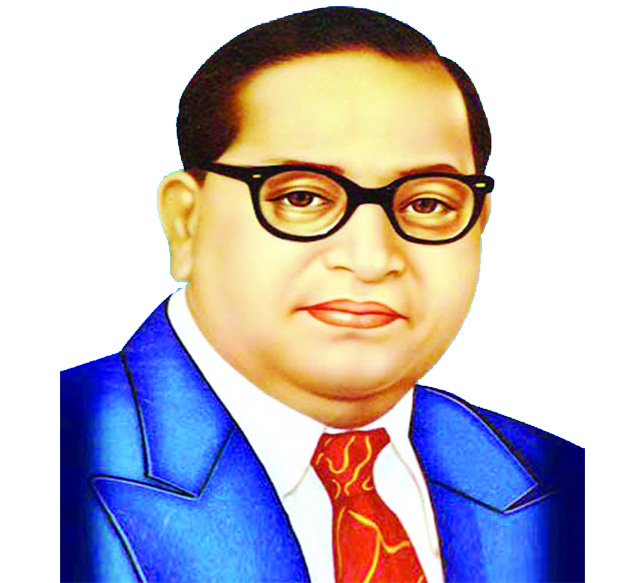
Arvind P. Bhanu, Adarsh Verma
Dr. B.R. Ambedkar, born on April 14, 1891, in a Mahar family deemed untouchable in India, emerged as a transformative leader. His exceptional intellect and unwavering commitment to social justice defined his way of life. While he engaged in political activities post-education, calling him a politician would not be appropriate. His essence lies as a relentless social reformer, determined from an early age but chose to confront injustice directly rather than retreat into comfort. He fought for equal rights and opportunities for all, irrespective of caste, advocating for a society rooted in equality. His role was pivotal in drafting the Indian Constitution, where he enshrined principles of social justice and affirmative action to safeguard the rights of Dalits, women and other marginalized communities. His relentless advocacy led to abolition of untouchability under article 17 of Indian constitution, enforcing his focus on social reform over political gain.
Ambedkar firmly believed that education is the foremost catalyst for social change. Despite enduring significant obstacles, he pursued higher education, achieving many degrees, including a Doctorate from Columbia University, USA. He envisioned educational upliftment for backward classes as a pathway to dismantling caste oppression rather than as a political manoeuver. His commitment to education resulted in the establishment of institutions and policies aimed at ensuring access to education for marginalized groups. Being an advocate for women’s rights, he understood that women’s empowerment underpins societal progress. As Chairman of the Drafting Committee, he championed women’s education and ensured constitutional protections that guaranteed equality, employment opportunities, and inheritance rights for women. He instituted reforms concerning marriage, divorce and property rights to strengthen women’s status.He instituted reforms concerning marriage, divorce and property rights to strengthen women’s status in society. His vision for the UCC (Uniform Civil Code) as enshrined in provision of Article 44 of Indian Constitution, was strengthening the women irrespective of their caste, creed and other identifications through availing them equality before law. It is appropriate to mention here that Ambedkar’s effort resulted in the Hindu Code Bill ensuring the Rights of Hindu women as Hindu Marriage Act 1955, Hindu Succession Act 1956, Hindu Minority and Guardianship Act 1956, and Hindu Adoption and Maintenance Act 1955 which were enacted by the Parliament of India.
While Ambedkar participated in political formations, such as the independent Labour Party and the Scheduled Caste Federation, his intent was not to seek political power but to utilize political mechanisms to achieve social equality and justice. He recognized that traditional Hindu reforms failed to eradicate caste discrimination, observing that the conversion of Dalits to Buddhism was driven by the pursuit of equality and dignity. In 1956, a massive conversion to Buddhism among his followers manifested a rejection of the caste system. Dr. B.R. Ambedkar’s legacy as a social reformer remains unparalleled. Emphasizing again, politics for Ambedkar was not an end but a means to realize social equality and upliftment of the marginalized. He exemplified a commitment to justice, equality and empowerment for the oppressed, strategically leveraging political influence to affect real change. Unlike conventional politicians seeking power, he aspired to create an egalitarian society, a vision that continues to inspire social justice movements even today. The Apex Court of the country has highlighted in judicial thinking the social reformative vision of Ambedkar. His contributions to law, education, human rights and the fight against caste discrimination solidify his status as a catalyst for transformative social reform, far transcending the label of a mere political figure.
Ambedkar had viewed Hinduism as “In my view, what is wrong is their religion, which has inculcated this notion of caste if this is correct, then obviously the enemy, you must grapple with, is not the people who observe caste, but the Shastras that teach them this religion of caste.” He had always advocated for Equality before the Law, Equal Protection of the Law and the Fundamental Rights. These contributions were built on the vision of a just and equal society and not based on any political ambition.
Ambedkar has greatly worked for social justice. He has been described as one of “the greatest disinfectants against inequality”. Dr. Ambedkar stressed on justice, not only political and economic but also social justice. Praising Ambedkar’s vision for economic justice towards society as constitutional goal, Dr. Amartya Sen stated that Ambedkar is “my father of economics”Ambedkar further commented that “The system of rank and gradation is simply another way of enunciating the principle of inequality, so it may be truly said that Hinduism doesn’t recognise equality.”Ambedkar’s social reformative measure reflected at the 1931 Second Round Table Conference where he with Mahatma Gandhi clashed over separate electorate for Dalits. He voiced for separate representation to ensure their political representation and protection from discrimination whereas Gandhiji advocated for the upliftment of Dalits. Later in the Poona Pact of 1932 which resulted in reserved seats for Dalits within general electorate, rather than a separate electorate. He strongly felt that a society based on liberty, equality and fraternity is the only alternative to a caste-basedsociety, and that is why he attached greater importance to the principle of humanity.
 Follow our WhatsApp channel
