

Rajeshwar Singh ‘Raju’
rajeshwar68@gmail.com
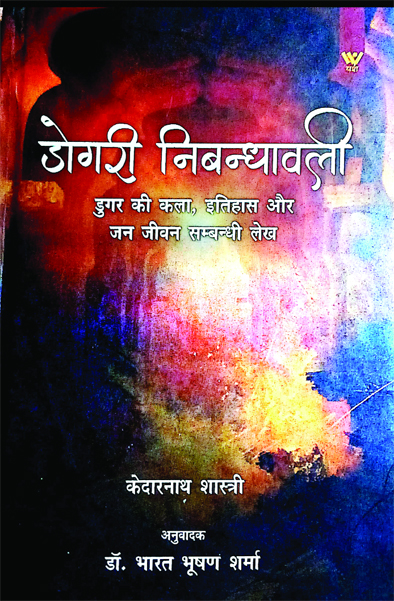
Book Name: DOGRI NIBANDAWALI
Author: Kedarnath Shastri
Original Language: Dogri
Translator in Hindi: Dr. Bharat Bhushan Sharma
Genre: A collection of articles on Art, History and Life of Duggar.
Publisher: Yash Publications, 1/10753 Subhash Park, Naveen Shahdra, Delhi-110002
“Traditions are the roots that keep us grounded; Preserving them ensures that future generations inherit not just our memories,
But our identity.”
Yes, we all know it from the core of our hearts. But the point of concern is that how much we areconcerned for our roots. It does not require too much of contemplations but just a self-realization from within serves the purpose. Can a plant or tree survive without roots ? Roots are must for survival and same is in case with races. We have to realize it as soon as possible as the time gone by leaves behind only the concerns not addressed well in time and one is left behind with excuses that have no relevance when it’s all over. It’s better for us to be grounded and know, preserve and promote our belongingsi.e factors responsible to our existence as a Dogra community. It is commendable that the efforts are being made that need appreciation and should be inspiring for others also to take steps in the right direction thus fulfilling our responsibilities towards our society. Now Dr.Bharat Bhushan Sharma has been working with the much desired zeal andpassion thus enriching the literature related to Duggar Pradesh’s art, history and cultural heritagewith colossal contributions. After having translated eminent historian Sukhdev Singh Charak’s “Duggar Sanskritike Mool Aaadhaar’, the translation of eminent historian and archaeologist Pandit Kedarnath Shastri ‘s collection of Dogri articles in Hindi language entitled ” Dogri Nibandwali” has added another feather in his cap.
About Author:
The book contains a small reference from Padmashri Prof. Ramnath Shastri about the works of the author. Pandit Kedarnath Shastri received his early education at two of Jammu’s renowned institutions Sri Ranbir High School and Prince of Wales College, presently Gandhi Memorial Science College Jammu. After completing his studies, he joined the Archaeological Survey of India in 1921 and was posted to its Northern Circle. For nearly three decades, until 1949, he worked in various capacities in the department, contributing significantly to archaeological research and documentation. During this period, while serving in supervisory roles he was closely associated with explorations and excavations in the region of the Saraswati and Sutlej civilizations. In 1949, he was appointed as a Technical Assistant at the Central Asian Museum, New Delhi, where he continued his scholarly service. However, in 1961, he chose to return to his native land, Jammu. Inspired by the cultural resurgence that was taking root in his homeland, he resolved to dedicate his rich knowledge and experience towards this renaissance. His decision proved immensely fruitful, as his scholarship added valuable dimensions to the cultural consciousness of the region. By this time, he had already authored several important works. His major writings include “The Original Centre of the Indus Civilization – Harappa (Hindi), A Review of the Indus Culture, The Cultural Tradition of India, Indian Archaeology (2 Volumes – co-authored with B.S. Agarwal),Tavi Shatakam – a collection of 100 Sanskrit verses in praise of the Tawi River with Hindi and English translations. Through these contributions, Pandit Kedarnath Shastri not only established himself as a distinguished scholar but also as a cultural visionary who sought to reawaken pride in the heritage of Jammu and India at large.
About Book:
Dogri Nibandwali is a distinguished collection of eight scholarly essays, Srinagar Sangrahalya Ke Sharda Lekh, Duggar Desh Ki Vastukala Aur Murtikala, General Wazir Jorawar Singh, Duggar Desh Ka Soundarya, Duggar Ke Rajon Ka Sankshipat Itihas, Kashmir Ghati Mein Puratatva Ki Khoj, Kashmir Ke Pracheen Samarak, Ramnagar Mahal Ke Bhitichitra authored by PanditKedarnathShastri and compiled by PadmashriRamnathShastri. It is widely acknowledged as the first published work on the history, culture, and archaeology of Duggar. PanditKedarnathShastri is also celebrated as the first researcher of the state to systematically study and document the architectural legacy of Duggar.
The first essay examines the Sharda inscriptions preserved in the Srinagar Museum. Engraved on temples’ buildings and idols of deities, these inscriptions have been meticulously studied by the author to establish their historical context and also sheds light on the socio-cultural aspects of the era.The second essay elaborates the architecture and sculpture of Duggar Pradesh. It offers insightful descriptions of heritage sites, emphasizing their cultural significance and instilling pride in the region’s artistic achievements whereasthe third essay is devoted to the legendary warrior of the soil “GeneralWazirJorawar Singh”. It provides a detailed account of his life, focusing on his remarkable military expeditions, especially his celebrated victories in Ladakh and Tibet. Through his indomitable courage and determination, he transformed seemingly impossible missions into glorious triumphs. The fourth essay ” Duggar Deshka Soundarya” is a lyrical tribute to the natural beauty of Duggar. Alongside its poetic expression, the essay outlines the geographical features of the region, describing its mountain ranges, rivers, streams, lakes, valleys, plains, and seasonal landscapes.The fifth essay presents a concise history of the kings of Duggar. It gives details of their dynastic lineage, territorial boundaries, political affairs, wars with neighboring states and the broader historical backdrop of the era.The sixth essay records the archaeological explorations in the Kashmir Valley. It introduces eminent archaeologists and experts who conducted extensive surveys, bringing valuable discoveries to light.The seventh essay focuses on ancient monuments of Kashmir, providing descriptions of their architectural grandeur and historical relevance.The eighth and final essay highlights the murals of Ramnagar Palace. It discusses the artistry, themes, and cultural context of these remarkable wall paintings that reflect the aesthetic vision of their time.
Together, these eight essays make DOGRI NIBANDWALI a landmark publication, offering deep insights into the history, culture, architecture, and natural beauty of Duggar and Kashmir.It is pertinent to add here that the original book written in Dogriwas published way back in 1969 but Dr. Bharat Bhushan Sharma translated it in Hindi and the significant information about Duggar Pradesh’s art, History and Life could reach to broader canvas.The book has preface by Padmashri Prof.Shiv Nirmohi and Padmashri Prof. LalitMagotra.
It is in fact a very valuable addition to literature about art and culture of the region. The fact remains that a lot of research is needed on the subjects because of the fact that very little has been explored till date from historical point of view. It is in fact a concern that should haunt all of us. Let us hope that such works will inspire all of us to come ahead, have extensive research on different aspects of our rich history, compile it in the forms of books so as to preserve same for our future generations. After all it’s our duty to pass on our heritage to coming generation with authentic documentation.
(The writer is Sahitya Akademi & State Awardee)
 Follow our WhatsApp channel
