

Seek bond system for PG, DM courses
Irfan Tramboo
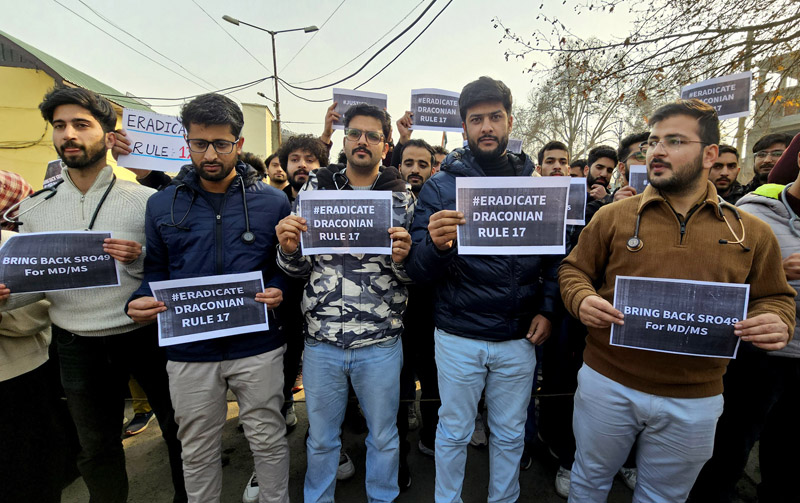
Srinagar, Dec 9: Doctors in Srinagar today protested against the reduction of Open Merit (OM) seats in Postgraduate (PG) admissions under the NEET PG framework.
Scores of doctors gathered at the Government Medical College (GMC) campus in Srinagar, raising slogans in support of their demands and criticizing Rule 17 of the reservation policy as “draconian and unique to J&K.”
The protesting doctors emphasized the need for minimum reservation in specialty courses like NEET PG, arguing that during MBBS, all students study under the same conditions, accessing identical resources such as books, faculty and libraries.
“This equips students equally and allows them to compete on merit. Specialty courses require a high level of competence determined through exams like NEET PG, which should prioritize merit to ensure the best candidates are selected,” said one of the protesting doctors, Dr. Arifa.
The doctors expressed concerns over recent changes in reservation policies. They noted that SRO 49, issued on January 30, 2018, originally allocated 75% of seats to Open Merit.
However, they said amendments under SO 176 (March 15, 2024) and SO 305 (May 21, 2024) reduced this quota to 40%, which effectively drops below 30% after the application of Horizontal Reservation and Rule 17.
“For NEET PG 2024, only 78-80 unreserved candidates secured seats out of 293 total seats in the state, a mere 27%, while the majority went to reserved categories,” said another doctor Saqib.
This significant reduction, he added, has caused anxiety and frustration among unreserved candidates, “who view it as a blow to merit-based admissions.”
The protesters also called for the removal of Rule 17 of the J&K Reservation Rules 2004-2005.
They argued that the rule allows reserved category candidates who secure seats through Open Merit to claim an additional reserved seat upon upgrading to a higher specialty.
“The vacated OM seat does not revert to the OM category but is instead returned to the reserved pool, creating an imbalance and undermining the principle of merit-based selection,” Dr. Arifa stressed.
Additionally, the doctors demanded the implementation of a three-year bond system for PG and DM courses, as is practiced in other states, to ensure equitable service provision.
Highlighting disparities in NEET PG 2024, they pointed out that of the 293 seats in Government colleges, Open Merit initially accounted for 113 seats (38.5%).
After applying Rule 17 and Horizontal Reservation, OM seats were reduced to 78, making up only 26.6% of the total, doctors said.
They also noted that seven out of 28 EWS seats were filled, but 21 vacant seats intended for the OM pool were allocated to the reserved category instead.
The aggrieved doctors urged authorities to address their concerns and ensure fairness in postgraduate admissions, emphasizing that such policies have far-reaching consequences for the healthcare system and society at large.
 Follow our WhatsApp channel
