

“Echoes of Justice”
Sunny Dua
Sunnydua55@gmail.com
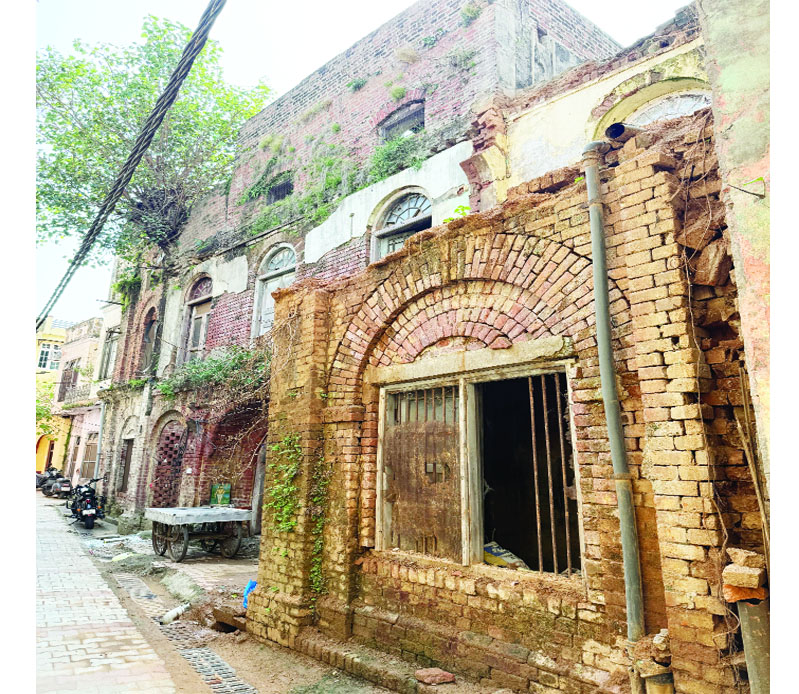
Away from the eyes of historians, architects, and even heritage enthusiasts, tucked deep inside the narrow, timeworn streets of old Jammu, stands a magnificent structure more than a century and a half old. Once believed to have served as the High Court of Jammu and Kashmir during the reign of Maharaja Pratap Singh, this building in Kucha Nahar Singh silently bears witness to an era when justice, governance, and grandeur were all housed within walls of brick and dignity. Located not far from the historic Mubarak Mandi Complex, the crumbling edifice now fights for survival against neglect, harsh weather, and the indifference of those meant to protect it.
The two-storied building, with its arched brick entrance, wooden doors, curved window frames, and a central courtyard, once reflected the regal architectural style of its time – a blend of strength and subtlety. After the High Court was shifted inside the Mubarak Mandi complex, this once-prestigious building fell from grace. The Estates Department moved in a few tenants, and over the next five decades, generations grew up within these fading walls. Many tenants refused to vacate the premises, some even stopped paying rent, and the building gradually lost both its purpose and pride. It was only when the department finally declared it unsafe and disconnected its electricity for safety reasons that the occupants reluctantly moved out, leaving behind a hollowed-out shell of what was once a proud judicial seat.
In northern India, the term “Kucha” typically refers to a narrow lane or alley – intimate spaces that hold stories within their turns. The “Kucha” in question is believed to be named after Mia Nahar Singh, a saintly and revered figure once known in Jammu. Though little documented, oral traditions suggest that even after his passing, he was seen by many, his presence gentle and harmless. His name lives on in the lane, as does that of another revered soul – Baba Boor Singh – remembered through another old lane, Kucha Baba Boor Singh in Kachi Chawni. These names tell us something profound about Jammu’s past: that its streets were not just pathways, but memorials – dedicated to those whose piety and presence shaped the city’s spirit.
Sadly, the department responsible for this heritage structure neither undertook its restoration nor spent any meaningful resources to preserve it. The building was simply locked and abandoned, left to battle time and the elements alone. Now, peepul trees and wild shrubs have forced their way out through the cracks in the walls, windows and jharokhas have been blocked by adjoining constructions, and parts of the roof and courtyard have collapsed. What was once an architectural gem on about 3,500 to 4,000 square foot plot, constructed entirely with hand-laid bricks and adorned with graceful double arches, is now being branded “unsafe” and eyed for demolition.
Yet, when one stands before it today, beneath its weathered archways, it’s impossible not to feel the pulse of history that still lingers there a faint heartbeat echoing through time. This is not just an old building. It is a silent witness to justice once dispensed, to lives once lived, and to the slow, painful neglect that heritage so often endures.
Sahitya Akademi Award-winning writer and senior citizen Shiv Mehta vividly recalls the court complex was originally built by Maharaja Ranbir Singh, but it attained its real prominence during the reign of Maharaja Pratap Singh, when it functioned in full glory as the High Court of Jammu and Kashmir. He describes it as the supreme seat of justice of that era, where litigants whose pleas were left unheard in lower courts brought their final appeals. “Those who didn’t get justice at the tehsil level could come here to Kucha Nahar Singh,” he says, “and from here, certain special cases were taken directly to the court of Maharaja Pratap Singh himself – something comparable to moving the Supreme Court today.”
The rediscovery of Kucha Nahar Singh’s old High Court rekindles pride in a forgotten chapter of the city’s judicial past.
The veteran writer, who has authored several revealing works on Jammu’s heritage, adds that during the Dogra rulers’ time, when the boundaries of the princely state of Jammu and Kashmir extended far into the western frontiers, people would travel hundreds of miles from distant areas to seek justice in these very courts. “This building,” he says, “was not just a court – it was a symbol of trust, where people placed their faith in the fairness of the Maharaja’s law.”
But over the decades, the dignity of that hallowed structure slowly eroded. After the courts were shifted inside the Mubarak Mandi Complex, the old High Court at Kucha Nahar Singh was rented out to government officials and even private individuals at nominal rates. Many of them, Mehta recalls, never vacated the premises, continuing to live in shabby, unsafe conditions as the government neither restored nor maintained the structure. The building, once resounding with arguments of advocates and the pronouncements of judges, fell silent – its arches now echoing only the sighs of time.
With a heavy heart, Mehta laments how a place that once represented faith, fairness, and justice now stands abandoned and forgotten. “It deserves to be remembered,” he says quietly, “for this is not just a building – it’s a witness to the conscience of a bygone era.” He said Kucha Nahar Singh derives its name from the revered saint Baba Nahar Singh, whose small shrine or sthan still stands there.
The present-day structure, though weathered and neglected, still holds the promise of restoration and stands as a silent testament to the bustling activity it once hosted. During its heyday, this building would have echoed with the footsteps of litigants, the deliberations of judges, and the everyday rhythm of justice being delivered. Over time, however, as the courts were relocated and tenants from various departments moved in, unauthorized constructions were carried out, particularly in the central courtyard, marring its original aesthetics and compromising the architectural integrity of this heritage gem. A closer look at the walls, arches, and wooden frames reveals the intricate craftsmanship and attention to detail that went into its creation – a level of artistry rarely seen today.
Former Mayor of Jammu Municipal Corporation (JMC), Narendra Singh ‘Raju,’ recalls that Kucha Nahar Singh and the High Court complex were central to judicial life during the reign of Maharaja Pratap Singh, and locals often referred to it as the “Purani Adalat” (Old Courts). Before the courts were finally shifted to the Mubarak Mandi Complex – and later to Janipur – both subordinate courts and the High Court operated from this building for decades. Raju adds that after the relocation, several tenants occupied the vacated rooms, many of whom remained for decades without authorization, contributing to the building’s slow deterioration and leaving it vulnerable to further neglect.
The building, he believes is in very much dilapidated conditions but if there’s any revival scheme under which the project can be taken up and engineers and architects approve, this will be a great gift to people of Jammu. He however believes that adaptive use of this building like setting up of a library, place for displaying artefacts or handicrafts if is done then it will have a great footfall, historians and art lovers can also see it as a paradise in old Jammu Street and historians who conduct heritage walks can also get an iconic place right in the heart of old Jammu city. Simultaneously, a parking lot at old Panjtirthi Poonch house can be ideal for cars and then people can walk the city streets and even Mubarak Mandi complex at ease.
Strangely, the building is also remembered for having served as a location for films and documentaries, one notable instance being a feature on the life of former minister and MP Chaman Lal Gupta. A film on his life was directed by Shiv Dutt, and several scenes were shot within the premises. The building was depicted as the residence of Chaman Lal Gupta and his family after they moved to Jammu from Kaleeth-Akhnoor. Shankar Bhan, a renowned film producer and director, who had also made the Dogri film Chanchelo, once resided in this building, known historically as the High Court. During his later years, he had requested friends to send him photographs of the structure, which he cherished deeply.
Steel plates indicating waterworks and electricity connections are still affixed to the doors, marking the presence of former tenants. The entrance, comprising two identical arches joined by a passage, opens into a central courtyard, creating a striking architectural effect. Though the building is primarily two-storied, the addition of a room above the entrance and another at the rear gives it the appearance of a three-storied structure. Its arched windows and main entrance door further enhance its historical elegance.
The first floor features an extended balcony that runs along the length of the rooms, supported by ornate gallows brackets, with a wooden railing featuring cross bars that adds to the building’s aesthetic appeal. The bracket system, which combines brackets with tie-rods to support the first-floor walkway, is a testament to the ingenuity of the original construction. If properly restored, these features could significantly revive the architectural grandeur of the High Court building.
According to the historical text Tareekh-i-Jammu, translated by A.R. Khan, there are references to Maharaja Pratap Singh establishing courts, though no specific mention is made of this particular High Court in Kucha Nahar Singh. At that time, the surrounding areas were largely open spaces, and the narrow streets familiar today emerged only later as settlements increased and urban development progressed.
It reads that during Maharaja Partap Singh era, “All departments were separated from one another with respect to their work load and divided among members. The Executive, criminal and civil courts were classified properly. The powers of officers were formulated. More courts were established and in almost every Tehsil, with its headquarter in a big town, one Munsiff and in every district one Sub-Judge was appointed. As against Practice, they were empowered to deal with criminal cases”. The Lawyers were allowed to Practice in the courts and only border courts were exempted, it reads.
Well-known cartoonist and artist Chander Shekhar grows nostalgic as he recalls the memories tied to this old building. He shares that several television serials and documentary films were once shot in the High Court complex of Jammu – a magnificent structure that once resonated with both justice and art. Today, however, it stands silent, its fading walls whispering tales of neglect and forgotten glory.
“Some things don’t truly break – they simply fall apart under the weight of our own neglect,” Shekhar reflects softly, remembering his visit nearly eight years ago. He had arrived two days early for a film shoot, eager, as the art director, to study every crack, every wall, and every broken jharokha with an artist’s eye. “It could have been saved,” he remembers thinking. “There was still life in those stones; they only needed care.” Yet, the building had fallen into shared ownership and had housed tenants who made it their home without preserving its heritage.
Shekhar recalls how the courtyard became a dumping ground, and over time, the story of its past gradually faded beneath daily routines. With too many owners and too little attention, the very heart of the building became homeless. Then came the rains: the roof began to leak, the walls cracked, and the mansion started to crumble – not due to age, but due to indifference. “That place didn’t really collapse,” Shekhar says. “It simply fell… perhaps by the hands of its own people.”
He emphasizes that the site deserves restoration, not merely as an architectural relic, but as a symbol of collective memory. “People should know,” he adds, “that this was once the High Court of Jammu, where people from distant towns came seeking justice.”
Rakesh Mehta, a businessman with close ties to the newspaper industry, recalls hearing countless stories about the High Court in Kucha Nahar Singh from his parents. He firmly believes that if the building is restored, it could seamlessly blend with other heritage structures in the area, helping Jammu reclaim a part of its lost identity. The vicinity already houses several landmarks of historical significance – from the Mubarak Mandi complex to old temples and havelis – and a restored High Court building would complement these structures beautifully. Heritage enthusiasts and casual walkers alike would delight in exploring this part of old Jammu, rubbing shoulders with history at every turn.
Nand Kishore, a senior citizen residing near the old court complex in Panjtirthi, confirms that the High Court operated here during the reign of Maharaja Pratap Singh before being shifted to Mubarak Mandi. For nearly fifty years, justice was dispensed from this building. Tenants such as Girdari Lala and Chaman Lal Arora lived here for decades, and a few rooms were allotted to their mother, a teacher. Kishore recalls that there are about ten rooms on the upper floor and an equal number on the ground floor, and at one time, around fifteen families called this building home, including Shankar Bhan, son of Tej Bahadur, who had portrayed Ravan in Billu Mandir and worked in the education department. He emphasizes that if restored as a heritage building, this erstwhile High Court could transform from a relic into a proud asset for the people of Jammu.
Poorna Devi, 77, who lives next to the iconic building, adds a personal memory. She moved to Jammu from Panthak, Kayra, when she got married, and recalls that many families, including her relatives like Mohinder, lived in this complex for nearly forty years. When tenants refused to vacate, their electricity and water connections were cut, forcing them to leave. She insists that the building must be restored, not demolished, for its historical and cultural value cannot be replaced.
According to reliable sources, the Department of Estates plans to demolish the building, terming it unsafe, and construct a new structure in its place. The department is seeking no-objection certificates from concerned authorities to proceed legally, which would erase the last physical trace of the erstwhile High Court in Kucha Nahar Singh. Once alive with lawyers, artists, and storytellers, the complex now lies in ruins – a silent witness to the passage of time. Yet, hope remains. What has fallen can rise again. The walls may have cracked, the rooms may have caved in, but the spirit of this place endures, quietly waiting for someone to heed its plea: “I wasn’t destroyed… I was forgotten.”
(The writer is senior journalist & heritage enthusiast)
 Follow our WhatsApp channel
