

By T N Ashok
There is a particular irony embedded in the story of film festivals and India’s capital. For decades, Delhi was the centre-piece of the nation’s most prestigious cinematic gathering. The Vigyan Bhavan echoed with the chatter of international directors. The Siri Fort Auditorium complex, built in the 1980s and still one of the subcontinent’s finest multi-auditorium cultural venues, was purpose-designed with film festivals in mind. Foreign luminaries walked the corridors of South Block and dined at Hyderabad House as part of a festival ecosystem that was, unmistakably, a projection of Indian state power. Then, in 2004, it all moved to Goa — and Delhi went quiet. Twenty-two years later, the capital has decided it wants back in.
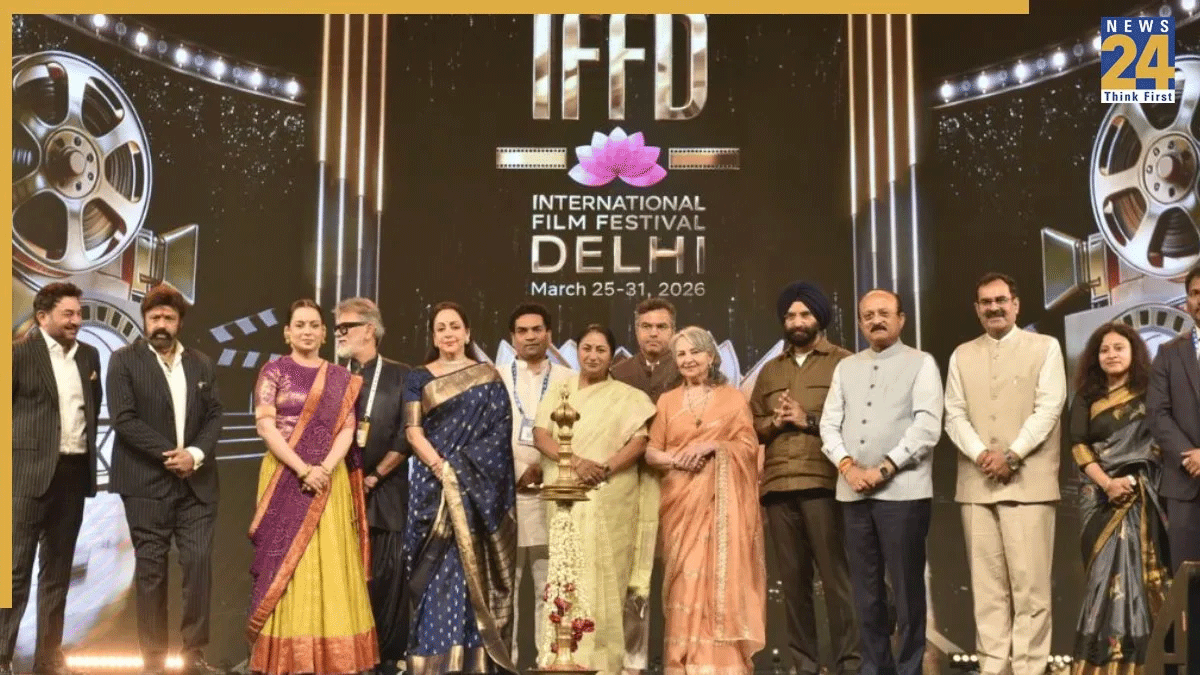
The inaugural International Film Festival Delhi, or IFFD, concluded March 31 at Bharat Mandapam with considerable spectacle: Grammy-winning composer Ricky Kej conducting an orchestral fusion that drew standing ovations, lifetime achievement honours bestowed on Sharmila Tagore, Dharmendra, and Nandamuri Balakrishna, and a closing ceremony that mixed Bollywood celebrity with nationalist cultural pageantry. The festival recorded participation from over 100 countries, with more than 2,100 entries and 30,000 registrations, screening over 125 films from 47 countries. By the metrics of a debut, it was not unimpressive.
The initiative is anchored in the Delhi Film Policy 2022 and executed by the Delhi Tourism and Transportation Development Corporation (DTTDC). As the nodal agency for Delhi Film Policy 2022, DTTDC streamlines film shoot approvals to attract productions and organised IFFD with a view to elevate Delhi’s global film presence and contribute to the growth of the film and media ecosystem in the national capital. Tourism Minister Kapil Mishra, the political architect of the effort, has framed it within Prime Minister Modi’s “orange economy” — a creative-sector growth model — and is pushing to make IFFD an annual fixture on India’s cultural calendar. The ambition is real. So are the limitations.
To understand what Delhi is attempting, one must understand what Delhi once was.
The first ever International Film Festival of India was organised by the Films Division, Government of India, with the patronage of the first Prime Minister of India, Pandit Jawaharlal Nehru, in Mumbai in 1952. It then rotated between India’s major cities — Calcutta, Madras, and Delhi among them — before finding more permanent homes. The venue for the second festival, held in 1961, which was also non-competitive, was New Delhi. The third edition was chaired by Satyajit Ray. For the first time the festival became competitive, and was graded ‘A’ category by the Paris-based Federation Internationale de Producteurs de Films — putting India’s festival on par with Cannes, Berlin, Venice, Karlovy Vary, and Moscow.
Under successive prime ministers — Nehru’s internationalism, Indira Gandhi’s cultural statecraft, Rajiv Gandhi’s modernising impulse — Delhi was the nerve centre. At the ninth festival in 1983, held in the Siri Fort complex in New Delhi, a new section for screening of 16mm films was added. An important landmark was the participation of 22 Third World countries, and IFFI had become a major forum of Third World cinema. The jury that year was chaired by British director Lindsay Anderson. A previous edition at Vigyan Bhavan had Russian director Grigory Chukhrai presiding over a jury that included Shyam Benegal, G Aravindan, and French director Bertrand Tavernier. These were not provincial gatherings. They were diplomatic-cultural events of international standing, attended by filmmakers and critics who flew in from Europe, the Americas, and across Asia.
The gallery of international luminaries who graced Delhi’s film festivals under the central government’s stewardship included figures from Hollywood, Soviet cinema, Italian neorealism, and the French New Wave. Delhi, as the seat of political power, gave these events a gravitas no other Indian city could replicate. Foreign directors visiting for the festival were also received at India’s diplomatic establishments — a confluence of culture and statecraft that no state-level initiative can easily reproduce.
In 2004 the IFFI was moved to Goa from Trivandrum. Since then IFFI has been an annual event and competitive. The move was administratively efficient — Goa offered a compact, manageable venue with a relaxed coastal atmosphere that festival-goers found appealing — but it quietly stripped Delhi of its cinematic identity. The capital, preoccupied with politics, barely noticed.
Delhi is arriving late to a well-populated field. There are over a dozen major city-based international film festivals in India, with key events including IFFI in Goa (FIAPF accredited), Mumbai Film Festival (MAMI), Kolkata International Film Festival (KIFF), Jaipur International Film Festival (JIFF), and Chennai International Film Festival (CIFF). Bengaluru, Dharamshala, Kerala, and Hyderabad all have established festivals of their own.
The comparisons are instructive, though not entirely fair to a first-edition event.
Goa’s IFFI remains in a category of its own — the only film festival in South Asia accredited by the International Federation of Film Producers’ Associations (FIAPF) in the Competitive Feature Films Category. The 56th edition in November 2025 presented more than 240 films from 81 countries, including 13 world premieres, 5 international premieres, and 44 Asian premieres. It has a recognised international jury, a coveted Golden Peacock award, and decades of institutional memory. IFFD’s non-competitive structure, modest international slate, and absence of FIAPF accreditation place it, frankly, in a different league — for now.
Chennai’s CIFF, run by the Indo Cine Appreciation Foundation with state and industry backing, has built a decades-long reputation as a serious cinephile festival with strong south Asian programming, consistently attracting arthouse selections from Iran, South Korea, and Eastern Europe. It operates with curatorial independence that state-run festivals rarely achieve.
Jaipur’s film festival ecosystem has traded on heritage tourism and the Rajasthan Film Festival’s regional reach. It doesn’t aspire to IFFI-level competition but has crafted a distinctive identity around Rajasthani and regional Indian cinema, and has found its niche.
Delhi, by contrast, is the only city attempting to build a festival simultaneously from the top down — with state infrastructure, political will, and world-class venues — and from the bottom up, reaching first-time cinema audiences across the NCR. That is an unusual and, potentially, powerful combination. But it requires coherence IFFD 2026 only partially demonstrated.
Credit where it is due. IFFD achieved things in its first edition that many festivals take years to establish.
The most significant was audience creation. Delhi is not Mumbai. It does not have Colaba’s café-culture cinephilia or the festival circuits that Mumbai’s film industry naturally generates. Entry was free, with screenings conducted across 14 screens including PVR INOX multiplexes in various locations across the city — a deliberate democratisation that drew students, civil servants, and ordinary Delhiites who might never attend a traditional film festival. The 30,000 registrations are not just a number; they represent a new audience for world cinema in a city that had none.
The government signed MoUs to establish Delhi as a hub for new cinema technologies like AI and animation, and three films found financiers at the festival itself. That last detail is the most consequential. Film markets create ecosystems. If Delhi can become a place where films get funded — not just screened — it begins to function as an industry node, not merely a cultural showcase.
Three films are also to be shot entirely in Delhi under new production-incentive arrangements, anchoring the festival’s promise to film tourism in tangible commitments rather than aspirational rhetoric.
The gaps, however, were as visible as the achievements.
The festival’s most glaring weakness was its programming architecture. IFFD positioned itself as “international” while operating largely without the hallmarks of international festival credibility: a competitive section, a recognised international jury, major world premieres, or meaningful participation from top-tier festival circuits — Cannes, Venice, Berlin, Sundance, Toronto. The opening film, Oliver Laxe’s Sirat — a dystopian masterpiece that won the Oscar for Best Foreign Language Film — fell through due to a dispute over screening rights. The irony was pointed out: the festival had the taste to invite the right film and the institutional weakness to lose it.
What remained was a hybrid that felt more like a curated national showcase with international additions than a genuine world cinema platform. The competitive awards that were announced — Best Picture going to Dhurandhar, Best Director to Anupam Kher for Tanvi The Great — were for films already either premiered or on platforms outside than exhibited at the festival itself. The logic was opaque and diluted whatever award credibility IFFD might have earned.
More structurally, IFFD suffers from the absence of the diplomatic leverage that once made Delhi’s film festivals formidable. The BJP government in Delhi belongs to the same party that controls the Centre, and Tourism Minister Mishra has spoken of advancing PM Modi’s creative-economy vision. Yet the clout of Narendra Modi’s global standing, or the formidable foreign-policy machinery of External Affairs Minister Dr S Jaishankar — whose diplomatic networks span every continent — has not been meaningfully deployed to bring A-list international filmmakers, foreign juries, or co-production delegations to IFFD. This is, frankly, a missed opportunity. When Delhi hosted IFFI in the 1980s under Rajiv Gandhi, international participation was partly a function of India’s diplomatic outreach. That infrastructure exists today in a far more sophisticated form. It is not being used.
The road to relevance for IFFD runs through three concrete reforms.
First, FIAPF accreditation. Without it, IFFD cannot be taken seriously by the international film community as a competitive festival. The pathway requires a credible international competition section, an independent jury of recognised filmmakers, and institutional separation between government logistics and programming decisions. This is achievable within two to three editions — if the political will exists to cede curatorial control.
Second, a genuine film market. The CineXchange platform introduced at IFFD 2026 was a beginning. But Film Bazaar at IFFI Goa is South Asia’s largest film market, attracting buyers, distributors, and streaming platforms from across Asia and Europe. Delhi’s superior infrastructure — Bharat Mandapam, Yashobhoomi, proximity to the diplomatic enclave — should make it a more attractive venue for international co-production discussions. The government needs to actively court Netflix, Amazon, and the major European and Asian distributors with concrete co-production incentives, not just invite them to red carpets.
Third, diplomatic cinema. Delhi is, uniquely among Indian cities, a place where a film festival can be an act of foreign policy. A dedicated country-focus section — rotating annually between strategic partners — that brings the head of each nation’s film industry to Delhi, curated with input from the Ministry of External Affairs, would give IFFD an identity no other Indian festival can claim. Cannes has its Marché. Berlin has its European Film Market. Delhi could have its diplomatic cinema corridor — films as soft power, screened at the capital of the world’s most populous democracy.
The closing ceremony at Bharat Mandapam was genuine spectacle. Ricky Kej’s orchestral sweep across Mission Impossible and ancient Vedic hymns in the same breath captured something true about Delhi: its appetite for scale, for bridging the ancient and the contemporary, for performing its own importance. The audience was on its feet.
But great festivals are not built on closing ceremonies. They are built on the films that provoke arguments in corridors at midnight, on the jury deliberations that end in disagreement, on the first-time filmmaker from Burkina Faso who finds a French distributor in a hotel lobby. IFFD 2026 created the infrastructure for those things to happen. It did not yet create the culture.
Delhi was once India’s cinematic capital by default — because power lived here, and where power lives, the world comes calling. It can be again. But reclaiming that status requires more than a government policy and a week at Bharat Mandapam. It requires institutional patience, curatorial courage, and the willingness to let cinema do what it does best: surprise you.
The applause was real. The work begins now. (IPA Service)
 Follow our WhatsApp channel
