

2 flights cancelled, 8 delayed
*Samba colder than Gulmarg at 6.7
Gopal Sharma
JAMMU, Jan 15: Ahead of fresh Western Disturbances (WDs) expected to hit Jammu and Kashmir from Friday, night temperatures across Kashmir valley showed a slight improvement at most places, while the day temperature witnessed some improvement in Jammu as the weather improved.
Dense fog and poor visibility continued to engulf Jammu and its plain areas, affecting air, train and vehicular traffic. Two flights were cancelled and eight others delayed due to fog and poor visibility at Jammu Airport today.
Samba turned colder than Srinagar, Gulmarg, Pahalgam and many other places in J&K as its day temperature dropped to a record low of 6.7 degrees Celsius today. Gulmarg recorded a day temperature of 7.6 deg while Pahalgam registered 9.6 deg C today.
A MeT official said that winter capital, Jammu which recorded 4th lowest day temperature of 7.4 degrees Celsius in last 40 years on Wednesday, today witnessed 12.6 degrees C, however, Samba recorded a lowest day temperature of 6.7 degree Celsius today.
The night temperature in Udhampur town again dropped below zero, recording a low of -0.4 degrees Celsius and in Bhaderwah it was -0.1 deg C on Thursday.
Follow the Daily Excelsior channel on WhatsApp
Poonch town recorded a minimum temperature of 4.4 degrees C, Rajouri 0.3 deg, Ramban 2.6 deg, Doda town 4.7, Kishtwar 4.3, while Kathua town 4.3 degrees C today.
Katra Mata Vaishnodevi today recorded a a minimum temperature of 6.8 deg C and maximum 17.9 deg C, Banihal town a night temperature of 1.9 deg C while Batote a minimum temperature of 4.9 deg C. The day temperature however, in Banihal and Batote remained 18.9 degrees and 17.6 degr C on Thursday.
The weatherman further said that Srinagar recorded a minimum temperature of -3.9 deg C last night, up from -5.2 deg C the preceding night. Qazigund, the gateway town to Kashmir, also witnessed a slight rise, settling at -4.7 deg C compared to -5.3 deg C earlier.
South Kashmir, however, continued to reel under severe cold conditions. Pulwama and Shopian emerged as the coldest places, both recording -6.1 deg C, though this was an improvement from the previous night when Pulwama logged -7.0 deg C and Shopian plunged to -7.5 deg C.
The tourist resort of Pahalgam recorded -5.0 deg C, up from -6.0 deg C a night earlier. The other tourist destinations also showed mixed trends, with Gulmarg recording -3.2 deg C compared to -3.8 deg C earlier, while Sonamarg saw a sharp drop to -5.8 deg C from -2.2 deg the previous night. Kupwara registered -4.9 deg C, improving from -6.2 deg C.
Meanwhile, Srinagar recorded a maximum temperature of 13.4 deg C, Pahalgam settled at 9.6 deg C, while Gulmarg recorded 7.6 deg C.
At least three week Western Disturbance are expected to impact J&K from January 16 in coming days. The weather department has forecast isolated light rain or snowfall over the next two days.
On January 19 and 20, light rain or snowfall is likely at scattered to fairly widespread places. From January 22 to 24, the weather is expected to remain generally cloudy with light to moderate rain or snowfall at most places. There is also a possibility of moderate to heavy rain or snowfall over a few districts of the erstwhile Doda district, Udhampur, Reasi and parts of South Kashmir during January 23 and 24.
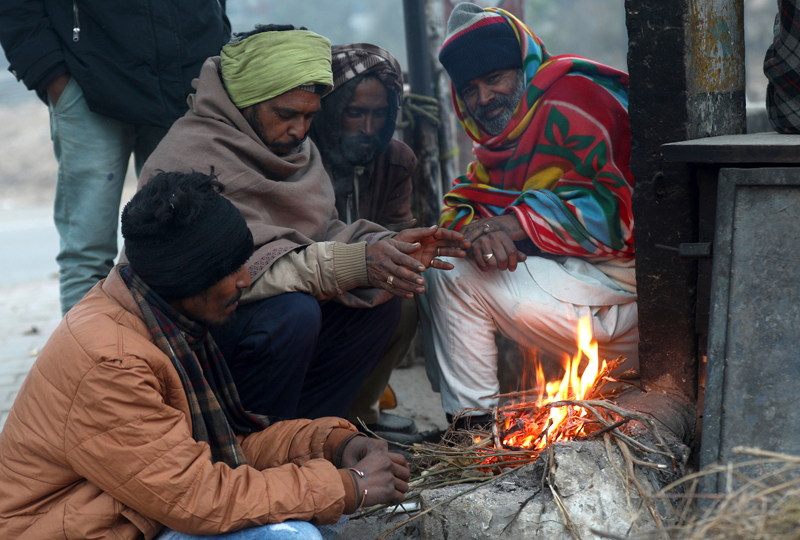
Bone-chilling cold conditions have frozen parts of several water bodies, including the interiors of the Dal lake.
Meanwhile, a Railway official said that about half dozen trains arrived late in Jammu today in view of fog and poor visibility in the region and parts of adjoining Punjab and Haryana. He said several long and medium distance trains are arriving late from the last over three weeks. Several trains were late by one to five hours.
The movement of vehicular traffic has also been affected with the fog in the region.
Kashmir valley is currently in the midst of ‘Chilla-i-Kalan’, the 40-day harshest winter period, during which night temperatures frequently plunge several degrees below the freezing point and snowfall chances are the highest.
‘Chilla-i-Kalan’, which began on December 21 last year, will end on January 30. The India Meteorological Department has said the western disturbance is approaching Kashmir and is likely to affect the Valley from January 16.
 Follow our WhatsApp channel
