

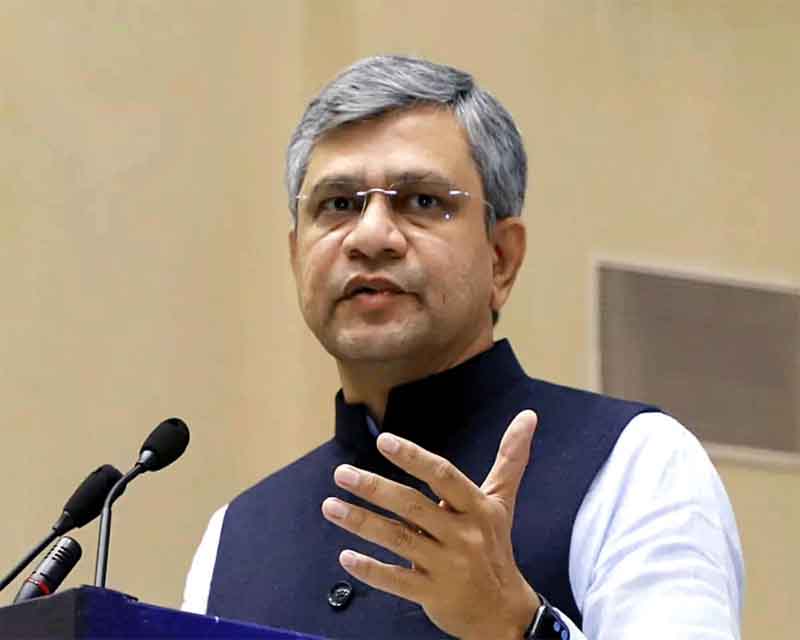
NEW DELHI, Jun 25: Union Information and Broadcasting Minister Ashwini Vaishnaw on Wednesday charged that “all four pillars of democracy were attacked” during the Emergency, as he also took a dig at the Congress, saying those who carry a copy of the Constitution today, should remember their own party had censored press and muzzled the voice of the nation in that dark period.
“India is a mother of democracy, but exactly 50 years ago a severe blow was dealt to this democracy. Emergency was declared in the country. That period is the darkest chapter in the history of our republic,” he said at an event held in Delhi.
The Ministry of Culture hosted ‘Samvidhan Hatya Diwas’ at the Thyagaraj Stadium to mark 50 years since Emergency was imposed on June 25, 1975.
Earlier in the day, Defence Minster Rajnath Singh and External Affairs Minister S Jaishankar took to X to share their thoughts on the Emergency.
“Fifty years ago, a despicable attempt was made to strangle Indian democracy through the Emergency. People still remember the Emergency as the darkest chapter of Indian democracy,” Singh said.
The EAM in his post wrote, “On #SamvidhaanHatyaDiwas, we recall a painful chapter of independent India’s history, when institutions were undermined, rights were suspended and accountability was set aside. It also remains a powerful reminder of our collective duty to safeguard constitutional values and uphold the resilience of Indian democracy.”
During his address at the event later in the day, the I&B minister highlighted the press censorship done during the 21-month period, before the Emergency was lifted on March 21, 1977.
Addressing a large crowd, with Union Home Minister Amit Shah also on the dais, Vaishnaw also showed a copy of a photo of a “blank editorial” that was published by The Indian Express on June 28, 1975 in protest against the censorship.
“In those 21 months, people’s fundamental rights were seized, all four pillars of democracy were attacked, judiciary’s impartiality was curbed, legislature was reduced to a rubber stamp, executive had also become submissive, and media’s pen was broken, and press’ freedom was trampled,” he said.
But, there were some “courageous warriors” who countered that dictatorship to defend democracy, the I&B minister said.
“Those who go around carrying a copy of the Constitution today, should remember that it was the work of their own party, which was countered by media in this way by publishing a bank editorial,” he said, without naming any one.
Addressing a press conference at the Congress’ Indira Bhawan here earlier in the day, party president Mallikarjun Kharge slammed the BJP-RSS for raking up the Emergency 50 years after it was proclaimed, and said those who “played no role in the independence of the country, in framing the Constitution, and rejected Babasaheb Ambedkar’s Constitution” are now talking of saving the Constitution.
Close to midnight of June 25, 1975, President Fakhruddin Ali Ahmed had proclaimed the Emergency citing “internal disturbance”.
“There was a very suffocating environment during the Emergency,” Vaishnaw said.
“Press censorship was done and voice of the nation and its people were suppressed. The Press Council of India was dissolved so that no one could criticise the attack on the press. Overnight hundreds of journalists were arrested, foreign correspondents were expelled, and on the night of June 25, 1975, suddenly power supply to media houses were snapped,” he added.
The I&B minister said “raids were conducted on many newspaper presses, printing was stopped, bundles of newspapers were seized. For next two days, no newspaper was published”.
But, some media house and journalists remained steadfast with courage, and they opposed that “dictatorial mindset tooth hand nail”.
One instance of that is the blank editorial published on June 28, 1975 in The Indian Express, which was a “befitting reply to media censorship in their own language”, the Union minister said.
Defence Minster Singh in his long post in Hindi on X also wrote that Prime Minister Narendra Modi has decided to mark ‘Samvidhan Hatya Diwas’ on June 25, so that every citizen of the country “remembers how dictatorship tries to murder democracy”.
“The manner in which Emergency was imposed on the country by ignoring the Constitution is a great example of misuse of power and dictatorship. All opposition leaders were put in jail. There was no constitutional institution left that was not misused,” he said.
“But despite its efforts, the then government could not erase the democratic traditions that existed in this country. Today democracy is alive in India, for this all those who struggled, went to jail and suffered torture during the emergency have made a huge contribution. The future generations of India can never forget their contribution,” Singh added. (PTI)
 Follow our WhatsApp channel
