

*Reviews functioning of FCS & CA, Legal Metrology
Excelsior Correspondent
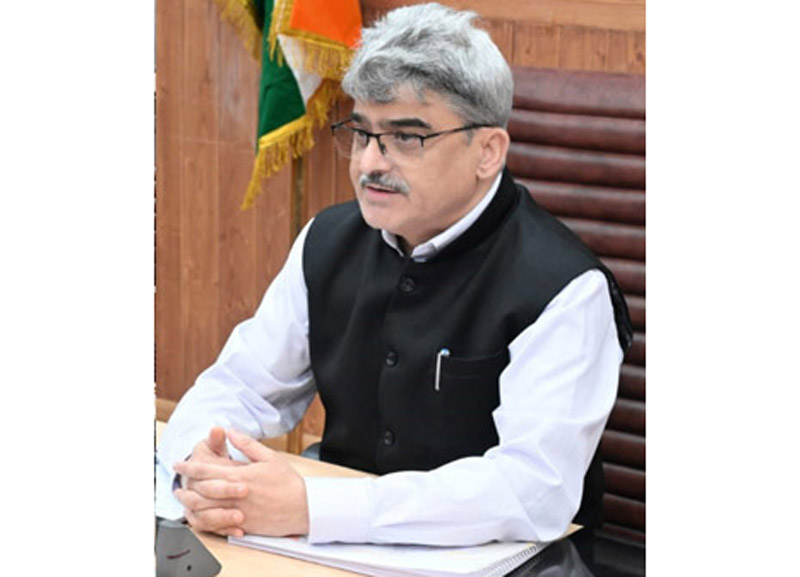
SRINAGAR, Sept 18: Chief Secretary, Atal Dulloo, today held a detailed discussion with Member, NITI Aayog, Dr. V.K. Paul, on the establishment of Tele-ICU facilities across the newly established Government Medical Colleges (GMCs) in the Union Territory of Jammu and Kashmir.
During the interaction, Dr. Paul shared valuable insights and highlighted successful Tele-ICU models being implemented across the country by leading health technology providers such as Apollo Tele Health, Medanta, Cloudphysician, and Health Net. He emphasized the importance of studying these models to identify suitable strategies for J&K hospitals.
Dr. Paul further advised that the needs and aspirations of individual hospitals, as well as their existing infrastructure, must be carefully assessed before rolling out the Tele-ICU initiative. He underscored the significance of capacity building and staff training, which would be critical to ensuring the success of such a technology-driven healthcare model in the UT.
Chief Secretary reiterated the UT administration’s commitment to adopting innovative healthcare solutions. He highlighted that J&K is working towards establishing Tele-ICU facilities under the hub-and-spoke model, enabling 24×7 critical care monitoring and expert consultation. Under this model, newly established GMCs would serve as spokes, linked to a robust hub and command centre within the UT.
The Chief Secretary also proposed sending an expert team from J&K to leading healthcare institutions in the country to study the functioning of Tele-ICUs and their command centres. He noted that while J&K has unique challenges due to its difficult topography and human resource constraints, the administration is determined to tailor solutions that fit the region’s requirements.
He further stressed the need for establishing a state-of-the-art hub within J&K, supported by expert resource persons from technology partners. This hub would not only provide training to local healthcare professionals but also enable the creation of additional hubs in other parts of the UT, ensuring wider coverage and uninterrupted Tele-ICU services.
On the occasion, Secretary, Health & Medical Education Department, Dr. Syed Abid Rashid Shah, shared that the department has proposed setting up at least a 10-bedded Tele-ICU in each of the new GMCs. He also outlined the groundwork already completed and the roadmap ahead to make the initiative a reality.
Director, SKIMS, Prof. Mohammad Ashraf Ganie, provided expert inputs based on the institute’s current facilities and experience in critical care. Principals of various GMCs also contributed their perspectives on the merits, applications, and strategies for the effective rollout of Tele-ICUs in J&K.
Meanwhile, Chief Secretary chaired a detailed review meeting of the Food, Civil Supplies & Consumer Affairs (FCS&CA) and Legal Metrology Departments, where Commissioner Secretary, Saurabh Bhagat, presented a comprehensive overview of the functioning, achievements, and upcoming deliverables of the department.
Others who were present in the meeting includes Director, FCS&CA, Kashmir/Jammu; Controller, Legal Metrology along with other concerned officers.
The Chief Secretary commended the department for its achievements in digitization, Aadhaar integration, and ensuring transparency in food distribution. He stressed on the need to remove undeserving beneficiaries, strengthen consumer protection mechanisms, and ensure timely completion of deliverables to enhance efficiency in service delivery.
The Chief Secretary was apprised that the National Food Security Act (NFSA) is benefitting over 102.54 lakh individuals across 25.61 lakh families in J&K, ensuring food security to the vulnerable sections. The distribution includes 3.70 lakh quintals under NFSA, 1.59 lakh quintals under non-NFSA, 1.24 lakh quintals under PMGKAY, and 0.20 lakh quintals under State Ayushman Ann Yojana (SAAY) on a monthly basis.
It was further informed that J&K has achieved 100% Aadhaar seeding of ration cards and beneficiaries, with 96.55% authenticated transactions, thereby ensuring transparency in public distribution. The network comprises 6611 sale outlets, of which 6362 operate online through e-PoS devices.
 Follow our WhatsApp channel
