

*Reviews progress on business reforms
Excelsior Correspondent
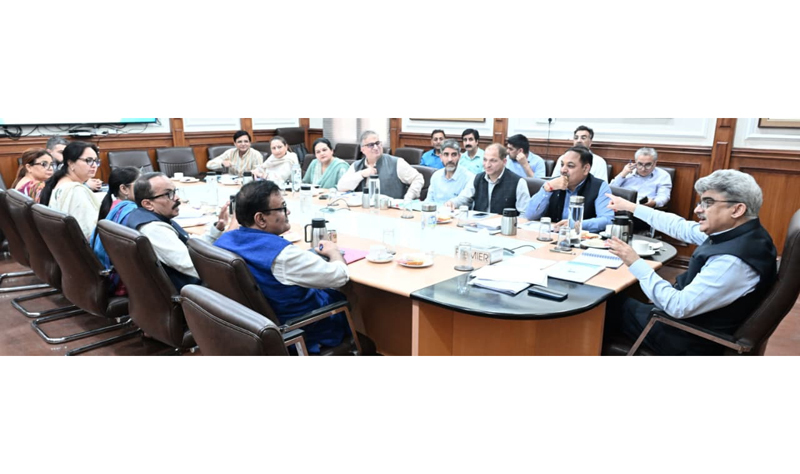
JAMMU, Mar 28: Chief Secretary, Atal Dulloo today chaired a comprehensive review meeting of the Higher Education Department (HED) to strategise a forward-looking roadmap for advancing higher education and steering Higher Educational Institutions (HEIs) in Jammu and Kashmir towards excellence.
The meeting was attended by the Vice-Chancellors of various Universities; Commissioner Secretary, HED; Registrars of the Universities; Director Colleges; and other senior officers of the department.
Emphasising the need for institutional accountability and time-bound reforms, the Chief Secretary directed all HEIs to formulate their own actionable plans for implementation of reform measures recommended during the 5th Chief Secretaries’ Conference chaired by the Prime Ministerhimself. He stressed strict adherence to timelines and called for a results-oriented approach without any laxity.
He observed that these reform measures are closely aligned with the National Education Policy (NEP) 2020 and form a strong foundation for achieving the objectives envisioned for higher education institutions in the Union Territory.
Taking a detailed review of faculty positions and student enrollment across universities and colleges, the Chief Secretary directed that faculty vacancies be filled up to at least 90 percent by August this year, underscoring that quality education hinges on adequate and competent teaching staff.
Highlighting the need for academic relevance, he called for a comprehensive audit of all courses offered by universities and affiliated colleges. He stressed that courses with low demand or outdated content should be phased out and replaced with emerging, technology-driven programmes that align with market needs and student aspirations.
Focusing on professional education, he directed the Vice-Chancellors of IUST and SMVDU to undertake a detailed study of engineering colleges and schools of architecture in the UT and recommend measures to improve enrolment. He noted that these institutions possess robust infrastructure and faculty, which must be optimally utilised.
Similarly, the Vice-Chancellors of the University of Kashmir and University of Jammu were asked to assess enrolment trends in their affiliated colleges and suggest corrective measures, particularly in institutions witnessing low student intake. The Chief Secretary also reviewed the status of infrastructure development in newly established colleges and stressed expeditious completion of ongoing construction works.
During the meeting, the Vice-Chancellors presented updates on implementation of the 21 reform points identified in the Chief Secretaries’ Conference. They also outlined their respective roadmaps and assured timely and effective execution of these reforms.
Earlier, Commissioner Secretary, HED, Ram Niwas Sharma presented a detailed overview of the higher education landscape in Jammu and Kashmir. He apprised the meeting of the existing faculty strength, vacancies, course offerings, seat matrix and enrolment trends across institutions.
Meanwhile, Chief Secretary, chaired a meeting of the concerned Administrative Secretaries to review the progress achieved in the implementation of identified deregulation measures under the next phase of the Ease of Doing Business (EoDB) programme in Jammu and Kashmir.
During the meeting, the Chief Secretary underscored the urgent need to eliminate unnecessary regulatory bottlenecks, particularly the requirement of multiple No Objection Certificates (NoCs) for establishing businesses.
He observed that such procedures are often redundant and create avoidable hurdles for entrepreneurs. Emphasizing the importance of timely reforms, he remarked that rationalizing these requirements within a defined timeframe would significantly benefit the people of the Union Territory.
Citing practical examples, the Chief Secretary pointed out that individuals seeking to establish small enterprises such as schools, nursing homes, or health clinics are often required to obtain numerous clearances from different departments, making the process cumbersome and discouraging for potential investors.
He stressed the need to streamline such procedures and explore the feasibility of issuing lifetime licenses in suitable sectors, particularly in health and education, where periodic renewals may not serve any meaningful purpose.
To address these concerns, the Chief Secretary directed the Labour and Employment Department to work in close coordination with the Department of Law to examine the existing regulatory framework and propose comprehensive solutions.
He further called for a detailed review of the proposed Right to Business Act, with a view to incorporating provisions that facilitate smoother and more efficient processes for establishing and operating businesses in the UT.
Earlier, Commissioner Secretary, Industries and Commerce, Vikramjit Singh, provided an overview of the ongoing initiatives under the second phase of compliance reduction and deregulation, commonly referred to as Deregulation 2.0 or Phase-II of EoDB.
 Follow our WhatsApp channel
