

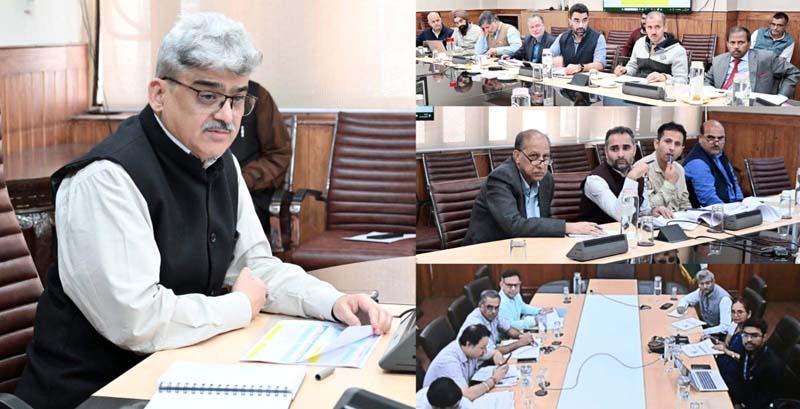
Enforcement of GST 2.0 reforms assessed
*Stresses timely completion of all ongoing works
Excelsior Correspondent
SRINAGAR, Oct 12: A meeting of the High Powered Committee (HPC) of NABARD was held here today under the chairmanship of Chief Secretary, Atal Dulloo, to review the progress and achievements made under the previous Rural Infrastructure Development Fund (RIDF) programmes and to accord approval for new projects to be taken up under RIDF XXXI (2025-26) across J&K.
The meeting was attended by Additional Chief Secretary, Public Works (R&B); Principal Secretary, Finance; Secretary, Health & Medical Education; Development Commissioner (Works); Director General, Resources; Chief General Manager, NABARD; and senior officers from Jal Shakti, Agriculture Production, Horticulture, Animal & Sheep Husbandry and other concerned departments.
At the outset, the Chief Secretary took department-wise appraisal of the progress made in the ongoing RIDF projects and emphasized the importance of timely completion of works sanctioned under RIDF XXVI and XXVII, whose timelines have reached their final phase.
He impressed upon all executing agencies to focus on project completion within stipulated deadlines, underscoring that projects nearing completion should receive top priority. He directed departments to secure the remaining tranches of funds from NABARD expeditiously to ensure successful culmination of the ongoing RIDF programmes.
The Chief Secretary further advised departments to propose only feasible projects that can be completed within the given timeframe of the respective RIDF tenure. He cautioned that delays and carryover liabilities not only affect project delivery but also put additional burden on the normal Capex budget of departments.
He also suggested that departments like PWD and Jal Shakti should consider taking up time-intensive projects under other funding programmes, while utilizing NABARD allocations exclusively for projects that can be executed and completed within the set period of the RIDF.
The Chief Secretary also emphasized the importance of timely submission of Project Completion Certificates (PCCs) and Project Completion Reports (PCRs) for completed projects to facilitate the release of additional funds from NABARD and to pave the way for new project approvals.
Meanwhile, Chief Secretary chaired a meeting to review the implementation and enforcement of GST 2.0 reforms across J&K.
The meeting was attended by Principal Secretary, Finance; Commissioner Secretary, Food, Civil Supplies & Consumer Affairs (FCS&CA); Secretary, Health; Commissioner, State Taxes; Secretary in Industries & Commerce Department; Director, I&C, Kashmir/Jammu and other senior officers.
During the meeting, the Chief Secretary reviewed the enforcement and compliance measures being undertaken by the State Taxes Department, Legal Metrology, Industries & Commerce, and the Drug & Food Control Organisation (DFCO). He emphasized the need for rigorous market inspections and mass awareness campaigns to ensure that the benefits of tax reductions reach the end consumers and are not lost to profiteering by traders.
He maintained that the core objective of GST 2.0 reforms is to strengthen the anti-profiteering framework, increase household savings, and make healthcare and other daily essentials more affordable.
Giving details about the implementation, Principal Secretary, Finance, Santosh D. Vaidya, informed that following the recommendations of the 56th GST Council Meeting held on September 3, 2025, the new GST rates came into effect from September 22, 2025.
He added that J&K promptly issued nine corresponding notifications under the J&K GST Act to operationalize the revised tax rates. These measures were introduced with a clear mandate to ensure that manufacturers revise their Maximum Retail Prices (MRP) accordingly, in keeping with the spirit of the anti-profiteering provisions.
The Commissioner Secretary, FCS&CA, Saurabh Bhagat, informed that the Legal Metrology Department conducted 3,304 inspections across all districts of the Union Territory to prevent overcharging and ensure accurate pricing of pre-packed commodities.
This drive resulted in 135 violation cases, with 82 cases compounded on the spot and penalties amounting to Rs11.84 lakh imposed on erring traders.
In parallel, the State Taxes Department issued 28 notices for offenses such as non-issuance of invoices and incorrect tax computation, proposing penalties totot all in Rs 5.60 lakh.
Reaffirming the Government’s commitment, the Chief Secretary stressed that vigilant monitoring and coordinated enforcement will continue to ensure that the GST 2.0 reforms achieve their intended objective of reducing the financial burden on citizens and making essential commodities and healthcare more affordable to the citizens across the UT.
 Follow our WhatsApp channel
