

* Reviews implementation of key school education initiatives
Excelsior Correspondent
JAMMU, Nov 28: In a significant step towards countering the growing menace of drug addiction in Jammu and Kashmir, Chief Secretary, Atal Dulloo today held a high-level consultation with Member NITI Aayog, Dr V.K. Paul, seeking expert guidance to evolve a comprehensive, effective and sustainable strategy to combat substance abuse across the UT.
The consultation session brought together leading national-level experts from AIIMS New Delhi and PGIMER Chandigarh, besides senior officers and health administrators from J&K.
The meeting was steered by the Secretary, Health & Medical Education (H&ME), and attended by the Managing Director, National Health Mission; Director SKIMS; Principals of Government Medical Colleges; and Heads of Departments of Psychiatry from GMC Srinagar and GMC Jammu.
While addressing the gathering, the Chief Secretary outlined the gravity and dimensions of the drug abuse problem in the UT, highlighting ongoing initiatives, institutional mechanisms and coordinated efforts being undertaken by various agencies.
He elaborated on the multi-pronged strategy adopted by the administration, which rests on five key pillars of strict enforcement, Information, Education and Communication (IEC) campaigns, counselling, treatment, and rehabilitation aimed at ensuring both immediate intervention and long-term recovery of victims.
Emphasizing the need for a community-centric approach, the Chief Secretary sought expert inputs from Dr Paul on strengthening the network of counsellors down to the grassroots level, including educational institutions, Primary Health Centres (PHCs) and local communities.
He further stressed the importance of developing a more robust rehabilitation framework, supported by an effective monitoring mechanism to prevent relapse and enable reintegrated individuals to lead dignified and productive lives in society.
Dr Paul also shared insights from the Himachal Pradesh model of substance abuse management, wherein a structured treatment network supported by national experts has yielded positive results. He suggested studying this model in detail and adapting its framework, with necessary modifications, to suit the specific needs and socio-cultural context of Jammu and Kashmir.
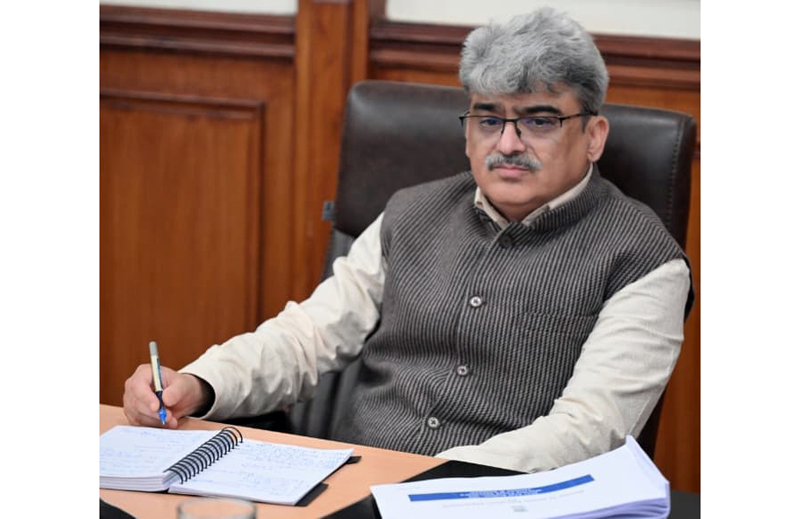
Meanwhile, Chief Secretary chaired a comprehensive review meeting of the School Education Department to assess the progress and implementation of various initiatives aimed at improving teaching-learning outcomes in schools across all districts of Jammu and Kashmir.
The meeting was attended by the Secretary, School Education; Project Director, Samagra Shiksha; Director, School Education, Jammu/Kashmir, along with other senior officers of the department.
During the deliberations, the Chief Secretary reviewed the status of the Five-Year Plan submitted to the Ministry of Education, Government of India, progress of Aadhaar enrolment of students, human resource management (HRM) related matters, establishment of Kendriya Vidyalayas (KVs), Jawahar Navodaya Vidyalayas (JNVs), residential schools and the progress of Atal Tinkering Labs (ATLs).
Expressing concern over the comparative enrollment trends, the Chief Secretary took note of the disparity between student enrollment in government and private schools.
He observed that despite the availability of free meals, uniforms, textbooks and other facilities in government institutions, enrollment particularly at the primary level remains relatively low. He directed the department to undertake a detailed assessment to identify gaps and devise a targeted strategy to enhance educational quality and strengthen parental confidence in government schools.
Emphasising the role of technology in transforming education, the Chief Secretary called for making existing technological interventions more focused, inclusive and student-centric. He stressed the need for enriching the Vidya Samiksha Kendra (VSK) platform with diverse and comprehensive learning materials and increasing the number of high-quality learning videos for students across all classes to ensure ease of access and effective learning.
Addressing human resource concerns, the Chief Secretary reviewed the status of seniority lists, conduct of Departmental Promotion Committees (DPCs) and other cadre-related matters. He impressed upon the department to accord priority to resolving these issues to enable teachers to focus entirely on their primary responsibility of imparting quality education.
 Follow our WhatsApp channel
