

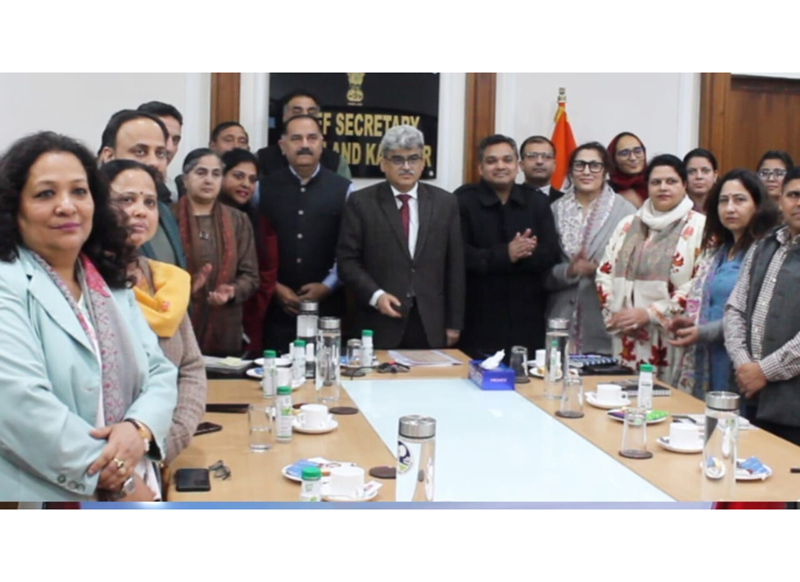
* Launches new website of Culture Deptt
Excelsior Correspondent
JAMMU, Feb 9: Chief Secretary, Atal Dulloo today chaired the 2nd meeting of the Union Territory Level Sanctioning & Monitoring Committee (UTLSMC) under Pradhan Mantri Awas Yojana-Urban (PMAY-U) 2.0. The meeting reviewed major implementation milestones, approved key project proposals, and deliberated on quality monitoring, social audit compliance, and capacity building initiatives aimed at accelerating affordable housing delivery across the Union Territory.
The meeting besides ACS, APD and PDD was attended by Commissioner Secretary, H&UDD; DG, Budget; Commissioner, JMC/SMC; Representative from J&K Bank and other concerned officers.
During the meeting, the Chief Secretary emphasized the need to extend proactive support to economically weaker sections to enable them to complete construction of their dwelling units within a stipulated timeframe. He directed the Urban Local Bodies (ULBs) and Municipal Corporations to reach out to all eligible beneficiaries who were previously surveyed for coverage under the Interest Subsidy Scheme for Self Construction/ Enhancement (ISSS) vertical of PMAY-Urban. He observed that reaching out to nearly 80,000 households is achievable through coordinated efforts between ULBs and banking institutions.
The Chief Secretary further instructed the department to develop a dedicated digital tool to facilitate seamless beneficiary outreach and application processing, minimizing manual intervention. He also stressed the importance of organizing special camps across all ULBs and municipal wards to ensure maximum enrolment of eligible beneficiaries under the scheme.
The Committee approved 47 Detailed Project Reports (DPRs) submitted by various Urban Local Bodies under the Beneficiary-Led Construction (BLC) vertical. These DPRs cover 879 dwelling units, further strengthening the affordable housing ecosystem in the Union Territory and enabling eligible beneficiaries to construct or upgrade their own houses.
Commissioner Secretary, Housing & Urban Development Department (H&UDD), Mandeep Kaur, highlighted the significance of PMAY-Urban 2.0 in ensuring housing for all urban poor. She elaborated on the different scheme verticals including BLC, Affordable Housing in Partnership (AHP), and ISSS, stating that the combined implementation of these components would help in saturating the housing needs of all eligible urban households in the UT.
Managing Director, J&K Housing Board, Shahbaz Ahmed Mirza, briefed the Committee on the Action Taken Reports (ATRs) submitted in response to observations made by Third Party Quality Monitoring (TPQM) agencies during their second and third inspection visits to BLC houses.
Meanwhile, Chief Secretary launched the newly developed official website of the Department of Culture, marking a major step towards digital governance and improved public access to cultural services. The portal has been designed to provide comprehensive information on the cultural heritage, activities, and initiatives of the Department.
The website was launched in presence of Principal Secretary, Culture Department; Secretary, IT; ED, Mubarak Mandi Heritage Society; Secretary, J&K AAC&L and other concerned officers.
The website, https://culture.jk.gov.in, serves as a single digital window for citizens, artists, researchers, and institutions to access departmental information, cultural resources, and public services in a transparent and user-friendly manner.
Speaking on the occasion, the Chief Secretary described it as a significant step towards leveraging technology for preservation and promotion of cultural heritage, while enhancing citizen engagement and service delivery under the Digital J&K initiative.
A key upcoming feature of the portal as described by Principal Secretary, Culture, Brij Mohan Sharma is the Online Auditorium and Hall Booking Facilities belonging to the Department which will allow users to check availability and submit booking requests digitally. The system is aimed at ensuring transparency, efficiency, and ease of access to cultural infrastructure across the Union Territory.
The portal offers detailed sections on departmental profile, divisions, legislation, projects, and both tangible and intangible cultural heritage. It also provides real-time updates on events, orders, circulars, and official notifications.
 Follow our WhatsApp channel
