

*Says ULI to transform Lending Ecosystem
Excelsior Correspondent
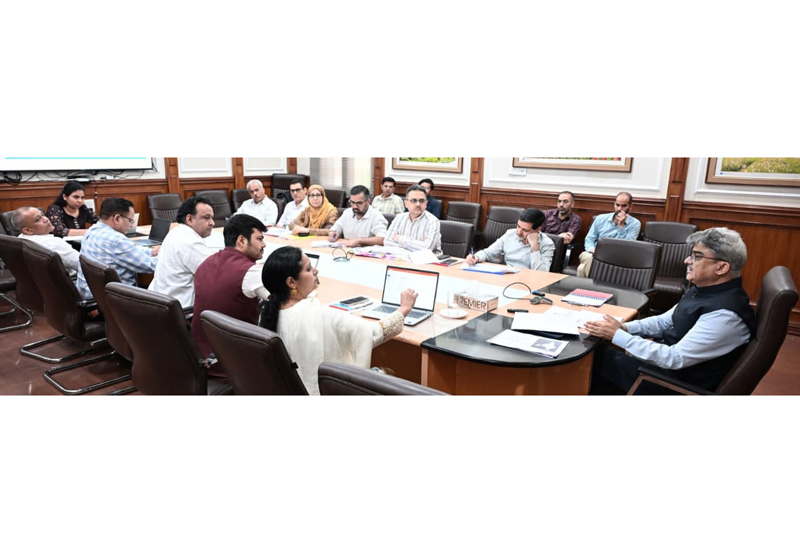
JAMMU, Apr 7: Chief Secretary, Atal Dulloo, held a meeting of the Housing & Urban Development Department (H&UDD) to assess the progress of major schemes aimed at transforming urban infrastructure, generating livelihoods, ensuring cleanliness and improving quality of life across the urban areas in J&K.
The meeting was attended by Commissioner Secretary, H&UDD; Commissioner, Jammu and Srinagar Municipal Corporations (JMC/SMC); Managing Director, J&K Housing Board; Managing Director, AMRUT; Chairperson, Jammu and Srinagar Development Authorities (JDA/SDA); Directors of Urban Local Bodies (ULBs) for Kashmir and Jammu divisions; Managing Director, Deendayal Antyodaya Yojana (DAY-NULM/Shehri); and other senior officers.
During the comprehensive review, the Chief Secretary took a detailed appraisal of the implementation of key Centrally Sponsored Schemes, including the Swachh Bharat Mission (Urban), Pradhan Mantri Awas Yojana (Urban), AMRUT 2.0, and Deendayal Antyodaya Yojana (DAY-NULM) Shehri.
Emphasizing the critical role of these initiatives in strengthening urban infrastructure and municipal services, the Chief Secretary directed the department to significantly accelerate the pace of implementation. He underscored the need for expeditious completion of projects, particularly those related to used water management, sanitation, waste disposal, and treatment.
With regard to PMAY (Urban), he stressed the importance of removing bottlenecks and ensuring timely completion of housing units. He called for proactive sensitization of beneficiaries to commence and complete construction promptly, alongside timely release of financial assistance. He further directed the department to sponsor all eligible beneficiaries under the Interest Subsidy Scheme (ISS) component and ensure rigorous monitoring for early completion of housing projects.
Reviewing the progress under AMRUT 2.0, the Chief Secretary instructed the concerned authorities to fix clear timelines for each project and ensure strict adherence to completion schedules through continuous monitoring.
Earlier, Commissioner Secretary, H&UDD, Mandeep Kaur, presented a detailed overview of the progress achieved under various schemes.
Later, the Chief Secretary, under the Swachh Bharat Mission (Urban), launched the Single Use Plastic Challan and IEC Portal aimed at generating awareness about the hazards of single-use plastic and strengthening enforcement mechanisms to curb its usage across the Union Territory.
Meanwhile, the Reserve Bank of India (RBI), Jammu organised a workshop on the Unified Lending Interface (ULI) for officials from various Government departments and banks operating in the Union Territories of Jammu & Kashmir and Ladakh.
The workshop was graced by Chief Secretary, Atal Dulloo, as the Chief Guest, and Executive Director, RBI Mumbai, P. Vasudevan, as the Special Guest. The event was held in the presence of Regional Director, RBI Jammu, Chandrashekhar Azad, and attended by senior dignitaries including Dr. Ashish Chandra Verma, Financial Commissioner (ACS), Tourism;Mandeep Kaur, Commissioner Secretary, Housing & Urban Development Department; Secretaries of various departments and senior officials from banks.
Addressing the gathering, Dulloo, described the Unified Lending Interface as a transformative step towards democratising access to credit, ensuring that no deserving entrepreneur, farmer or small business is left behind due to procedural bottlenecks. He highlighted the special relevance of ULI for a hilly region like Jammu & Kashmir, noting that technology-driven integration of data has the potential to compress loan processing timelines from weeks to minutes, thereby ushering in a new era of efficiency, transparency and trust in the lending ecosystem.
The Chief Secretary further observed that ULI would bridge longstanding gaps in credit accessibility, particularly in rural and semi-urban areas, and aligns with the broader vision of financial inclusion for MSMEs, farmers and first-time borrowers. Emphasising the shift from collateral-based to data-driven lending, he noted that the platform would enable institutions to take informed decisions based on verified digital footprints while reducing reliance on physical documentation.
In his inaugural address, Regional Director, RBI Jammu, Chandrashekhar Azad, highlighted that the Unified Lending Interface, conceptualised by the Reserve Bank of India and developed by the Reserve Bank Innovation Hub (RBIH), is designed to enable seamless and frictionless credit delivery. He noted that the platform integrates diverse data sources across the credit ecosystem, thereby improving access to credit, reducing turnaround time and enhancing customer experience.
Executive Director, RBI, P. Vasudevan, in his address, highlighted the platform’s potential to transform credit delivery through secure, consent-based access to digital data.
 Follow our WhatsApp channel
